
Best Ways to Sell Old Jewelry: Online Options & Orange County Appraisers
Digging through a jewelry box full of pieces you no longer wear? Old jewelry often carries more value than owners realize, but figuring out where to sell it — and getting a fair price — takes some research. Vasco Assets, a licensed and bonded investment firm in Newport Beach, evaluates old and estate jewelry at no charge, giving Orange County sellers a certified alternative to guesswork.
Between online buyers, local pawn shops, and specialized appraisers, sellers have more options than ever, but not all of them are equal. Understanding the tradeoffs between convenience, speed, and accurate valuation helps you avoid leaving money on the table.
Is Your Jewelry Appraisal the Same as What a Buyer Will Pay?
Appraisal Purpose Matters
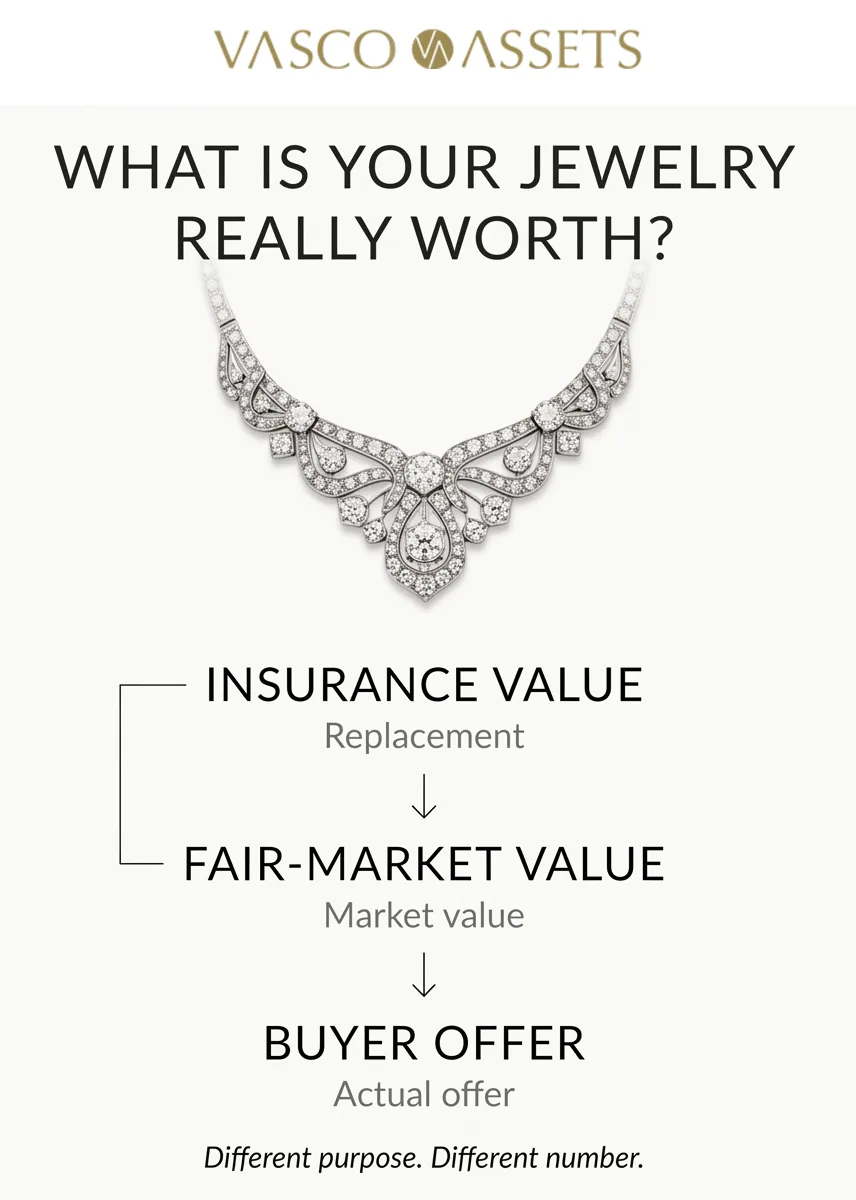
Not necessarily. An appraisal provides an opinion of value for a particular purpose, and the figure can vary depending on whether the valuation is intended for insurance, estate planning, fair-market purposes, or another use. The Gemological Institute of America (GIA) explains that jewelry appraisals may be prepared for different reasons, including determining fair-market value and establishing replacement value for insurance. That distinction matters when you’re preparing to sell old jewelry, because an insurance or replacement-value figure shouldn’t automatically be treated as the amount a buyer will offer.
Different Types of Jewelry Value
Think of the process as a series of different values: insurance/replacement value → fair-market value → retail price → actual buyer offer. Replacement value generally concerns what it would cost to replace an item, while fair-market value is more relevant to what a willing buyer and seller might reasonably agree upon. For someone preparing to sell, GIA specifically recommends considering a fair-market-value appraisal when deciding what price to ask.
Why the Final Offer Can Be Different
The final offer can still differ from any appraisal, since a buyer must weigh its own purchasing and resale economics, current demand, the condition of the jewelry, and whether the piece has value beyond its raw materials. The Federal Trade Commission also emphasizes that representations about jewelry’s characteristics and value should be truthful and not misleading, which is part of why working with a certified appraiser matters. An appraisal can give you an informed benchmark, but it isn’t a guaranteed sale price — comparing that figure against real offers is the best way to know if you’re getting a fair deal.
Online Jewelry Buyers: Convenience With Tradeoffs
Mailing in your jewelry to an online buyer is fast and requires no in-person visit, which appeals to sellers who want a quick transaction. Most online services ask you to fill out a form, ship your items using a prepaid kit, and wait for an offer based on their remote assessment.
The tradeoff is control. Without an in-person evaluation, you’re relying entirely on the buyer’s stated process, and negotiating a low offer after your jewelry has already been shipped away is far harder than negotiating in person. Sellers with unique, designer, or estate pieces often find remote assessments undervalue details that only show up under an appraiser’s eye.
Local Pawn Shops: Fast Cash, Limited Expertise
Pawn shops offer same-day cash and no shipping wait, making them appealing for sellers who need money immediately. However, most general pawn shops aren’t staffed with specialists trained in gemology, designer jewelry, or estate pieces.
This gap in expertise often shows up in the offer. A pawn shop unfamiliar with a particular designer house or gemstone origin is likely to price conservatively, protecting itself from an inaccurate valuation rather than paying what the piece is genuinely worth. For jewelry with any complexity, this can mean a meaningfully lower payout.
Certified Orange County Appraisers: Accuracy You Can Verify
A certified appraiser combines the speed of in-person evaluation with specialized knowledge of metals, gemstones, and designer jewelry. Vasco Assets uses precision technology alongside a team with over 150 years of combined luxury asset experience to assess old jewelry accurately, rather than relying on rough visual estimates.
This matters most for estate pieces, vintage settings, and jewelry from recognized designer houses, where value often depends on details a generalist buyer might miss entirely. An accurate appraisal gives you a fair-market-value figure you can trust and compare against other offers before deciding where to sell.
How Old Jewelry Value Is Actually Determined
Old jewelry’s value comes from a combination of factors, not just its age. Precious metal content and purity, gemstone quality and carat weight, designer or brand origin, craftsmanship, and current condition all contribute to the underlying valuation before any offer is made.
Market demand plays a role too. Certain vintage styles, designer signatures, and gemstone cuts carry premiums in today’s resale market that a generic buyer might not account for. A specialist who understands both the piece and the current market is far more likely to land on an accurate number than a buyer working from a simple weight-based calculation.
Selling Outright vs. Using Jewelry as Collateral
Selling isn’t the only option for old jewelry you’re not using. If a piece has sentimental value or you’d rather not part with it permanently, collateral loans let you borrow against its value while retaining ownership. This can be a better fit for jewelry you’re not ready to say goodbye to but still want to put to financial use.
If you’re confident you want to sell, Vasco Assets evaluates and purchases jewelry outright at no charge, with no obligation to accept the offer. Comparing both paths before deciding ensures you choose the option that actually fits your goals, rather than defaulting to whichever buyer you found first.
What to Prepare Before Selling Old Jewelry
Gathering any original receipts, appraisal certificates, or designer documentation before your appointment can support a stronger valuation. These aren’t required, but they give an appraiser useful context, especially for estate pieces with an unclear history or unmarked hallmarks.
It’s also worth noting any repairs, resizing, or stone replacements a piece has undergone over the years. Being upfront about this history helps ensure the condition assessment is accurate, and it prevents any surprises once your jewelry is examined closely under proper lighting and equipment.
The Vasco Assets Selling Process
Getting a valuation starts with a simple, no-obligation request online or by phone. From there, you can bring your old jewelry to the Newport Beach office in person, or use the firm’s Sure Secure Shipping service if visiting isn’t convenient.
Once evaluated, you’ll receive a clear explanation of how your offer was calculated, based on metal, gemstones, brand, and condition rather than an insurance or replacement figure. If you accept, payment is typically issued the same day, with no pressure to decide before you’re ready.
Get a Free Valuation on Your Old Jewelry Today
Whether you’re ready to sell or simply curious what your old jewelry is worth, the first step is free. Vasco Assets evaluates rings, necklaces, bracelets, and estate pieces at no charge, and provides the highest possible payment amount based on an accurate, in-person assessment.
You can request a valuation online, by phone, or in person at the Newport Beach office, with Sure Secure Shipping available for Orange County sellers who prefer not to visit directly. Most sellers walk away the same day with a clear, well-explained offer in hand.
Ready to find out what your old jewelry is worth? Request your free valuation or call Vasco Assets at 949.674.3575 to speak with a specialist today.
Frequently Asked Questions
Is it better to sell old jewelry online or in person?
In-person selling generally gives you more control and a more accurate valuation, since a specialist can examine metal, gemstones, and craftsmanship directly. Online buyers offer convenience but rely on remote assessment, which can undervalue pieces with unique or complex details.
Why doesn’t my insurance appraisal match the offer I’m getting?
Insurance appraisals typically reflect replacement value, or what it would cost to buy a similar new piece at retail, rather than fair-market value or an actual buyer’s offer. These are different figures prepared for different purposes, so a gap between them is expected rather than a sign something is wrong.
How do I know if my old jewelry has designer value beyond its materials?
Designer signatures, distinctive craftsmanship, and recognizable styles from established jewelry houses can add value well beyond the raw materials alone. A specialist familiar with designer jewelry markets is better positioned to identify and price this added value than a general buyer.
Does the age of a piece affect its value?
Age alone doesn’t determine value — a piece’s metal content, gemstones, condition, and market demand matter more than how old it is. Some vintage styles carry premiums due to demand, while others hold value based purely on material content.
Can I sell jewelry that’s missing stones or is otherwise damaged?
Yes. Damaged or incomplete jewelry can still be evaluated and purchased, though the condition will factor into the final offer. It’s worth getting a valuation regardless, since metal content and any remaining gemstones still hold real value.
What’s the difference between selling old jewelry and pawning it?
Selling transfers ownership permanently in exchange for an upfront payment, while pawning lets you borrow against the jewelry’s value while retaining ownership. Vasco Assets offers both options, so you can choose based on whether you intend to keep the piece long-term.
How quickly can I sell old jewelry and get paid?
Once your jewelry is evaluated and you accept an offer, payment is typically issued the same day. This is significantly faster than most online buyers, who often require shipping time and a waiting period before funds are released.