
What Is PVD Coating On A Rolex?
PVD coating gives Rolex watches sleek blacked-out or vibrant dials, but it’s often misunderstood. Collectors debate its impact on value, enthusiasts question its durability, and first-time buyers may not distinguish factory finishes from aftermarket modifications. At Vasco Assets, we work with luxury timepieces every day and understand how details like PVD coating can significantly influence a watch’s worth and appeal.
This guide cuts through the confusion. Whether you’re considering a PVD-coated watch, already own one, or are simply curious about the technology, here’s everything you need to know — from the science behind the process to what it means for your investment.
What Is PVD? The Science in Plain Terms
PVD stands for Physical Vapor Deposition. According to Wikipedia’s technical definition, PVD describes a group of vacuum-based methods used to deposit ultra-thin, durable films onto surfaces including metals, ceramics, and glass. The process works by transitioning a solid material into a vapor and then back into a solid film — this time bonded directly to the surface of your watch component.
Think of it like a very thin, extremely tough metallic skin that fuses to the watch at a molecular level. Unlike paint or lacquer, it doesn’t simply sit on top of the surface — it forms a chemical and physical bond with the base metal, which is what gives it such impressive durability.
The basic steps are:
- The watch component is placed inside a vacuum chamber
- The coating material (often titanium nitride, gold, or black chromium) is vaporized using high heat or ion bombardment
- The vaporized particles travel across the vacuum and condense uniformly onto the watch surface
- The result is a hard, consistent, ultra-thin layer — typically just 2 to 5 microns thick
To put that thickness in perspective, a single human hair is roughly 70 microns wide. Yet despite being a fraction of that, a PVD coating dramatically changes the hardness and behavior of the surface beneath it.
The U.S. National Institute of Standards and Technology (NIST) recognizes PVD as a precision surface engineering process used across industries — from aerospace components and surgical instruments to cutting tools and semiconductors — precisely because of its exceptional hardness, adhesion strength, and resistance to corrosion.
How Rolex Actually Uses PVD Technology
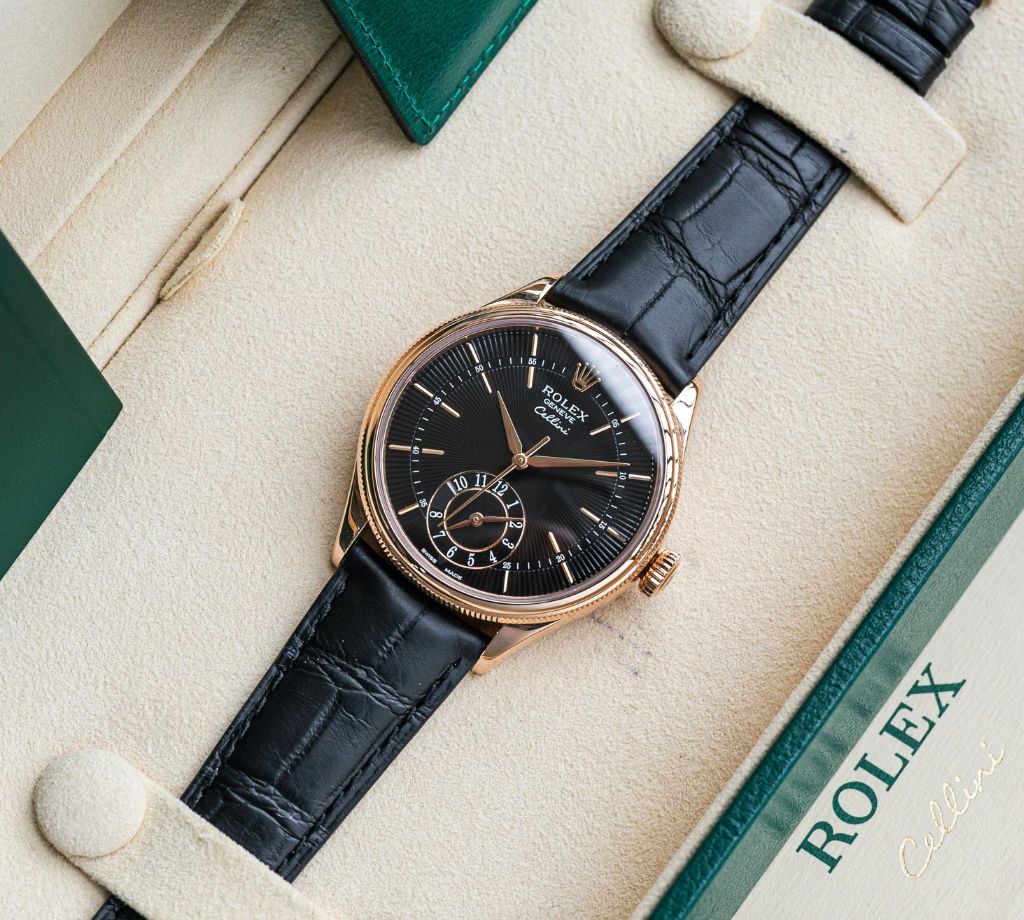
Here’s where many articles get it wrong: Rolex does not apply PVD coating to watch cases or bracelets in its standard factory models. Instead, Rolex officially uses PVD technology in a very specific and deliberate way — on dial finishing.
On Rolex’s own website, the brand explains how PVD is used to deposit thin layers of metallic particles onto dials, producing unique chromatic effects, sunray patterns, and rich, consistent color tones that cannot be achieved through traditional painting or lacquering. The deep blue, slate, and jet-black dials you see on models like the Submariner, Sky-Dweller, and Datejust often owe their visual depth and consistency to this very process.
This means when you look at the stunning midnight blue dial of a Rolex Day-Date or the intense black dial of a Submariner, you’re seeing PVD technology at its finest — a controlled, precise application that defines the watch’s character from the inside out.
So when people ask “does Rolex use PVD?” — the answer is yes, but exclusively for dials in standard production, not for case surfaces.
What About Blacked-Out and Custom Rolex Watches?
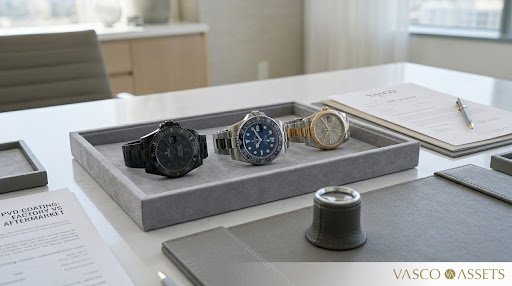
The PVD-coated Rolex cases and bracelets you see online — sleek, all-black Submariners, stealthy Daytonas, rose-gold-toned GMT-Masters — are almost exclusively aftermarket modifications. Companies like Bamford Watch Department and Project X specialize in applying PVD coatings to Rolex cases and bracelets after purchase, transforming the look of a classic model into something far more contemporary.
These modifications can look extraordinary, and there is certainly a market for them among style-focused buyers. However, it’s important to understand that they fall entirely outside of Rolex’s manufacturing standards and warranty terms. A Rolex service center will note any non-original surface treatment on the case during servicing, and this can have implications for both maintenance and resale.
Benefits of PVD Coating on Watches
Whether applied by Rolex to its dials or by aftermarket specialists to cases and bracelets, PVD coating offers a compelling and well-documented set of advantages over bare metal or traditional plating.
Scratch resistance — The deposited layer is significantly harder than standard stainless steel. Titanium nitride, one of the most common PVD materials used in watchmaking, achieves a hardness rating that far exceeds that of untreated steel, making the surface much more resistant to everyday contact, abrasion, and minor impacts.
Corrosion resistance — The coating acts as a dense, inert barrier against moisture, sweat, salt, and environmental chemicals. This is particularly valuable for watches worn during outdoor activities or in coastal environments, where bare steel or standard plating would deteriorate more quickly.
Aesthetic versatility — PVD enables finishes in black, gold, rose gold, grey, deep bronze, and even vivid colors like blue and green, without the cost or weight of solid precious metals. This gives designers and consumers far more expressive options than conventional metal finishing allows.
Strong, lasting adhesion — Because the coating bonds at a molecular level rather than sitting loosely on the surface, it significantly outlasts traditional electroplating. Where a plated layer might begin to peel or fade within a couple of years, a quality PVD coating can remain intact for a decade or more under normal wear.
Environmentally responsible production — The U.S. Environmental Protection Agency (EPA) recognizes that PVD processes produce minimal hazardous by-products compared to conventional electroplating, which typically relies on toxic chemical baths containing chromium, cyanide, or other hazardous compounds. For manufacturers and consumers who care about sustainable production, this is a meaningful distinction.
PVD vs. Electroplating vs. DLC: What’s the Difference?
It helps to understand how PVD stacks up against the two other coating methods you’re most likely to encounter in the watch world.
| Feature | PVD | Electroplating | DLC (Diamond-Like Carbon) |
| Adhesion | Molecular bond | Surface deposit | Molecular bond |
| Hardness | Very high | Moderate | Extremely high |
| Color options | Wide range | Limited | Mostly black/grey |
| Typical longevity | 5–10+ years | 1–3 years | 10+ years |
| Cost | Moderate–high | Low–moderate | High |
| Environmental impact | Low | High (chemical waste) | Low |
Electroplating uses an electric current to deposit metal ions onto a surface from a liquid solution. It’s the oldest and cheapest method, widely used in fashion jewelry and entry-level watches. The result is a thinner, softer layer that wears away faster, especially at edges and high-friction points. It also poses greater environmental risks during production due to the chemicals involved.
DLC (Diamond-Like Carbon) coating is even harder than standard PVD and offers outstanding longevity. However, it is more expensive to apply, offers fewer color options (mostly dark grey to black), and requires highly specialized equipment. Some luxury sport watches use DLC precisely because of its extreme toughness, but it remains less common than PVD in the broader watch market.
For most luxury watch applications — where both aesthetics and durability matter — PVD hits a strong balance between cost, versatility, and performance.
Does PVD Coating Affect Rolex Resale Value?
Factory PVD Dials
Applied by Rolex during manufacturing, these are fully authentic and do not hurt resale value. Certain colors and finishes, especially on vintage or limited editions, can even command a premium.
Aftermarket PVD Coatings
Modifications to the case, bezel, bracelet, or dial outside official Rolex service are considered non-original and typically lower resale value. A blacked-out Submariner, for example, usually sells for less than an unmodified equivalent.
Secondary Market
Some buyers specifically seek custom PVD-coated Rolexes for their aesthetics and will pay accordingly—but usually less than for factory-original pieces.
Investment vs. Personal Use
If resale value matters, keep the watch original. Aftermarket PVD is better suited for personal enjoyment rather than investment.
How Long Does PVD Coating Last, and How Do You Care for It?
A properly applied PVD coating on a watch can last 5 to 10 years or more under typical wear conditions. The coating is extremely hard, but it is not impervious to all damage:
- Deep scratches or sharp impacts can chip or cut through the coating at vulnerable points
- High-contact areas like lug edges, crown guards, and bracelet links show wear first
- Unlike bare stainless steel, a PVD surface cannot be polished or buffed back — refinishing requires a full strip and re-coat
- Prolonged exposure to harsh chemicals such as chlorine, bleach, or strong solvents will degrade the coating faster than normal wear
Practical care tips:
- Clean with mild soap and lukewarm water, using a soft, lint-free cloth
- Avoid ultrasonic cleaners, which can stress and eventually crack the coating
- Store in a soft pouch or lined watch box to prevent contact scratches from other pieces
- Remove the watch before swimming in chlorinated pools, hot tubs, or exposure to cleaning products
- Inspect the coating periodically for signs of wear, particularly at edges and high-friction points
With the right care, a PVD-coated watch can remain visually striking for many years — often outlasting the expectations of first-time owners.
FAQs:
Is PVD coating on a Rolex permanent?
Not permanently — it is very durable, typically lasting 5–10+ years with proper care, but it will eventually show wear at high-contact areas like lugs, crown guards, and bracelet links.
Can a PVD-coated Rolex be repaired if the coating chips?
The damaged section cannot simply be touched up. The watch would need to be fully stripped and re-coated, which Rolex service centers do not perform for aftermarket PVD. Third-party specialists can re-coat, but this further distances the watch from original specification and affects collector value.
Does Rolex officially sell PVD-coated case models?
No. Rolex uses PVD in its dial manufacturing process but does not produce factory models with PVD-coated cases or bracelets. All-black or colored-case Rolexes are aftermarket modifications.
Do Cartier or Tiffany watches use PVD?
Cartier applies PVD coating to select models to achieve durable colored and black finishes while maintaining the brand’s high aesthetic standards. Tiffany & Co.’s co-branded Rolex pieces rely on Rolex’s own manufacturing, which includes PVD dial finishing. Neither brand is as widely associated with PVD case coatings as aftermarket watch modification specialists.
Is PVD coating safe to wear against skin?
Yes. The hard, inert surface of a PVD coating is hypoallergenic and non-reactive, making it safe for daily wear — even for those with sensitivities to certain base metals like nickel or brass.
How can I tell if a watch has a PVD coating?
PVD-coated watches typically display a very uniform, deep color with no visible brush marks, pooling, or surface variation. The finish is consistent across all surfaces, including recessed areas. Early wear typically appears at edges and corners rather than flat surfaces. A qualified watchmaker or jeweler can confirm the coating type under magnification.