
Pawn My Audemars Piguet: Collateral Valuation for Royal Oak Owners

Need cash without giving up your Royal Oak for good? Vasco Assets helps Audemars Piguet owners unlock the value of their watch through certified collateral lending, backed by a team with over 150 years of combined luxury asset experience. You get the funds you need now, and your watch waits for you until you’re ready to pay off the loan.
Audemars Piguet holds a different position than most luxury watch brands. The Royal Oak’s octagonal bezel and integrated bracelet, designed by Gérald Genta in 1972, turned stainless steel into a legitimate luxury material and created one of the most recognized silhouettes in horology. That reputation is exactly why lenders need real expertise to value one correctly, since a mistake in either direction costs the owner money.
How Is an Audemars Piguet Royal Oak Loan Value Calculated?
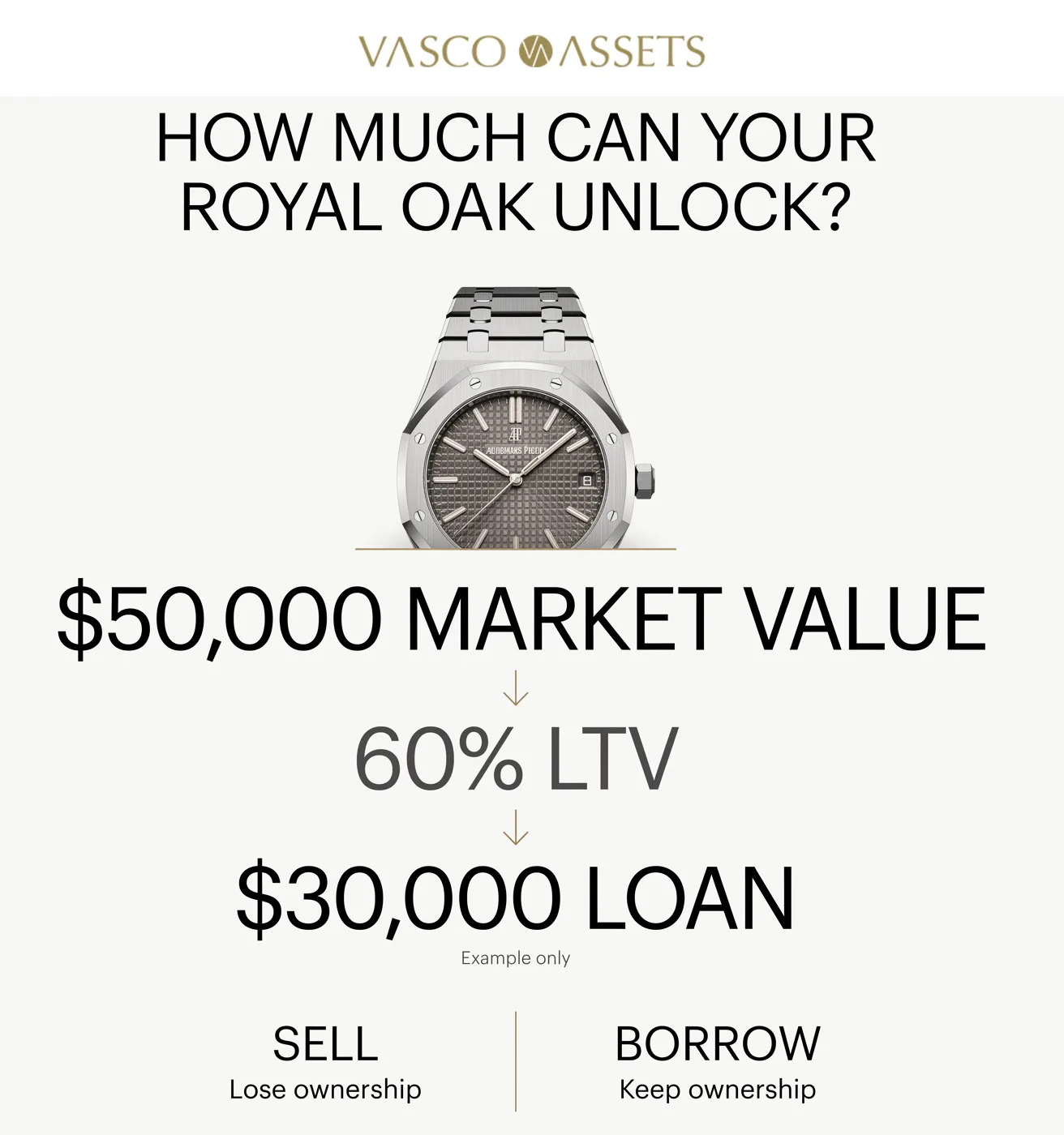
A Royal Oak’s resale value and its collateral value are not the same number. A watch may carry a secondary-market value of $50,000, for example, but that doesn’t mean a lender will advance the full $50,000 against it. Valuation generally moves through several stages: current secondary-market value → collateral valuation → applicable loan-to-value (LTV) ratio → maximum loan amount. The OCC’s Comptroller’s Handbook on Asset-Based Lending describes how properly margined lending against collateral helps protect against fluctuations in value, which illustrates why an asset’s market value doesn’t automatically equal its borrowing capacity.
For a Royal Oak, the starting valuation should reflect the specific watch rather than just the Audemars Piguet name. Reference number, material, dial configuration, condition, documentation, service history, and current secondary-market demand all influence the underlying number. The lender then applies its own LTV criteria on top of that valuation — for example, a $50,000 Royal Oak at a 60% LTV would support a maximum loan of $30,000, with the remaining value acting as a cushion against market shifts and recovery costs.
Because LTV policies vary by lender and by watch, there’s no universal percentage that applies to every Royal Oak on the market. A vintage reference with irregular demand might warrant a more conservative LTV than a current production model with steady turnover. The most useful approach is a valuation based on your specific reference and current conditions, followed by a clearly explained offer from a specialist like Vasco Assets.
Why Royal Oak Owners Consider Collateral Loans
Selling a Royal Oak outright means losing a piece that’s often appreciated significantly since purchase, especially on sought-after references. A collateral loan lets you access a large percentage of your watch’s market value in cash while retaining ownership, so you keep the upside if the watch continues to gain value.
This route works well for owners facing a short-term cash need — a business opportunity, a tax bill, a real estate deposit — who don’t want to disrupt their long-term collection. Once the loan is repaid, your Royal Oak is returned exactly as it was received, with no change in ownership recorded anywhere and no gap in your collection.
What Determines Your Royal Oak’s Loan Value
Not all Royal Oaks are valued the same. Reference number, case material, complication, condition, and box-and-papers completeness all move the needle significantly. A steel 15500 in excellent condition with full documentation will command a stronger loan value than a worn example missing its papers, even if both watches look similar at a glance.
Market demand also plays a role, since certain references and dial colors trade at a premium in the resale market due to limited production or celebrity association. A specialist lender who tracks these trends closely can offer a loan amount that reflects your watch’s true current demand, not just a generic “luxury watch” estimate based on brand name alone.
Why Generic Pawn Shops Fall Short
Most pawn shops aren’t equipped to assess a Royal Oak’s true value. Without specialized knowledge of Audemars Piguet references, movements, and market trends, a general pawn shop is likely to undervalue your watch significantly and offer a loan far below what it’s actually worth.
Vasco Assets buys and lends against luxury watches with a team that understands specific references, movement calibers, and current resale demand. That specialized knowledge means your Royal Oak is assessed against real market data, not a rough guess based on brand recognition alone or an outdated price guide.
Preparing Your Royal Oak for Valuation
A little preparation can make your valuation appointment faster and often stronger. Gather any original box, papers, service records, and purchase receipts you still have, since these documents help establish provenance and can support a higher collateral value. If your watch hasn’t been serviced recently, don’t attempt a repair beforehand — let the specialist assess it as-is.
It also helps to have a rough sense of your reference number and any complications your watch includes before your appointment. This isn’t required, but it allows the valuation conversation to move faster and gives you a better sense of what to expect once the formal assessment begins.
The Vasco Assets Collateral Loan Process
Getting started is straightforward: request a free, no-obligation valuation online or by phone, then bring your watch to the Newport Beach office or ship it securely through the firm’s Sure Secure Shipping service. Either path leads to the same thorough, in-person evaluation of your specific reference.
Once your Royal Oak is assessed, you’ll receive a clear loan offer based on its exact market value and applicable LTV, with no pressure to accept on the spot. If you move forward, funds are typically issued the same day, and your watch is held securely until the loan is repaid in full.
LuxLoc: A Flexible Line of Credit Against Your Collection
If you own more than one high-value piece, a single collateral loan might not be the most efficient option. The LuxLoc line of credit lets you borrow against your Royal Oak or other luxury assets on an ongoing basis, rather than requesting a new loan each time you need funds.
This structure suits collectors who anticipate needing liquidity more than once, since it avoids repeating the full application process for every draw. Vasco Assets works with you to determine which structure — a single collateral loan or LuxLoc — best fits your financial goals and collection size.
Selling vs. Pawning: Which Makes Sense for You
If you’ve decided you no longer want to own your Royal Oak, selling your assets outright gives you an immediate lump sum with no repayment obligation. Vasco Assets evaluates and buys watches at no charge, providing a straightforward path if a full sale is your goal.
But if you simply need short-term liquidity and want your watch back, a collateral loan is almost always the better choice. It preserves ownership, avoids the emotional cost of parting with a piece you value, and lets you decide later whether selling ever makes sense down the line.
Get Your Free Royal Oak Valuation Today
Whether you’re leaning toward a loan or just want to know what your Audemars Piguet is worth, the first step costs nothing. Vasco Assets provides free, no-obligation valuations on Royal Oaks and other luxury watches, backed by a team that understands the brand’s specific references and market value.
You can request a valuation online, over the phone, or in person at the Newport Beach office, with Sure Secure Shipping available if you’re outside the area. Most owners walk away the same day with a clear loan offer and full confidence in how it was calculated.
Ready to see what your Royal Oak could unlock? Request your free collateral valuation or call Vasco Assets at 949.674.3575 to speak with a specialist today.
Frequently Asked Questions
How much can I borrow against my Audemars Piguet Royal Oak?
Loan amounts depend on your watch’s reference, condition, completeness of box and papers, and current resale demand, run through the lender’s applicable LTV ratio. A well-documented, in-demand reference will typically qualify for a higher loan amount than a worn piece missing its original packaging.
Will I lose ownership of my watch if I pawn it?
No. A collateral loan lets you borrow against your Royal Oak’s value while retaining full ownership. Once the loan is repaid, your watch is returned to you exactly as it was received, with no transfer of title at any point in the process.
What happens if I can’t repay the loan on time?
Specific repayment terms and outcomes vary by loan agreement, so it’s important to discuss your situation directly with a Vasco Assets specialist. They can walk you through available options and timelines before you commit to a loan structure.
Do I need the original box and papers to get a loan?
You don’t strictly need them, but having full documentation typically supports a stronger loan valuation. Vasco Assets can still assess and lend against a watch missing its papers, though the offer may reflect that difference in completeness.
How is a Royal Oak’s collateral value different from its resale value?
Collateral value reflects the amount a lender will advance against the watch as security, while resale value reflects what a buyer would pay outright. The gap between the two is the lender’s margin, which protects against market fluctuations and recovery costs if a loan isn’t repaid.
Can I use a LuxLoc line of credit for more than one watch?
Yes. LuxLoc is designed for collectors who may want to borrow against multiple pieces over time, rather than applying for a new loan with each item. It offers ongoing flexibility for anyone building or maintaining a larger collection.
Is the valuation process different for rare or limited Royal Oak references?
Rare and limited references often require closer attention to current market demand, since these pieces can carry values well above standard production models. Vasco Assets’ team stays current on reference-specific trends to ensure limited editions are valued accurately rather than treated as standard inventory.