
Why Omega Watches Are So Expensive: A Look at Craftsmanship, Heritage & Value

Omega watches carry price tags that can rival or exceed cars, and yet the brand consistently sells out of its most iconic models. Understanding why comes down to three things: genuine engineering excellence, a heritage few brands can match, and a resale market that increasingly rewards the right references.
Vasco Assets works with Omega owners regularly, whether they’re looking to sell, understand a piece’s current value, or borrow against a collection. Knowing what actually drives Omega’s pricing helps you make a smarter decision about your own watch, whether you’re buying your first piece or deciding whether to part with one you’ve owned for years.
More Than Just a Name
It’s easy to assume luxury watch pricing is purely about brand prestige, but Omega’s costs are rooted in specific, verifiable engineering and history. That distinction matters both for collectors deciding what to buy and owners deciding whether now is the right time to sell.
Working with certified buyers who understand these details ensures you’re never underselling a piece with real substance behind its price. Too many owners assume their watch is worth only its brand-average price, without accounting for the specific factors that can push value higher or lower.
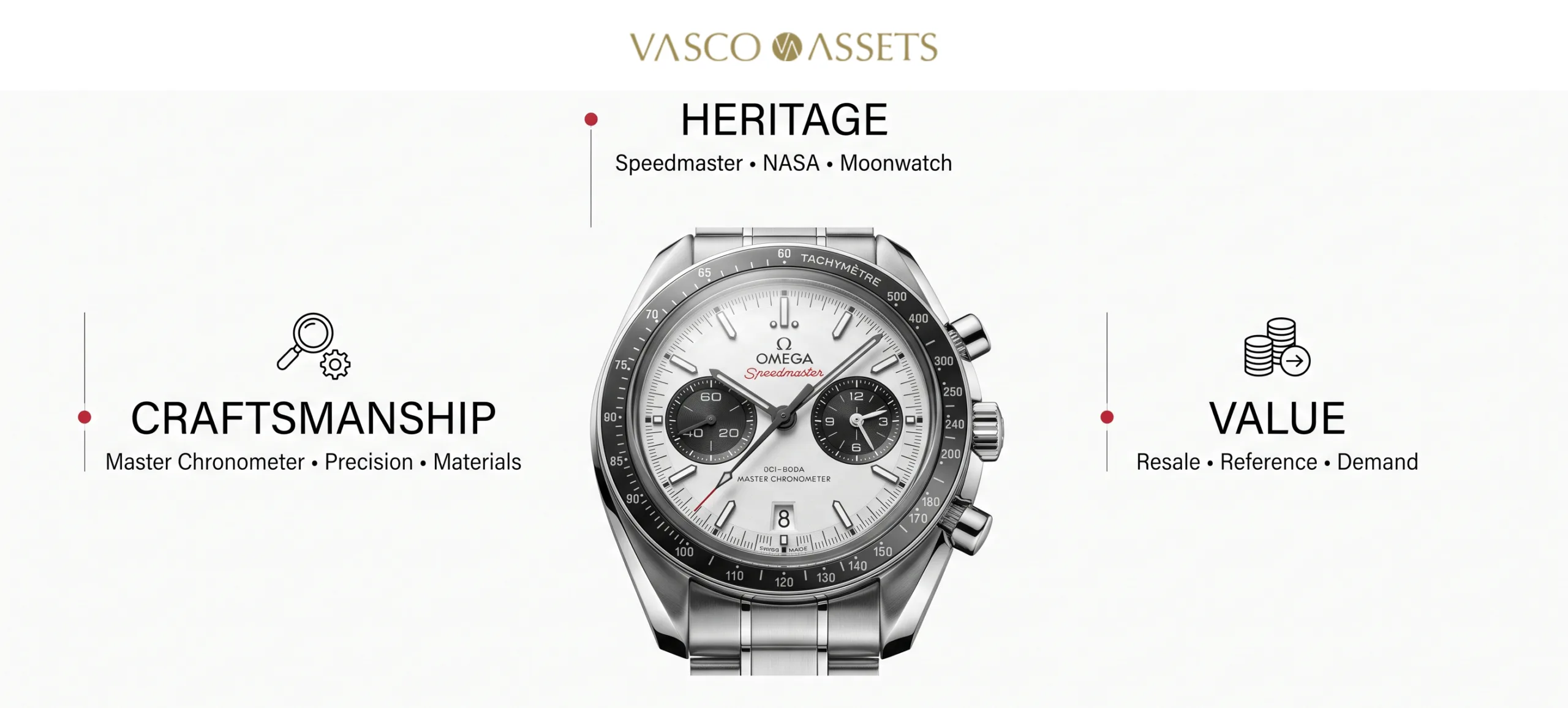
The Heritage Behind the Price Tag
Omega’s most famous watch isn’t valuable just because of its design, it’s valuable because of what it actually did. The Speedmaster Moonwatch is the only watch ever certified by NASA for manned spaceflight, worn on six lunar landings and, most famously, during the Apollo 13 emergency in 1970.
A Story No Other Brand Can Tell
That’s not marketing language, it’s documented aerospace history that no competitor can claim for their own watch. When a brand’s flagship piece has genuinely been to the moon and helped save astronauts’ lives, that heritage becomes part of what a buyer is paying for, alongside the mechanics inside the case.
Heritage That Spans Decades
The Speedmaster’s story dates back to 1957, when Omega introduced it as a motorsport chronograph long before NASA ever took interest. That original reference carried a hand-wound column-wheel movement that would later, through several iterations, become the exact watch worn during lunar missions.
This decades-long continuity, a watch whose design lineage can be traced directly back to its origins, is something very few brands can claim with a straight face. It’s part of why heritage-heavy references consistently outperform generic pieces without that same documented history.
What Are You Actually Paying For in an Omega Watch?
The price of an Omega is not simply a premium for the name on the dial. It reflects several layers of value: manufacturing and engineering, materials, certification and testing, complications, heritage and design, brand positioning, retail costs, and ultimately secondary-market demand.
Why Similar-Sized Watches Can Cost So Differently
Understanding those layers helps explain why two Omega watches with similar sizes can have dramatically different prices. A watch with a more complex movement, premium materials, or a limited-edition heritage story will command a higher price than a visually similar piece without those elements, even if the two look nearly identical on the wrist.
Master Chronometer Certification Isn’t Just Marketing
One concrete example is Master Chronometer certification. Switzerland’s Federal Institute of Metrology (METAS) states that the certification is performed independently on the finished watch and evaluates water resistance, chronometric performance, magnetic resistance, and power reserve.
The Actual Technical Bar Being Cleared
The underlying METAS requirements specify testing criteria for performance and resistance to magnetic fields up to 1.5 tesla, or 15,000 gauss, a level far beyond what a typical mechanical watch is built to withstand. That’s a concrete, independently verified technical standard, not a phrase Omega applies to its own products without outside scrutiny.
Price as a Sum of Inputs, Not One Premium
You can think of an Omega’s retail price as the result of multiple inputs rather than one “luxury premium”: the cost and complexity of producing the movement and case, the materials used, the testing and certification applied to the finished watch, and the complications or specialized engineering involved. Heritage and design add another layer by creating demand for particular collections and references, while retail positioning then influences the price you see in a boutique.
Why This Matters for Resale
Secondary-market demand is what ultimately determines how much of that original price a watch retains after purchase, and it doesn’t always track retail pricing directly. A high retail price does not automatically mean equally high resale value, which is exactly why understanding your specific reference matters more than judging by sticker price alone.
The Craftsmanship That Justifies the Cost
Omega’s engineering credentials go well beyond history. Many of the brand’s modern movements carry Master Chronometer certification, verifying precision, magnetic resistance, and performance beyond standard chronometer requirements.
Precision You Can Verify
This certification means an Omega movement has been tested to standards most other watchmakers don’t attempt to meet, adding real, verifiable engineering value on top of the brand name. That level of scrutiny is part of why certain Omega calibers command a premium even among watch enthusiasts who aren’t swayed by heritage alone.
The Materials Behind the Price
Beyond the movement, materials play a significant role in what you’re paying for. Ceramic cases, sapphire crystal casebacks, and specialized alloys used in certain Speedmaster and Seamaster references all add manufacturing complexity and cost compared to standard steel construction.
Understanding Omega’s Resale Value
Unlike some luxury brands where resale value depends heavily on speculation, Omega’s pricing tends to be more stable and grounded in specific model performance. Current Speedmaster retail prices range from around $6,800 for entry references to over $109,000 for the most complicated pieces in the collection, reflecting a wide spread depending on materials and complications.
Which References Hold Value Best
Not every Omega holds value equally. Sapphire crystal Speedmaster Moonwatch references with the Caliber 3861 movement retain approximately 88 to 90% of retail value in lightly pre-owned condition, a strong result for a watch outside the Rolex or Patek Philippe tier.
Why Some References Underperform
Not every variation performs the same, however. Certain limited or specialty finishes have actually underperformed the broader Speedmaster market and the overall watch market over the past year, showing that even within one collection, specific configuration matters enormously to resale value.
Stability Compared to Speculative Brands
One advantage Omega offers collectors is relative price stability compared to brands more prone to speculative swings. Where certain Rolex, Patek Philippe, or Audemars Piguet references can see dramatic price spikes and corrections tied to hype, Omega’s pricing tends to move more gradually, reflecting genuine collector demand rather than short-term speculation.
What This Means If You’re Selling an Omega
Because Omega’s resale performance varies meaningfully by specific reference, movement, and even case material, a generic brand-wide assumption about value can lead you astray. Checking your exact model against current secondary market data is the only reliable way to know what your watch is actually worth today.
Documentation Still Matters
Original box, papers, and service history remain important for Omega just as they do for other luxury brands, supporting a stronger offer and speeding up the valuation process. A free assessment from a certified buyer accounts for your watch’s specific configuration rather than applying a blanket brand-level estimate.
Get More Than One Opinion
As with any luxury asset, requesting valuations from more than one buyer gives you a real basis for comparison rather than accepting the first number offered. This is especially useful for Omega given how much value can shift based on reference-specific factors that a less experienced buyer might overlook entirely.
Why Sell Your Omega to Vasco Assets
Vasco Assets brings certified watch expertise to every valuation, whether you’re selling a Speedmaster with genuine spaceflight heritage or a more understated Seamaster from your everyday collection. That expertise, backed by over 100 five-star reviews, ensures your watch is priced against real market data specific to its reference.
A Global Network, A Faster Process
As a multinational luxury asset firm, Vasco Assets can match your watch against a broader buyer pool than most local jewelers, often resulting in a stronger offer. Combined with secure, insured shipping, you can request a free valuation online and sell with confidence from anywhere.
Selling Isn’t Your Only Option
If you’re not ready to part with your Omega permanently but still need liquidity, a collateral loan lets you borrow against its value while keeping ownership. This flexibility means you’re never forced into a decision before you’re genuinely ready to make it.
Understand the Value, Then Decide What’s Next
Omega’s prices reflect real history, real engineering, and a resale market that rewards knowing your specific reference rather than assuming based on the brand name alone. Whether you’re buying, holding, or ready to sell, understanding what actually drives that value puts you in a stronger position.
Curious what your Omega is worth today? Request a free, no-obligation valuation from Vasco Assets and get an expert opinion grounded in current market data.
Frequently Asked Questions
Why is the Omega Speedmaster specifically so expensive?
The Speedmaster Moonwatch is the only watch certified by NASA for manned spaceflight, having been worn on six lunar landings including the Apollo 13 mission. That documented history, combined with its mechanical engineering, drives much of its premium.
Does Master Chronometer certification actually matter for value?
Yes. It’s an independent standard verified by Switzerland’s METAS testing agency, confirming water resistance, chronometric performance, and resistance to magnetic fields up to 15,000 gauss, well beyond typical chronometer requirements.
Do all Omega watches hold their value equally well?
No. Certain references, like sapphire-crystal Speedmaster Moonwatches with the Caliber 3861 movement, retain a strong percentage of retail value, while other specialty finishes have actually underperformed the broader market.
Does a higher retail price always mean stronger resale value?
Not necessarily. Retail pricing reflects manufacturing, materials, certification, and brand positioning, while resale value depends separately on secondary-market demand, which doesn’t always move in the same direction as the original price.
How do I know what my specific Omega is worth?
The most reliable way is a certified valuation that checks your exact reference and configuration against current secondary market data, since performance varies significantly even within the same collection. Vasco Assets offers a free assessment for exactly this purpose.
Do I need the original box and papers to sell my Omega?
Not strictly, but complete documentation, including box, papers, and service history, can meaningfully strengthen your offer. A certified buyer can still assess and purchase a watch without full documentation, though the price may reflect what’s missing.
What if I want cash but don’t want to sell my Omega permanently?
A collateral loan lets you borrow against your watch’s value while retaining ownership, which is a good option if you need liquidity without giving up the piece for good.