
Fake Cartier Bracelet vs. Real: How to Tell the Difference
The Cartier Love bracelet is one of the most counterfeited luxury jewelry pieces in the world. With authentic models retailing from around $4,000 and climbing well into five figures for diamond-set variants, the financial stakes of buying a fake are significant. Whether you’re shopping the secondary market, evaluating an inherited piece, or verifying a gift, knowing what separates a genuine Cartier from a convincing replica is knowledge worth having.
Vasco Assets has spent over 35 years evaluating luxury jewelry — including Cartier — through free, no-obligation TruValue Valuations. Here’s what their team, and the broader authentication community, look for.
A Brief Background on Cartier Bracelets
Cartier’s bracelet lineup has produced some of the most iconic designs in fine jewelry history. The Love Bracelet — conceived in 1969 by designer Aldo Cipullo — introduced a locking screw mechanism as a symbol of commitment and has since become Cartier’s most recognized piece.
Other standout designs include the Juste un Clou (a bent nail wrapped around the wrist), the Trinity (three interlocking bands in yellow, white, and rose gold), and the Panthère de Cartier (embellished with diamonds, emeralds, and onyx). Each is built to a precise standard from precious metals only — and that specificity is exactly what makes fakes identifiable.
Materials: The First Test
Authentic Cartier bracelets are made exclusively from solid 18-karat gold (yellow, white, or rose) or 95% pure platinum. There is no silver, steel, or gold-plated alloy in any genuine piece. A bracelet made from anything else — regardless of how convincingly finished — is not real Cartier.
Metal Purity Stamps
Genuine 18k gold pieces are stamped “750” or “Au750,” while platinum models carry “PT950.” Per DSF Antique Jewelry’s hallmark guide and Amayra Jewellery’s hallmark explainer, hallmarks function as independent marks of both metal purity and maker identity — their precision and placement matter as much as their presence.
What Fake Stamps Look Like
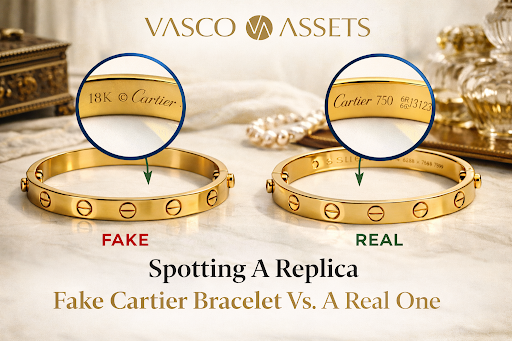
On a counterfeit, purity stamps may be blurry, incorrectly formatted, misplaced, or absent entirely. Some fakes include the right numbers but engrave them with laser-thin lines that lack the depth of a genuine stamp. Run your fingertip across the inside of the bracelet — authentic Cartier hallmarks have a tactile depth that cheap engravings simply don’t replicate.
Weight and Dimensions
Genuine Cartier bracelets are crafted from solid precious metals, so they carry real weight. An authentic 18k gold Love Bracelet typically weighs between 28 and 42 grams depending on size and model. Replicas built from inferior alloys or hollow construction are noticeably lighter — the discrepancy is often obvious the moment you hold one.
Exact Measurements
Genuine Love Bracelets range from 3.65mm to 6.1mm in width and are available in circumferences from 16cm to 21cm. Counterfeits often fail to match these specifications precisely, appearing slightly bulkier, thinner, or inconsistent in cross-section. Even minor dimensional deviations are a meaningful signal.
Engravings and Hallmarks: Where Most Fakes Fail
The interior of an authentic Cartier Love Bracelet is engraved with the Cartier copyright logo, the metal purity mark, the size, and a unique serial number. These engravings should be crisp, deeply cut, evenly spaced, and consistent in font weight — you should feel them when you run your finger across the metal.
Serial Number Formats
Serial numbers on genuine pieces follow specific formatting patterns that changed over production years:
- Five digits and one letter (e.g., 12345A)
- Two letters and four digits (e.g., AB 1234)
- Three letters and three digits (e.g., ABC 123)
Characters should be bold and sharp, with round “0”s and clean “1”s featuring a short top line. On counterfeits, serial numbers are commonly too shallow, inconsistently spaced, or use an elongated font that looks weak and washed out.
Logo Placement
The Cartier logo should sit centered on one side of the bracelet, proportionately positioned between the outer edges — not too high, not too low. A logo that’s off-center or inconsistently placed is a clear sign of a fake.
The Screw Mechanism
The Love Bracelet’s signature screw motif is one of its most counterfeited elements — and one of the easiest places to spot a fake once you know what to look for.
What Real Screws Look Like
On an authentic piece, screws sit completely flush with the bracelet’s surface. They are precisely centered, uniformly spaced, and thinly engraved. Functional versions are designed to be operated only with Cartier’s proprietary flat-head screwdriver, with machined threading so precise that the action is smooth and deliberate.
Post-2011 models feature an updated screw system that stays attached to the bracelet — counterfeits of newer models often miss this detail entirely.
Common Screw Defects on Fakes
- Screws that protrude above the surface
- Decorative (non-functional) screws designed to look functional
- Misaligned or unevenly spaced positioning
- Stiff or catching threading due to poor machining
Packaging and Documentation
Genuine Cartier pieces come with high-quality packaging — the brand’s iconic cardinal red box, a soft pouch, and official documentation including a certificate of authenticity and warranty card. Per Cartier’s guarantee and authenticity guidance, only pieces purchased through authorized channels carry Cartier’s International Guarantee.
Verifying the Certificate
The serial number on the certificate must match the one engraved inside the bracelet. Discrepancies between these two numbers are an immediate red flag. That said, counterfeiters also produce fake boxes and certificates — always verify the bracelet itself, not just the paperwork around it.
Spotting Fake Packaging
- Inauthentic boxes have a less vibrant red than Cartier’s cardinal tone
- Fake boxes may use memory foam padding instead of genuine batting
- Counterfeit boxes sometimes don’t open all the way
- Spelling errors or low-quality printing on certificates are common tells
Quick Home Checks
Before seeking professional evaluation, a few informal tests can raise or lower suspicion quickly.
- Magnet test — Genuine gold and platinum are not magnetic. Any reaction to a magnet means the metal is not what it claims to be.
- Smell test — A metallic, penny-like smell after handling suggests inferior alloys.
- Discoloration check — Look for peeling, fading, or patches of different color. Solid gold doesn’t plate, so wear-through is impossible on a genuine piece.
- Finish consistency — Under good lighting, genuine pieces have a flawless, uniform polish with no rough edges or visible tool marks.
These checks help rule out obvious fakes but are not a substitute for professional authentication when significant money is involved.
When to Get a Professional Opinion
If you’re buying pre-owned, inherited a piece through an estate, or simply want certainty, professional evaluation is the most reliable path to a definitive answer. Expert gemologists use alloy chemistry analysis, microscopic engraving examination, and gemstone testing — well beyond what any visual inspection provides.
Gemological Standards and Lab Reports
The Gemological Institute of America (GIA) sets the global standard for jewelry evaluation. Their comprehensive jewelry analysis reports include metal testing, hallmark verification, and gemstone grading — the kind of documentation that holds up for insurance, resale, or legal purposes. Independent organizations like IGI provide similar grading and identification services.
Contacting Cartier Directly
If you suspect a counterfeit, Cartier’s customer service recommends contacting the brand directly. Cartier boutiques can verify whether a serial number exists within their production records — the most authoritative confirmation available.
Getting a Free Valuation at Vasco
Vasco Assets offers free TruValue Valuations on luxury jewelry including Cartier — with no obligation to sell or borrow. For those looking to leverage a verified piece financially, Vasco also offers collateral loans and LuxLoc lines of credit against authenticated luxury assets.
Where to Buy With Confidence
The safest route is purchasing directly from a Cartier boutique or an authorized retailer. Luxury platforms like Farfetch or Net-a-Porter carrying official Cartier inventory are also reliable options. On the secondary market, prioritize sellers with transparent authentication documentation, verified transaction history, and strong reviews on platforms like Google, Yelp, or the BBB.
Unusually low prices are the most consistent red flag. Genuine Cartier bracelets hold their value well — a deal that seems too good to be true almost always is.
Frequently Asked Questions
How can I tell if a Cartier bracelet is real just by looking at it?
Start with the interior engravings — the Cartier logo, purity mark, size, and serial number should all be crisp, deeply cut, and evenly spaced. Check that screws sit flush and are uniformly aligned. Examine the finish for consistency under good lighting. These visual markers catch the majority of fakes.
What hallmarks should a genuine Cartier Love Bracelet have?
Gold models are stamped “750” or “Au750,” and platinum models carry “PT950.” The Cartier copyright logo, size, and a unique serial number are also engraved on the interior. Any piece missing these marks — or showing them in a shallow, blurry, or incorrect format — warrants serious scrutiny. For more on how hallmarks work, see DSF Antique Jewelry’s hallmark guide.
Do all fake Cartier bracelets feel lighter than real ones?
Most do. Authentic pieces weigh between 28 and 42 grams. However, some higher-quality counterfeits add weight to compensate. Weight alone isn’t conclusive — always check alongside engraving quality, screw precision, and metal stamps.
Can fake packaging fool a professional?
Sophisticated fakes do produce convincing boxes and certificates. A professional authenticator verifies the bracelet itself — not just the paperwork. The serial number on the certificate must always match the one engraved inside the bracelet.
What should I do if I think I’ve bought a fake?
Contact Cartier directly — the brand can check whether a serial number is genuine and advise on next steps. A certified gemologist can also provide independent documentation. The GIA’s jewelry lab services offer comprehensive analysis reports suitable for insurance or legal use.
Is it safe to buy a Cartier bracelet secondhand?
Yes, with the right precautions. Purchase from dealers with verified authentication processes, request documentation, and have the piece independently evaluated before committing. Always confirm the serial number on any certificate matches the bracelet.
Can Vasco Assets authenticate and value my Cartier bracelet?
Yes. Vasco Assets provides free TruValue Valuations on luxury jewelry including Cartier, with no obligation to sell or borrow. Reach out today at 2024 Quail Street, Newport Beach, CA 92660, call +1 (949) 591-8796, or email info@vascoassets.com.