
Jewelry Loan or Jewelry Sell? That is the Question
When you need cash, the jewelry in your safe can feel like a lifeline. A diamond ring, a gold necklace, or a designer bracelet may hold thousands of dollars in value. Before you hand it over, you face an important decision. Should you borrow against your jewelry and keep it, or sell it and walk away with the full proceeds?
There is no single right answer. The best choice depends on your timeline, your attachment to the piece, and how much money you need. Vasco Assets, a licensed and bonded luxury asset firm in Newport Beach, offers both jewelry loans and direct purchases. You can compare each path with a complimentary valuation before deciding.
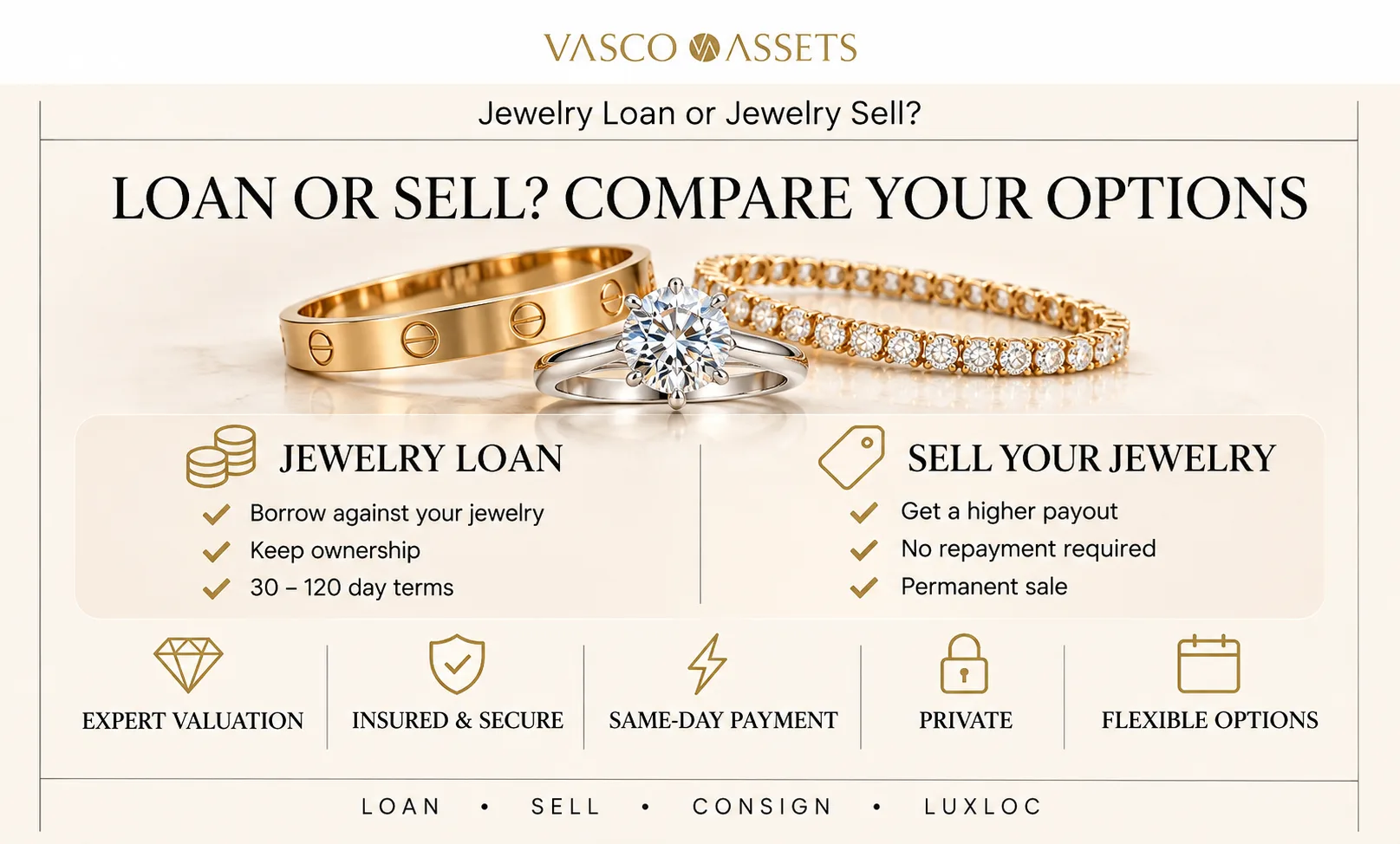
Jewelry Loan vs. Selling: The Core Difference
A jewelry loan, also called a collateral or pawn loan, lets you borrow money using your jewelry as security. The lender holds your piece while the loan is active, and when you repay the principal and fees, your jewelry is returned. You keep ownership, but you pay for the privilege of borrowing.
Selling is a permanent transaction. You receive a one-time payment, the buyer takes ownership, and there are no fees or deadlines afterward. Selling often puts more money in your hands than a loan on the same piece, because a loan is usually a percentage of the item’s value. The trade-off is that the piece is gone for good.
When a Jewelry Loan Makes More Sense
A loan is usually the better choice when your cash need is temporary and you expect to repay soon. It works for business owners covering a short-term gap, people waiting on a paycheck or settlement, and anyone facing an unexpected bill. It also makes sense for heirlooms, engagement rings, and other pieces with deep sentimental value.
Through Vasco’s collateral loans, terms typically run 30, 60, 90, or 120 days, and you can redeem your jewelry anytime within that four-month window. Loans start at $2,500, and rates are negotiable between 2% and 10%, with an average of about 5%. Every piece is insured through Lloyd’s and Partners of London for twice the loan amount.
When Selling Your Jewelry Is the Smarter Move
Selling often makes more sense when you no longer wear the piece, need the maximum amount of cash, or don’t want an ongoing repayment obligation. Common candidates include broken chains, mismatched earrings, outdated settings, and pieces tied to difficult memories. If you are unsure you could repay a loan on time, selling avoids the risk of losing the piece for less than it is worth.
With Vasco Assets, the selling process starts with a quick inquiry. Next comes an in-person evaluation in Newport Beach, or you can send your pieces through Sure Secure Shipping. Certified diamond buyers and precious metal specialists assess your pieces and present an offer. If you accept, you can receive payment the same day.
Jewelry Loan vs. Selling: How Much Money Would You Actually Receive?
Choosing between a jewelry loan and selling becomes easier when you compare immediate cash, repayment costs, and ownership. Borrowing may suit someone with reliable repayment funds who values keeping the jewelry, while selling eliminates repayment obligations entirely.
Consider a diamond ring with a hypothetical assessed resale value of $10,000. Assume a lender offers a $6,000 collateral loan (60% of assessed value), while a buyer offers $8,000 for an outright purchase (80% of assessed value).
| Financial factor | Jewelry loan | Direct sale |
| Assessed resale value | $10,000 | $10,000 |
| Immediate cash received | $6,000 | $8,000 |
| Assumed financing cost | $450 | $0 |
| Total repayment | $6,450 | $0 |
| Ownership outcome | Ring returned after repayment | Ownership transferred |
Assumptions: A 90-day loan charging 2.5% simple interest per 30-day period, totaling $450, with no additional fees. The sale assumes no transaction fees or taxes. These figures are illustrative, not actual Vasco Assets offers or rates.
When Does Repaying the Loan Break Even?
Borrowing costs $450 to preserve the opportunity to reclaim the ring. Suppose you repay $6,450 and later sell the ring for $8,000. Your combined net proceeds would be $7,550, including the original $6,000 loan advance. The break-even resale price is $8,450. Selling for that amount after repayment produces the same $8,000 net as selling immediately.
Additional interest or fees would raise this threshold. The Consumer Financial Protection Bureau’s pawn transaction guidance explains how finance charges and redemption amounts are calculated. The California Department of Financial Protection and Innovation notes that APR reflects both interest and fees. Compare written offers and review the complete repayment terms before deciding.
Questions to Ask Before You Decide
Start with three questions. How much money do you need, and for how long? Can you realistically repay a loan, including fees, within a few months? And how would you feel if this piece were gone permanently? Honest answers usually point clearly toward one option.
Also consider the market. If gold prices are strong, selling may lock in a good return. If you believe a designer piece will gain value, borrowing lets you keep that upside. Either way, a professional valuation tells you what your jewelry is actually worth before you commit.
Explore Both Options With Vasco Assets
Vasco Assets is licensed by California’s Department of Justice and headquartered at 2024 Quail Street in Newport Beach. Its team brings more than 150 years of combined experience in luxury buying. Clients have left more than 100 five-star reviews praising its honesty and clear communication. Valuations are complimentary, so exploring your options costs nothing.
Bring your jewelry in, and the team can walk you through a loan, a sale, or consignment. For high-value collections, Vasco’s LuxLoc credit line offers up to 80% loan-to-value with no credit inquiries. Request your free valuation or call 949.674.3575 to schedule a private appointment.
Conclusion: Make the Choice That Fits Your Life
Choosing between a jewelry loan and selling comes down to timing, value, and attachment. A loan offers temporary cash while you keep ownership. A sale delivers more immediate funds with no future obligations. Neither choice is wrong, as long as you make it with accurate information about your jewelry’s worth.
Whatever you choose, Vasco Assets can help with expert valuations, transparent terms, and secure handling from start to finish. Contact the team at info@vascoassets.com today to find out what your jewelry can do for you.
Frequently Asked Questions
Can I sell my jewelry after taking a loan on it?
Yes, but you must first repay the loan, including all fees, to redeem the piece. After that, you own it outright and can sell it. Keep in mind that the borrowing costs raise the price you need to receive to match what an immediate sale would have paid.
What happens if I can’t repay my jewelry loan?
At the end of your term, you can request an extension by paying the fees from your original agreement, after which a new agreement is issued. If a loan is neither repaid nor extended, you may lose the jewelry. Contact the lender before your due date if you need more time.
Does a jewelry loan require a credit check?
Collateral loans are secured by your jewelry, so approval centers on the piece’s value rather than your credit history. For its LuxLoc credit line, Vasco states there are no credit inquiries and no credit reporting. Ask about the specifics of your loan during your valuation.
What types of jewelry can I borrow against or sell?
Vasco Assets works with diamonds, gold and other precious metals, fine and estate jewelry, designer pieces, and luxury watches. Loans start at a $2,500 minimum, so lower-value pieces may be better suited to a sale. Contact the team with photos and details to confirm eligibility.
How is my jewelry valued?
Specialists consider metal type and weight, gemstone quality, craftsmanship, brand, condition, and current market demand. Grading certificates, appraisals, receipts, and original packaging can support your valuation. Vasco’s valuations are complimentary, whether you plan to borrow or sell.
Is my jewelry safe while it’s held as collateral?
Yes. Vasco stores collateral in secure vaults and insures it through Lloyd’s and Partners of London for twice the loan amount. Once you repay the principal and fees, your jewelry is returned to you.
Can I sell or borrow if I don’t live near Newport Beach?
Yes. Vasco Assets serves clients internationally, and its Sure Secure Shipping service provides an insured way to send your jewelry for evaluation. Many Southern California clients also visit the Newport Beach office for a private, in-person appointment.