
Top 10 Luxury Jewelry Brands: A Connoisseur’s Guide
When investing in fine jewelry — whether for a milestone moment, a meaningful gift, or a long-term asset — the brand matters enormously. It shapes how a piece is made, how it holds value, and what it communicates about the person wearing it.
At Vasco Assets, we guide buyers, sellers, and collectors through the world’s top jewelry brands. The global luxury jewelry market, valued at $48.97B in 2023, is projected to reach $97.05B by 2032 (CAGR 7.9%), driven by rising incomes, Gen Z demand, and interest in ethically sourced pieces. Here’s what buyers should know about the leading brands
1. Cartier
The Classic. The Standard. The Market Leader.
Founded in Paris in 1847, Cartier is the undisputed financial and cultural leader in luxury jewelry. The Richemont Group’s FY2023 Annual Report confirms that its three Jewelry Maisons — Cartier, Van Cleef & Arpels, and Buccellati — achieved combined sales of €13.4 billion, a 21% increase year-on-year, with Cartier as the dominant contributor. Brand Finance valued the Cartier brand at approximately $12.5 billion in 2023. King Edward VII of England famously called it the “Jeweler of Kings, King of Jewelers,” and that reputation has only grown.
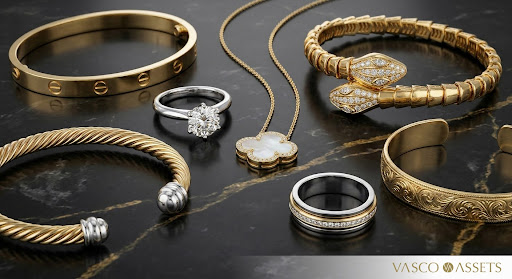
The Love bracelet (~$4,000 in yellow gold) is Cartier’s most iconic piece and a top resale performer. The Panthère de Cartier and Juste un Clou collections appeal to collectors, while the Solitaire 1895 ring is a timeless engagement benchmark. Cartier’s global presence, classic design, and strong resale make it ideal for both first-time buyers and seasoned collectors.
Price range: ~$500 entry (small accessories); signature bracelets $4,000–$50,000+; high jewelry can reach millions.
2. Tiffany & Co.
America’s Most Recognized Jewelry Brand
Established in New York in 1837, Tiffany & Co. is synonymous with American luxury. In January 2021, LVMH completed its $15.8 billion acquisition of the brand — the largest transaction in luxury goods history — cementing Tiffany’s place within the world’s most powerful luxury conglomerate and accelerating its global expansion, particularly across Asia. Its iconic blue box remains arguably the most recognized packaging in the world.
The Tiffany Setting engagement ring, introduced in 1886, remains the bridal industry’s most iconic design. Everyday luxury options like Return to Tiffany and T collection pieces offer accessible entry points. Post-LVMH, Tiffany is expanding its high jewelry and global reach.
Price range: ~$200 entry (silver); engagement rings $2,500–$100,000+; Blue Book high jewelry $50,000–millions.
3. Harry Winston
The King of Diamonds
Harry Winston founded his New York house in 1932 with a singular obsession: the world’s finest diamonds. His estate handled some of history’s most famous stones, including the Hope Diamond and the Jonker Diamond. Today, owned by the Swatch Group, Winston remains the definitive name in diamond high jewelry and is consistently cited as a key global player in independent industry analyses.
Harry Winston’s signature cluster diamonds create a “floating” effect, making them red-carpet favorites with strong auction performance. The Winston Candy collection offers a more accessible entry, but the brand shines at higher price points, where its diamond mastery is unmatched.
Price range: ~$2,000–$5,000 entry; signature diamond jewelry $10,000 to $1 million+.
4. Van Cleef & Arpels
The Collector’s Choice
Founded in Paris in 1906 and part of the Richemont Group, Van Cleef & Arpels is consistently cited alongside Cartier as one of the strongest performers on the secondary market. Vintage and discontinued pieces routinely command significant premiums at Christie’s and Sotheby’s, and certain collections have become genuinely difficult to acquire at retail.
The Alhambra collection — four-leaf clover motif from 1968 — often resells above retail, with boutique waitlists worldwide. The Zip necklace converts to a bracelet, and the proprietary Mystery Set technique hides prongs for a seamless stone surface. For investment-focused buyers, Van Cleef stands out.
Price range: Alhambra pendants ~$2,000–$6,000; bracelets $5,000–$30,000+; high jewelry $50,000+.
5. Bvlgari
Bold, Roman, Collectible
Founded in Rome in 1884 by Greek silversmith Sotirios Voulgaris, Bvlgari is the most visually assertive brand on this list. Where French maisons tend toward refinement, Bvlgari embraces drama — vibrant colored gemstones, architectural silhouettes, and unmistakable presence. Now part of LVMH, it is highlighted as a key player in the collectible luxury segment across multiple market reports, with particular strength in Asian markets.
The Serpenti collection — coiling snake motifs — is Bvlgari’s most iconic line. The B.zero1 ring, inspired by the Colosseum, is a top entry-level investment piece. Ideal for buyers seeking bold visual impact and strong Asian market appeal.
Price range: B.zero1 ~$1,000–$5,000; Serpenti $3,000–$100,000+; high jewelry $50,000+.
6. Boucheron
The Innovator of Place Vendôme
Established in 1858, Boucheron was the first jeweler on Paris’s Place Vendôme, now the world’s premier fine jewelry address. Part of the Kering Group, it pioneered rock crystal, mixed metals, and unconventional materials in high jewelry, setting a tradition of bold creativity.
The Quatre collection — four interlocking bands in contrasting gold — is its most iconic contemporary line, while the Serpent Bohème collection offers playful designs at more accessible prices. Boucheron is perfect for buyers seeking genuine French heritage and exceptional craftsmanship with a distinctive aesthetic.
Price range: Entry ~$1,500; Quatre rings $3,000–$20,000+; high jewelry $30,000+.
7. Chopard
Founded in Switzerland in 1860, Chopard earned its reputation in watchmaking before expanding into high jewelry. The brand stands out for its commitment to ethical sourcing: since July 2018, 100% of Chopard’s gold has been responsibly sourced, documented in its annual Supply Chain Due Diligence Report and independently audited by the Responsible Jewellery Council — a transparency level rare in the industry.
The Happy Diamonds collection features free-floating diamonds between sapphire crystals, perfect for everyday luxury. The Red Carpet collection showcases the brand’s most ambitious high jewelry. For ethically minded buyers valuing both craftsmanship and prestige, Chopard is unmatched.
Price range: Happy Diamonds ~$2,000–$20,000; Red Carpet high jewelry $50,000+.
8. David Yurman
American Artisan Luxury
Founded in New York in 1980 by David and Sybil Yurman, the brand is built on artistic vision rather than royal heritage. Its signature cable bracelet — a twisted helix inspired by sculpture — is iconic and widely imitated. With Michael B. Jordan as global ambassador, the brand maintains strong cultural relevance. Pieces like the Albion ring and Châtelaine pendant combine timeless wearability with artisanal craftsmanship at accessible prices.
Price range: Entry ~$300–$500; cable bracelets $500–$5,000+; fine jewelry $2,000–$30,000.
9. Buccellati
Italy’s Best-Kept Secret
Founded in Milan in 1919, Buccellati is the fastest-growing Richemont brand yet remains a quietly prestigious choice for connoisseurs. Its signature Rigato (fine-line engraving) and Tulle (mesh-like openwork) techniques create textures resembling lace that cannot be machine-replicated. The Opera collection highlights its engraving mastery, while Macri and Ramage offer everyday wearable pieces.
Price range: Entry ~$1,000; signature gold $3,000–$50,000+; high jewelry from $20,000.
10. Piaget
Where Watchmaking Meets High Jewelry
Founded in Switzerland in 1874 and part of Richemont, Piaget excels as both a watchmaker and high jewelry house. Known for ultra-thin movements and meticulously set gemstones, its pieces showcase precision and artistry. The Possession collection, featuring a rotating inner band, exemplifies Piaget’s playful elegance, while gem-set watches seamlessly blend horology and jewelry.
Price range: Possession rings ~$2,000–$15,000; gem-set watches $10,000–$200,000+; high jewelry from $30,000.
How to Choose the Right Brand for You
With so many iconic names, choosing the right luxury jewelry comes down to four factors:
Style: Cartier and Tiffany suit classic tastes; Bvlgari and Boucheron favor bold designs; Van Cleef & Buccellati appeal to collectors who value rarity and artisanal craft.
Budget: David Yurman and Bvlgari B.zero1 offer accessible entry points. Cartier and Van Cleef command premiums but reward resale; Harry Winston requires a higher baseline investment.
Investment Horizon: For long-term appreciation, Cartier, Van Cleef & Arpels, and Tiffany lead. Buccellati’s scarcity and growth appeal to serious collectors.
Values Alignment: Chopard leads in ethical sourcing, with a fully audited, responsible gold supply chain.
The global luxury jewelry market is $94B in 2025 and growing. Understanding each brand helps you choose pieces that are both beautiful and meaningful.
For buying, selling, or appraising top-tier luxury jewelry, Vasco Assets provides expert services. Visit 2024 Quail Street, Newport Beach, CA, call +1 (949) 593-6125, or email info@vascoassets.com.
Frequently Asked Questions (FAQ)
1. Where can I buy, sell, or appraise luxury jewelry from these brands?
Vasco Assets handles buying, selling, and appraising top-tier brands like Cartier, Tiffany & Co., Van Cleef & Arpels, Harry Winston, and Bvlgari. Visit www.vascoassets.com, their Newport Beach showroom at 2024 Quail Street, or call +1 (949) 593-6125.
2. Which luxury jewelry brand holds its value best?
Cartier, Van Cleef & Arpels, and Tiffany & Co. lead the secondary market. Van Cleef’s Alhambra and Cartier’s Love bracelet show strong resale performance. Buccellati is rising among collectors.
3. Best luxury jewelry brand for a first-time buyer?
Cartier offers strong brand recognition and resale starting around $500. David Yurman provides artisanal quality at lower entry points, ideal for new buyers.
4. Which luxury jewelry brand is most ethically sourced?
Chopard leads in ethical sourcing, using 100% responsibly sourced gold since 2018, audited by the Responsible Jewellery Council.
5. Most iconic luxury jewelry pieces?
Cartier Love bracelet, Tiffany 1886 Solitaire engagement ring, and Van Cleef & Arpels Alhambra collection — all culturally enduring with strong secondary market demand.
6. Is luxury jewelry a good investment?
Top-tier brands like Cartier, Van Cleef & Arpels, Harry Winston, and Tiffany can hold value long-term. Performance varies by brand, collection, condition, and provenance. Buy for enjoyment first; investment is secondary.
7. How do I know if a piece is authentic?
Look for original paperwork, hallmarks, and verified provenance. For pre-owned jewelry, buy from reputable dealers and consider professional appraisal.
8. Difference between fine jewelry and high jewelry?
Fine jewelry: precious metals and gems, $500–$50,000, for regular wear.
High jewelry (Haute Joaillerie): unique, hand-crafted pieces with exceptional stones, $50,000–millions. Brands like Harry Winston, Van Cleef & Arpels, and Boucheron excel in high jewelry.