
Pledged Asset Line of Credit: Access Capital Without Selling

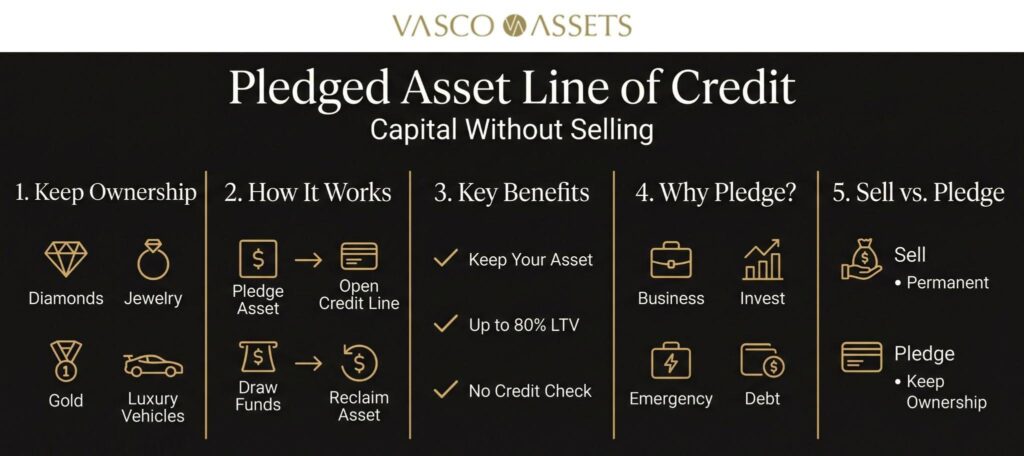
Selling a valuable asset to raise cash is permanent. Once that diamond, gold piece, or luxury car is gone, so is any future upside if its value climbs, and so is the asset itself if you ever wanted it back. A pledged asset line of credit solves this differently: you keep ownership, you pledge the item as security, and you unlock cash against it instead of giving it up.
Vasco Assets built exactly this model into a product called LuxLoc, which lets you pledge diamonds, gold, jewelry, or a luxury vehicle to open a flexible credit line, without ever having to part with the asset itself.
What a Pledged Asset Line of Credit Is
A pledged asset line of credit is a revolving credit facility secured by collateral you already own, rather than by your income or credit history. You pledge the asset, the lender holds it for the term of the agreement, and in return you get access to a credit limit calculated from that asset’s appraised value. You keep the title to the underlying item; the lender simply holds it as security while the line is open.
This structure sits in contrast to selling outright. When you sell, the transaction is final and the asset’s future value no longer belongs to you. When you pledge it for a line of credit, you retain the option to reclaim it once the balance is repaid, while still getting the liquidity you need in the meantime.
Why Pledging Beats Selling for Many Owners
Selling makes sense when you’re done with an asset for good. But if you still want it back eventually, pledging preserves that option while still solving your cash need today. This matters most for items with strong long-term value, appreciation potential, or sentimental weight, like a family heirloom or a car you’d rather not lose permanently over a short-term cash crunch.
LuxLoc is built around this exact idea: diamonds, jewelry, gold, precious metals, and select luxury vehicles from brands like Ferrari, Rolls-Royce, Bentley, and McLaren can all be pledged rather than sold. Assets need to be valued at $10,000 or more to qualify, with credit lines set at a loan-to-value ratio of up to 80%, depending on the asset class.
How the Pledge and Credit Line Work Together
The mechanics are simpler than most bank products. You pledge the asset, Vasco Assets evaluates it, and you’re granted a credit line, not a lump-sum loan you must immediately start repaying. Securing that line costs roughly 0.5% of the amount you might eventually want to borrow, a fraction of what a full loan would cost.
From there, the credit line sits ready until you actually need it. You only begin paying interest once you draw funds, so you can pledge the asset, lock in the line, and wait for the right moment to use it — whether that’s a business opportunity, an investment, or an emergency — without paying for money you haven’t touched yet.
Terms, Costs, and What You’re Actually Signing Up For
Every pledged line of credit comes with terms worth understanding before you commit. LuxLoc’s standard lines run from $20,000 to $99,999 in principal, with custom terms available above $100,000 depending on the pledged asset, its appraised value, and the loan-to-value ratio applied. Terms run six or twelve months, and clients in good standing can renew and extend indefinitely.
There’s no origination fee, no appraisal fee, and no credit inquiry, so pledging an asset never touches your credit bureau file. A maintenance fee covering insurance, storage, and administration is charged every 30 days regardless of whether you’ve drawn funds, and a missed fee payment comes with a 10-day grace period before a late fee applies.
What Happens If You Can’t Repay?
One of the biggest concerns borrowers have is what happens if they can’t repay a pledged asset line of credit on time. The answer depends on the terms of the agreement, but losing ownership is generally not the first step. Before collateral can be sold, lenders typically follow the procedures outlined in the credit agreement and applicable state law, which often include notifying the borrower of the default and providing an opportunity to resolve the issue. The Uniform Commercial Code (Article 9), which governs most secured transactions in the United States, establishes rules for how lenders may enforce their security interests after a default.
If you’re unable to make payments, the first step is usually to contact your lender as soon as possible, since there may be options to repay the balance, renew the agreement, or make other arrangements before collateral is liquidated. If the loan ultimately can’t be resolved, the lender may sell the pledged asset to recover what’s owed, and Article 9 generally requires that sale to be conducted in a commercially reasonable manner. In many cases, proceeds beyond the debt and permitted expenses are returned to the borrower, though a shortfall may leave the borrower responsible for the remaining deficiency depending on the contract and applicable law.
Pledged Line of Credit vs. Selling Your Assets Outright
The core question is whether you need permanent cash or temporary liquidity. According to the Consumer Financial Protection Bureau (CFPB), a line of credit is a revolving account that lets you draw funds as needed and pay interest only on what you use, which is a fundamentally different arrangement than an outright sale, where you receive a one-time payment and give up the asset for good.
If you’re certain you no longer want the item and just want maximum cash today, selling may be simpler. Vasco Assets also offers a direct path to sell your assets for those who’d rather close the chapter entirely. But if there’s any chance you’d want the asset back, or if you believe its value will keep climbing, pledging it for a credit line preserves that future while still solving today’s cash need.
| If you want… | Better option |
| Permanent cash, no attachment to the item | Sell your assets |
| To keep ownership and reclaim the item later | Pledged line of credit |
| Flexible access to funds over time | Pledged line of credit |
| One large lump sum today | Sell your assets or loan |
| To hedge against future appreciation | Pledged line of credit |
Neither option is universally better; it depends on whether you see the asset as something to cash out of, or something to lean on temporarily while holding onto it.
Who This Is Built For
A pledged asset line of credit fits owners who have something valuable, don’t want to lose it permanently, and need liquidity without the delay of a bank underwriting process. It’s especially useful for consolidating debt, funding a business move, covering a cash gap during a larger transaction, or simply keeping capital on standby for whenever an opportunity shows up.
It’s not the right fit if your asset is worth less than $10,000, in which case a standard collateral loan is usually the better structure. It also isn’t for anyone unwilling to have an item held as security for the term, since that pledge is exactly what makes the fast, no-credit-check process possible.
Take the Next Step
If you own diamonds, gold, jewelry, or a luxury vehicle and want to know what a pledged credit line against it could look like, the best first step is a free valuation. Vasco Assets, a licensed and bonded investment firm based in Newport Beach, CA, built LuxLoc so owners can access real capital without giving up what they own.
There’s no cost to explore what your line could be, and no obligation once you do. Reach out for a no-obligation valuation and see what your assets could unlock while staying yours.
Frequently Asked Questions
What is a pledged asset line of credit?
It’s a revolving credit line secured by an asset you pledge as collateral rather than sell. You retain ownership while the lender holds the item as security, and you can draw funds against the line as needed.
Do I lose ownership of my asset when I pledge it?
No. Pledging means the asset is held as security for the term of the agreement, but ownership stays with you. Once the balance is repaid, you’re entitled to get the asset back.
What assets qualify for LuxLoc?
Diamonds, jewelry, gold, precious metals, and select luxury vehicles like Ferrari, Rolls-Royce, Bentley, and McLaren qualify, provided they’re valued at $10,000 or more.
What LTV and loan amounts does LuxLoc offer?
LuxLoc offers loan-to-value up to 80%, depending on the asset class. Standard principal amounts range from $20,000 to $99,999, with custom terms available above $100,000.
Will pledging an asset affect my credit score?
No. LuxLoc requires no credit reporting and no credit inquiry, so pledging an asset and opening a line never touches your credit bureau file.
What happens if I can’t repay my balance?
Lenders generally must notify you of a default and follow procedures set by the credit agreement and state law before selling pledged collateral, under rules established by Article 9 of the UCC. Contacting your lender early often opens up more options than waiting.
How fast can I access cash once I decide to draw on my line?
Once you call for funds and documents are issued, funds are typically made available within 48 to 96 hours.