
Asset Backed Line of Credit: Turn What You Own Into Liquidity | Vasco Assets

Wealth sitting in a safe or a garage doesn’t help you seize an opportunity today. An asset backed line of credit changes that: it turns diamonds, gold, jewelry, or a luxury vehicle into usable capital without forcing you to sell anything or wait weeks for a bank’s approval.
Vasco Assets offers this through LuxLoc, a credit line built specifically around luxury holdings, so what you already own can start working for you instead of just sitting there.
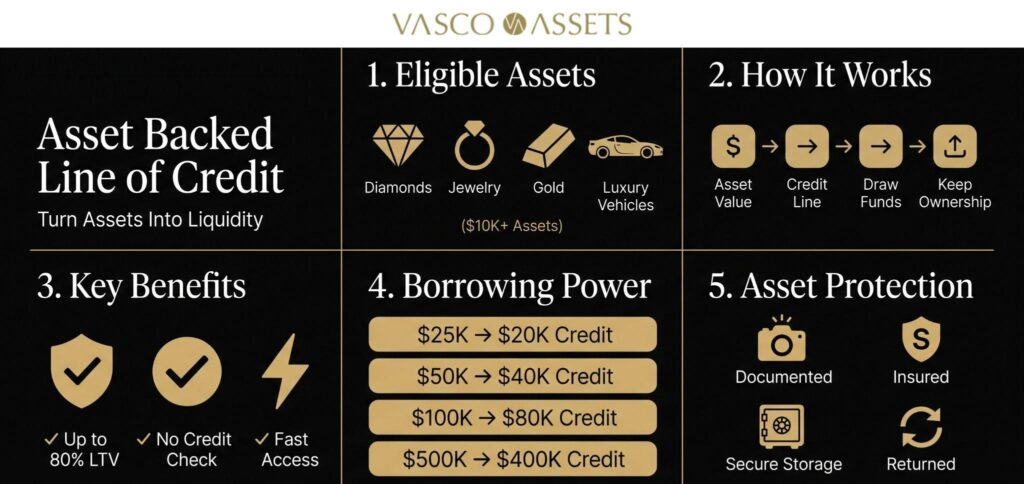
What an Asset Backed Line of Credit Is
An asset backed line of credit is a revolving credit account secured by physical collateral instead of your paycheck or credit report. You pledge the asset, the lender assigns a credit limit based on its appraised worth, and you draw on that limit whenever you need cash, rather than receiving one fixed sum upfront.
The appeal is in what it replaces. A bank line of credit runs on income verification, debt ratios, and a credit pull. An asset backed line runs on the value of the item itself, which is why it can be set up faster and with far less paperwork.
Why Luxury Assets Convert Well Into Liquidity
Not every possession makes good collateral, but luxury assets tend to hold recognized, tradable value. Diamonds, gold, and high-end vehicles have active resale markets and standardized ways to grade and appraise them, so a lender can move quickly without guessing at what the item is worth.
LuxLoc is built around this category specifically: diamonds, jewelry, gold, precious metals, and select luxury vehicles such as Ferrari, Rolls-Royce, Bentley, and McLaren. Qualifying assets must be valued at $10,000 or more, and the credit line is set using a loan-to-value ratio of up to 80%, depending on the asset class.
How Turning Assets Into a Credit Line Works
The process starts with pledging the asset, not selling it. Once Vasco Assets evaluates the item, you’re granted a credit line rather than a lump-sum loan, and securing that line costs roughly 0.5% of the amount you might eventually want to borrow.
From there, the line simply sits available. Interest doesn’t start accruing until you actually draw funds, so you can convert an asset into standing liquidity today and decide later — for a business move, an investment, or an emergency — exactly when to use it.
How Much Can I Actually Borrow?
One of the biggest questions borrowers have is simple: how much cash can I actually unlock from my assets? The calculation is fairly straightforward — the available credit line is generally based on a percentage of the asset’s appraised value. According to the Corporate Finance Institute, loan-to-value (LTV) represents the portion of an asset’s value a lender is willing to finance, with the exact percentage depending on factors like asset type, liquidity, and market demand.
For high-value assets, an 80% LTV means a borrower may access roughly 80 cents for every dollar of verified asset value, though the Corporate Finance Institute notes the final amount still depends on professional appraisal, asset condition, and lender requirements.
Asset Value vs. Available Credit Line
| Asset Value | Approximate 80% Credit Line |
| $25,000 jewelry collection | $20,000 |
| $50,000 gold holdings | $40,000 |
| $100,000 luxury vehicle | $80,000 |
| $500,000 diamond collection | $400,000 |
A borrower with a $100,000 Ferrari may potentially qualify for a credit line near $80,000, while someone with a $500,000 collection of investment-grade diamonds could unlock substantially more without selling anything outright. High-net-worth borrowers often turn to asset-backed lending precisely because it lets them access capital while preserving ownership, a dynamic the Financial Times has reported on among wealthy collectors using collectibles as loan collateral.
It’s worth remembering that 80% LTV is an illustration, not a guarantee, since luxury assets, collectibles, jewelry, and vehicles carry different valuation methods and risk profiles. Lenders typically formalize their security interest through collateral agreements governed, for most personal property transactions, under frameworks such as Article 9 of the Uniform Commercial Code (UCC). The fastest way to estimate your own borrowing capacity is to establish your asset’s current market value, apply the expected LTV range, and confirm the final number through an independent appraisal and lender review.
How Are Luxury Assets Protected While Pledged?
A natural concern when pledging something valuable is what happens to it physically once it’s in a lender’s hands. Reputable asset backed lenders follow documented custody and security practices for the life of the loan. Under Article 9 of the UCC, a secured party holding collateral has a legal duty to exercise reasonable care in its custody and preservation, and the collateral must remain identifiable while in the lender’s possession.
Before accepting an asset, lenders commonly record its condition through photographs, serial numbers, grading reports, and certificates of authenticity. The National Institute of Standards and Technology (NIST) defines a chain of custody as a documented process tracking an item’s handling, transfer, and safeguarding from receipt through final return, and this kind of record supports exactly that trail. Insurance matters too — Article 9 recognizes that preservation expenses, including insurance, may be incurred while an asset is held, so it’s worth confirming coverage details, limits, and responsibility for loss before signing anything.
Terms and Costs Worth Knowing
Understanding the numbers upfront avoids surprises later. LuxLoc’s standard credit lines range from $20,000 to $99,999 in principal, with custom terms available above $100,000 depending on the asset, its appraised value, and the loan-to-value ratio used. Terms run six or twelve months, and clients in good standing can renew indefinitely.
There’s no origination fee, no appraisal fee, and no credit inquiry, so the line never touches your credit bureau file. A maintenance fee covering insurance, storage, and administration is charged every 30 days regardless of use, with a 10-day grace period on any missed payment before a late fee applies.
What Happens If You Can’t Repay?
Borrowers naturally worry about what happens if repayment becomes difficult. Losing the asset is not usually the first consequence. Lenders typically follow procedures set out in the credit agreement and applicable state law, which generally include notifying the borrower of a default and offering a chance to resolve it, under the same Article 9 framework that governs most secured transactions in the U.S.
Contacting your lender as soon as a problem arises is usually the best move, since there may be options to repay the balance, renew the term, or make other arrangements before anything is liquidated. If the debt truly can’t be resolved, the lender may sell the pledged asset, and Article 9 generally requires that sale to be commercially reasonable. Proceeds beyond what’s owed are typically returned to the borrower, though a shortfall can leave the borrower responsible for the remaining deficiency, depending on the agreement and applicable law.
Asset Backed Line of Credit vs. Selling or a Lump-Sum Loan
Turning an asset into liquidity isn’t the only option, and it isn’t always the right one. According to the Consumer Financial Protection Bureau (CFPB), a line of credit is a revolving account that lets you draw funds as needed and pay interest only on what you use — different from a term loan, which disburses everything at once, and different again from selling, where you give up the item permanently for a single payment.
If you have one specific, known expense, a traditional collateral loan may be simpler, since the full amount arrives upfront. If you’re ready to part with the item entirely, selling your assets is the more direct route. But if your need for capital is ongoing or its timing is uncertain, a credit line lets you stay ready without paying for money you haven’t drawn.
| If you need… | Better option |
| A fixed, one-time amount | Collateral loan |
| Ongoing or flexible access to cash | Asset backed line of credit |
| Permanent cash with no attachment to the item | Sell your assets |
| Capital on standby for opportunities | Asset backed line of credit |
| To eventually reclaim the pledged item | Asset backed line of credit |
Who This Is Built For
An asset backed line of credit suits owners who want liquidity without selling, without a credit check, and without the wait of bank underwriting. It works well for consolidating debt, funding a business opportunity, covering an emergency, or simply keeping capital available for whenever the right moment comes along.
It’s not the right fit if your asset is worth less than $10,000, in which case a standard collateral loan is usually the better structure. It’s also not suited to anyone unwilling to have an item held as security for the term, since that pledge is exactly what makes the fast, no-credit-check process possible.
Take the Next Step
If you own diamonds, gold, jewelry, or a luxury vehicle and want to see what kind of credit line it could unlock, the fastest way to find out is a free valuation. Vasco Assets, a licensed and bonded investment firm based in Newport Beach, CA, built LuxLoc so your holdings can become real liquidity without the friction of a traditional bank.
There’s no cost to explore what your line could look like, and no obligation once you do. Reach out for a no-obligation valuation and see what your assets could open up for you.
Frequently Asked Questions
What is an asset backed line of credit?
It’s a revolving credit account secured by physical collateral, like diamonds, gold, or a luxury vehicle, rather than income or credit history. You draw funds as needed and pay interest only on what you use.
How much can I actually borrow against my assets?
Generally a percentage of the asset’s appraised value, known as the loan-to-value ratio. At an 80% LTV, for example, a $100,000 asset could unlock roughly $80,000, though the Corporate Finance Institute notes the final figure depends on appraisal, condition, and lender review.
What assets qualify for LuxLoc?
Diamonds, jewelry, gold, precious metals, and select luxury vehicles like Ferrari, Rolls-Royce, Bentley, and McLaren qualify, provided they’re valued at $10,000 or more.
How is my asset protected while it’s pledged?
Lenders are generally required to exercise reasonable care over pledged collateral under Article 9 of the UCC, and reputable lenders document an asset’s condition and maintain a chain of custody from intake through return.
What LTV and loan amounts does LuxLoc offer?
LuxLoc offers loan-to-value up to 80%, depending on the asset class. Standard principal amounts range from $20,000 to $99,999, with custom terms available above $100,000.
Will this affect my credit score?
No. LuxLoc requires no credit reporting and no credit inquiry, so opening a line never touches your credit bureau file.
What happens if I can’t repay my balance?
Lenders generally must notify you of a default and follow procedures set by the credit agreement and state law before selling pledged collateral, under rules established by Article 9 of the UCC. Contacting your lender early usually preserves more options.