
Unsecured vs. Secured Line of Credit | Vasco Assets

Not all lines of credit are built the same way, and the difference can determine whether you get approved at all, how fast you get funded, and what you risk if things go wrong. An unsecured line of credit relies entirely on your creditworthiness, while a secured line of credit is backed by something you own. Understanding which one fits your situation matters before you apply for either.
Vasco Assets specializes in the secured side of that equation through LuxLoc, a line of credit backed by luxury assets like diamonds, gold, and high-end vehicles rather than your credit score.
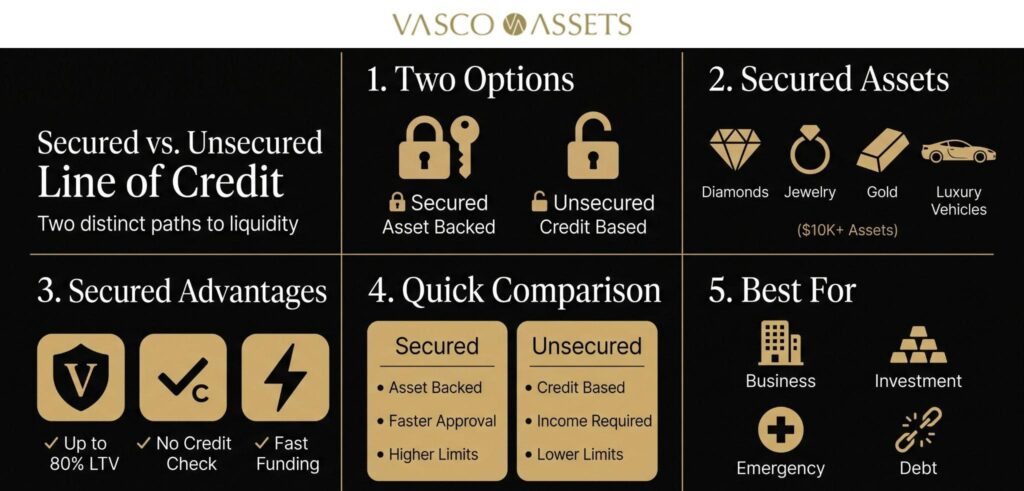
What Makes a Line of Credit “Unsecured”
An unsecured line of credit isn’t backed by any specific collateral. Approval depends on your credit score, income, and debt history, and the lender is taking on risk based entirely on your financial profile. According to the Consumer Financial Protection Bureau (CFPB), a line of credit — secured or not — is a revolving account that lets you draw funds as needed and pay interest only on what you use, but unsecured lines typically come with tighter qualification standards since there’s no asset backing the risk.
Because the lender has nothing to seize if you default, unsecured lines usually carry higher interest rates, lower credit limits, and stricter approval criteria. A strong credit score and a stable income history are essentially the entire application.
What Makes a Line of Credit “Secured”
A secured line of credit is backed by collateral you pledge, which shifts the lender’s risk away from your credit profile and onto the value of the asset itself. This is the model LuxLoc is built on: diamonds, jewelry, gold, precious metals, and select luxury vehicles like Ferrari, Rolls-Royce, Bentley, and McLaren can all serve as collateral, provided they’re valued at $10,000 or more.
Because the asset itself carries the risk, secured lines can skip income verification and credit checks almost entirely. LuxLoc sets its credit line using a loan-to-value ratio of up to 80%, depending on the asset class, rather than a credit-based formula.
How Much Can You Borrow With Each Type of Line of Credit?
The biggest difference between the two becomes clear when you look at actual borrowing scenarios. Unsecured credit decisions are primarily based on factors like income, credit history, and existing debt obligations, while secured lines are tied directly to the value of the asset pledged as collateral. The CFPB explains that lenders evaluate personal lines of credit based on a borrower’s ability to repay, with unsecured options relying heavily on financial qualifications precisely because no specific asset backs the loan.
Consider how borrowing capacity can differ across two very different applicants:
| Borrower Profile | Unsecured Line of Credit | Secured Asset Line |
| 720 credit score + $150,000 income | $25,000–$100,000 (varies by lender) | Not applicable |
| $50,000 gold holdings | Usually unavailable | Up to ~$40,000 at 80% LTV |
| $250,000 Ferrari | Usually unavailable | Up to ~$200,000 at 80% LTV |
| $500,000 diamond collection | Usually unavailable | Up to ~$400,000 at 80% LTV |
With an unsecured line, two borrowers with similar incomes may receive very different credit limits depending on their credit profile, existing obligations, and the lender’s underwriting model. With a secured asset-backed line, the calculation is generally more straightforward: the value of the collateral drives how much credit is available. Loan-to-value measures the percentage of an asset’s value a lender is willing to finance, and the Federal Reserve Bank of St. Louis tracks LTV precisely as this kind of ratio, with the exact percentage depending on the asset type, its liquidity, and risk factors.
The key difference is simple: unsecured credit asks, “How strong is your financial profile?” Secured credit asks, “What is the value of the asset backing this request?” For borrowers searching terms like “how much can I borrow against gold,” “borrow against jewelry,” or “secured line of credit with bad credit,” understanding this distinction is the first step toward choosing the right financing option.
The Core Trade-Off: Approval Speed vs. What’s at Stake
The real difference between the two comes down to what each side is trading. Unsecured lines don’t put a specific possession at risk, but they’re harder to qualify for, slower to approve, and often carry a higher interest rate to compensate the lender for taking on unbacked risk. Secured lines move faster and approve more easily because the collateral does the qualifying work — but that asset is what backs the agreement if things go wrong.
With LuxLoc, that trade-off leans heavily toward speed and access: there’s no credit inquiry, no appraisal fee, and no origination fee, and funds are typically available within 48 to 96 hours of a request once documents are issued.
Terms and Costs With LuxLoc
Knowing the actual numbers helps make the comparison concrete. LuxLoc’s standard secured credit lines range from $20,000 to $99,999 in principal, with custom terms available above $100,000 based on the asset, its appraised value, and the loan-to-value ratio used. Terms run six or twelve months, and clients in good standing can renew indefinitely.
There’s no origination fee, no appraisal fee, and no credit inquiry — the line never touches your credit bureau file. A maintenance fee covering insurance, storage, and administration is charged every 30 days regardless of use, and a missed payment comes with a 10-day grace period before a late fee applies.
What Happens If You Can’t Repay a Secured Line?
This is the biggest practical difference between the two types, so it’s worth understanding clearly. With a secured line, losing the asset is not the immediate consequence of a missed payment. Lenders typically follow procedures outlined in the credit agreement and applicable state law, which generally require notifying the borrower of a default and providing a chance to resolve it, under rules established by Article 9 of the Uniform Commercial Code (UCC), which governs most secured transactions in the U.S.
Contacting your lender early usually preserves more options — repaying the balance, renewing the term, or making other arrangements before collateral is liquidated. If a secured debt truly can’t be resolved, the lender may sell the pledged asset, and Article 9 generally requires that sale to be conducted in a commercially reasonable manner, with any surplus returned to the borrower after the debt and permitted expenses are covered. An unsecured line, by contrast, doesn’t put a specific item at risk this way, though default still damages your credit and can lead to collections.
Which One Fits Your Situation
Neither structure is universally better. If you have strong credit, stable income, and don’t own a qualifying luxury asset, an unsecured line may be your only realistic path. If you own diamonds, gold, or a luxury vehicle and want faster approval, higher limits, and no impact to your credit file, a secured line like LuxLoc is generally the stronger option.
| If you have… | Better option |
| Strong credit, no qualifying assets | Unsecured line of credit |
| Valuable luxury assets, want speed | Secured line of credit |
| A need to avoid credit checks entirely | Secured line of credit |
| No collateral to pledge | Unsecured line of credit |
| A preference for lower interest costs | Secured line of credit |
The decision ultimately comes down to what you have available to pledge, and how much you value speed and approval odds over avoiding collateral risk entirely.
Who LuxLoc Is Built For
LuxLoc fits owners of qualifying luxury assets who want to skip the credit-based hurdles of an unsecured line altogether. It works well for consolidating debt, funding a business opportunity, covering an emergency, or keeping capital ready for whenever an opportunity arrives, all without a hard credit pull.
It’s not the right fit if your asset is worth less than $10,000, in which case a standard collateral loan may be the better structure. It’s also not for anyone unwilling to have an item held as security for the loan term, since that pledge is what enables the faster approval and better terms in the first place.
Take the Next Step
If you’re weighing an unsecured line against something backed by what you already own, the fastest way to see the difference is a free valuation. Vasco Assets, a licensed and bonded investment firm based in Newport Beach, CA, built LuxLoc so your luxury holdings can unlock real credit without the credit checks, delays, or uncertainty of an unsecured line.
There’s no cost to explore what your line could look like, and no obligation once you do. Reach out for a no-obligation valuation and see what your assets could open up for you.
Frequently Asked Questions
What’s the main difference between unsecured and secured lines of credit?
An unsecured line is backed only by your credit and income; a secured line is backed by collateral you pledge, like a luxury asset, which typically means faster approval and no credit check.
Which type of line is easier to qualify for?
A secured line is generally easier to qualify for if you own a qualifying asset, since approval is based on the asset’s appraised value rather than your credit history or income.
How much can I borrow with a secured line like LuxLoc?
Generally a percentage of the asset’s appraised value, up to 80% loan-to-value depending on the asset class. A $100,000 asset could unlock roughly $80,000, consistent with the LTV framework tracked by the Federal Reserve Bank of St. Louis.
Will a secured line affect my credit score?
No, not with LuxLoc. It requires no credit reporting and no credit inquiry, so opening or using the line never touches your credit bureau file.
What happens if I can’t repay a secured line of credit?
Lenders generally must notify you of a default and follow procedures set by the credit agreement and state law before selling pledged collateral, under Article 9 of the UCC. Contacting your lender early usually preserves more options.
Does an unsecured line put my assets at risk?
Not directly, since there’s no specific collateral pledged. However, defaulting still damages your credit and can lead to collections or legal action for the outstanding balance.
What assets qualify for a secured LuxLoc credit line?
Diamonds, jewelry, gold, precious metals, and select luxury vehicles like Ferrari, Rolls-Royce, Bentley, and McLaren qualify, provided they’re valued at $10,000 or more.