
Sell a Breitling: High-End Watch Liquidation, Loans & Expert Appraisal
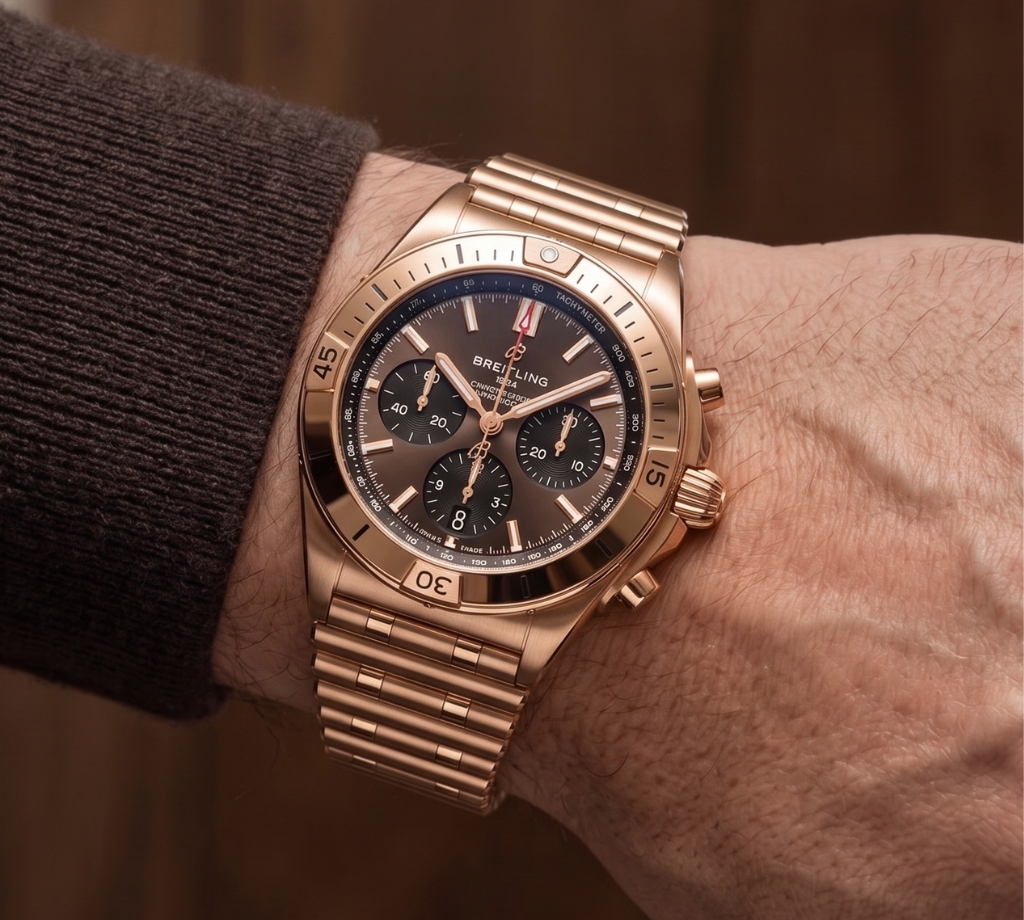
You own a Breitling — a Navitimer, a Chronomat, a Superocean, or perhaps a vintage piece from the brand’s aviation heritage. You’re considering liquidating it or borrowing against it. Before you act, it is worth understanding exactly how Breitling holds value in the secondary market and what separates a specialist appraisal from a generalist guess.
Vasco Assets offers both private luxury watch sales and collateral loans against high-end timepieces, providing certified valuations, discreet transactions, and returns that reflect what your Breitling is genuinely worth — not what a pawn shop or online platform decides to offer.
How Breitling Holds Value in the Secondary Market
A Brand with a Deep but Nuanced Market
Breitling occupies a distinctive position in the secondary market. The brand has nearly 140 years of history, a loyal collector base, and a heritage rooted in aviation and precision instrumentation. However, its secondary market performance is more reference-dependent than brands like Rolex, which means the model you own matters enormously when it comes to what you can expect to receive.
Which References Perform Best
The Navitimer leads Breitling’s lineup in resale value, with iconic pieces retaining 60–70% of their retail price and certain vintage AOPA-logo references attracting significant collector premiums. The Chronomat B01 42 — housing Breitling’s proprietary in-house calibre — has appreciated from its 2020 launch price, reflecting strong collector demand for movements built in-house. Limited editions tied to aviation and motorsport partnerships, and discontinued references in particular, consistently outperform standard production models in the secondary market.
The Calibre Premium
One of the most important valuation variables for Breitling is whether the watch contains a COSC-certified in-house calibre such as the B01. Models housing proprietary movements — the Premier B01, the Chronomat B01, the Navitimer B01 — carry meaningfully stronger secondary market values than those powered by outsourced or ETA-based movements. A Premier B01 Chronograph or Chronomat B01 42 typically trades between $5,500 and $7,000 in good condition with documentation. At Vasco Assets, movement provenance is always factored into the appraisal.
Why Your Breitling Doesn’t Have One Resale Price — It Has a Liquidity Curve
Depreciation Is Not a Flat Rule
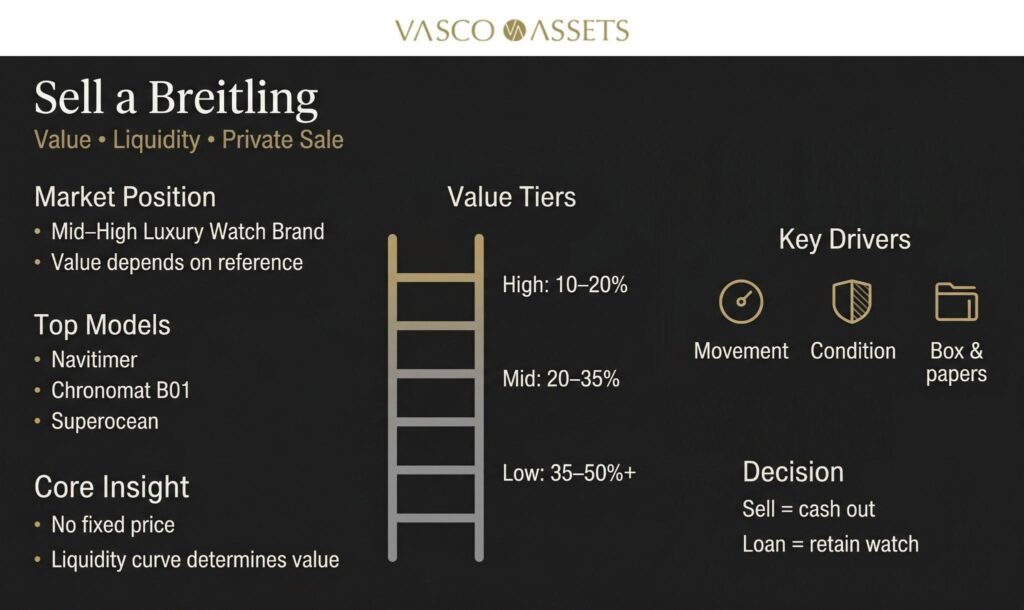
Most explanations of Breitling resale value rely on a simplified assumption: that watches lose a fixed percentage of value, typically 20–30% below retail. This framing is misleading because it treats depreciation as a flat rule rather than a function of market liquidity and demand depth. In reality, luxury watches behave more like financial assets traded in thin markets, where price is determined by how quickly and easily a specific reference can be absorbed by buyers at different price levels.
How Liquidity Funnels Shape Price
Academic research on market microstructure shows that prices in thin markets are shaped by liquidity funnels, where supply and demand are unevenly distributed around the current price, causing non-linear price impact rather than uniform depreciation. In other words, value is not lost evenly — it is discounted based on how deep the buyer pool is for each reference. This creates a liquidity discount curve rather than a single resale percentage, and it explains why two Breitlings of similar retail price can yield dramatically different outcomes at exit.
The Three Tiers of Breitling Liquidity
Highly liquid references — the Navitimer B01 and Chronomat B01 — typically trade with tight spreads of around 10–20%, reflecting strong buyer demand and fast turnover. Mid-tier models such as the Premier or Superocean Heritage sit in a broader 20–35% liquidity band, where demand exists but is more selective. Low-liquidity or quartz and ETA-driven references often require discounts of 35–50% or more to clear the market due to slower resale velocity and narrower buyer pools.
Liquidity, Not Depreciation, Defines Exit Value
The distinction is critical: depreciation suggests loss over time, but liquidity explains price variation at exit. As financial theory on asset pricing shows, valuation depends not only on intrinsic worth but also on how quickly an asset can be converted into cash under real market conditions. Breitling pricing is not a straight line of depreciation — it is a curve defined by market depth. Knowing where your specific reference sits on that curve is the first thing a specialist appraisal from Vasco Assets will tell you.
What Your Breitling Is Actually Worth
The Role of Documentation
As with all luxury watches, documentation is not peripheral — it is value. A Breitling with its original box, hang tags, chronometric certificate, and warranty card commands a measurable premium over an unpapered example of the same reference. The FTC’s Jewelry Guides reinforce that accurate representation of a luxury item’s provenance and authenticity is a baseline standard — and one that only specialist appraisers are equipped to apply correctly.
Condition Factors That Affect Your Offer
Beyond documentation, condition drives offer levels significantly. Case polishing that removes sharpness from original edges, crystal replacement, aftermarket bracelets, and non-original dials all reduce secondary market desirability. Specialist appraisers at Vasco Assets are trained to identify these factors and price them accurately — ensuring that sellers understand exactly what their specific example is worth in current market conditions, not what the most optimistic listing on a marketplace suggests.
Should You Sell Your Breitling or Borrow Against It?
When Selling Is the Right Move
Selling makes the most sense when the need for capital is long-term, when the watch no longer fits your collection strategy, or when you no longer wear it. For sellers who have moved on from the piece, a private sale through a trusted specialist delivers immediate, final liquidity without ongoing obligation. This is especially true for models that have appreciated — where locking in today’s market price makes strategic sense before any market correction.
The Tax Case for Knowing Before You Sell
Before proceeding, it is worth understanding the tax implications. The IRS classifies luxury watches sold at a gain as collectibles, potentially subject to a maximum federal capital gains rate of 28% on long-term gains. If your Breitling has appreciated, the net proceeds after tax may be meaningfully lower than the sale price. A tax professional should be consulted before completing a significant sale — and this is one reason borrowing is sometimes the more tax-efficient path when the capital need is temporary.
When a Collateral Loan Makes More Sense
If you still value owning the watch and need liquidity for a defined period, a collateral loan from Vasco Assets may be the smarter option. Loan terms run 30 to 120 days with no credit check required. Your watch is stored securely and returned in full upon repayment. For those considering a securities-backed alternative, the Financial Industry Regulatory Authority (FINRA) cautions that these facilities carry risks including potential forced liquidation if portfolio values decline — a risk that a watch-backed loan does not carry.
What to Avoid When Selling a Breitling
Pawn Shops and Generalist Buyers
Pawn shops and generalist buyers are not equipped to differentiate between a Breitling with an in-house B01 movement and one with an outsourced calibre, nor do they track secondary market demand by reference. The result is an offer that reflects the lowest common denominator — typically 20–30 cents on the dollar — rather than the watch’s real market position. For a Chronomat B01 or a vintage Navitimer, that gap can represent thousands of dollars in unrealized value.
Online Platforms and Their Hidden Costs
Selling through peer-to-peer online platforms introduces counterparty risk, authentication fraud, and fee structures that erode net proceeds. eBay’s final value fees for luxury watches range from 5.5% to 7.8% on high-value transactions — and that is before shipping, insurance, and the time cost of managing a listing. A private sale through Vasco Assets eliminates these costs entirely, delivering a clean, direct transaction with no surprises.
Vasco Assets: Expert Breitling Appraisal and Private Sale
Specialist Knowledge, Not Generalist Guesswork
Vasco Assets is a private international investment firm based in Newport Beach, California, with certified expertise across luxury watches, jewelry, diamonds, gold, and rare collectibles. Their appraisers actively follow secondary market data for Breitling across all major references — Navitimer, Chronomat, Superocean, Avenger, and vintage models — ensuring that every offer reflects real current market conditions rather than outdated price guides or conservative wholesale floors.
A Process Built for High-Net-Worth Sellers
The process begins with a complimentary TruValue valuation. Once Vasco’s certified appraisers assess your watch, you receive a transparent, liquidity-adjusted offer based on actual market data. If you accept, payment is issued promptly with no commissions, no listing delays, and no fraud risk. Contact Vasco Assets or call 949.674.3575 to schedule your appraisal — no obligation, no pressure, and a result in as little as 24 hours.
FAQs
1. How does Vasco Assets determine the value of my Breitling?
Vasco Assets uses a certified TruValue appraisal process that accounts for the specific reference, movement calibre, condition, documentation, and current secondary market data. Movement provenance — particularly whether the watch houses an in-house B01 calibre — is a significant factor in the final offer, as is where the reference sits on the liquidity curve.
2. Why do two Breitling watches of similar retail price receive different offers?
Breitling resale value follows a liquidity curve, not a flat depreciation rate. Highly liquid references like the Navitimer B01 and Chronomat B01 trade with tight discounts of 10–20%, while mid-tier or ETA-driven models may require discounts of 35–50% to find buyers. A specialist appraisal from Vasco Assets tells you exactly where your reference sits on that curve.
3. Will I owe capital gains tax when I sell my Breitling?
Potentially. The IRS classifies collectibles — including luxury watches sold at a profit — as subject to a maximum federal capital gains rate of 28% on long-term gains. Consult a tax professional before selling a significantly appreciated timepiece to understand your net proceeds after tax.
4. Can I borrow against my Breitling instead of selling it?
Yes. Vasco Assets offers collateral loans against Breitling watches and other luxury timepieces, with loan terms of 30 to 120 days, no credit check required, and funds available in as little as 24 hours. Your watch is stored securely and returned in the same condition upon full repayment.
5. Does documentation really affect the sale price of a Breitling?
Yes — significantly. A Breitling with its original box, hang tags, warranty card, and chronometric certificate commands a measurable premium over an unpapered example of the same reference. Vasco’s appraisers factor every element of your watch’s presentation into the offer.
6. Why is a private sale through Vasco better than selling online?
Online platforms charge final value fees of 5.5–7.8% on high-value watch transactions, introduce counterparty fraud risk, and require significant time to manage. Vasco Assets provides a direct, private sale with no fees, no fraud exposure, and payment issued promptly upon agreement — with a certified appraisal ensuring the offer reflects genuine market value.
7. Can I sell other watches or luxury assets at the same time?
Yes. Vasco Assets buys across a wide range of luxury categories including other watch brands, jewelry, diamonds, gold, fine art, and rare collectibles. Multiple assets can be evaluated together in a single confidential transaction, streamlining the process for sellers with broader collections.