
Sell Audemars Piguet Royal Oak: Private Asset Loans & Liquidation

You own an Audemars Piguet Royal Oak — a 15500ST, a Jumbo 15202, a Royal Oak Offshore, or perhaps a vintage reference from the collection that redefined luxury watchmaking in 1972. You are ready to sell or borrow against it. Before engaging with any buyer or lender, understanding exactly how the Royal Oak performs in the secondary market — and which exit path your specific reference belongs in — will determine how much capital you actually receive.
Vasco Assets offers private luxury watch acquisitions and collateral loans against high-end timepieces, providing certified appraisals, immediate capital, and outcomes that reflect what your specific Royal Oak reference is genuinely worth in today’s market.
The Royal Oak’s Position in the Secondary Market
A Watch That Changed Luxury Watchmaking in 1972
Audemars Piguet commissioned Gérald Genta to design the Royal Oak in 1972. The result — a stainless steel sports watch priced at a gold watch premium, with an exposed octagonal bezel, hexagonal screws, and an integrated metal bracelet — initially bewildered retailers and critics.
Within years it became the most important luxury sports watch ever made. The 15500ST currently trades at approximately $44,000 on the secondary market against a retail of $29,900 — a 48% premium that has stabilized after compressing from 2022 peaks and appears sustainable based on current depth data.
What the Secondary Market Data Shows
The Royal Oak’s secondary market spans a wide range depending on reference, generation, and configuration. Standard selfwinding references like the 15400ST and 15500ST typically trade between $33,000 and $48,000.
The Jumbo 15202ST trades around $65,000, reflecting its purist collector identity and limited production. Vintage original Royal Oak references — particularly the 5402ST from the 1970s — regularly sell for $100,000 to $500,000+ depending on condition and series. Steel models in excellent condition with complete documentation retain 85–120% of retail value.
The Reference-Level Divergence
The 15500ST has 136 comparable data points in verified secondary market indices — one of the deepest liquidity pools in the luxury watch market. The Jumbo 15202, by contrast, trades in a narrower, more collector-specific environment where documentation and generation differentiation produce materially different outcomes. The Royal Oak Offshore operates as a separate collector market from the core Royal Oak, with different buyer profiles, different price bands, and different exit path requirements. At Vasco Assets, identifying which reference you own — and which market it trades in — is the first step of every appraisal.
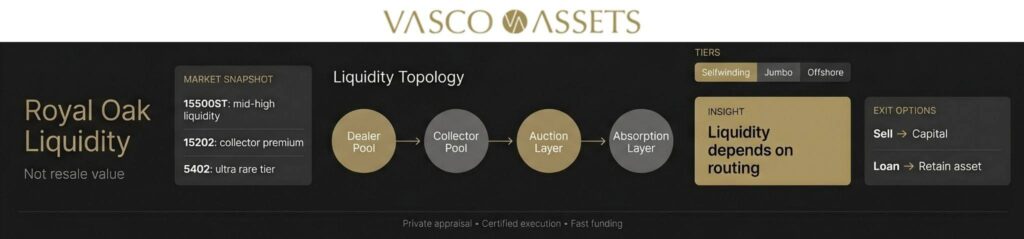
The Royal Oak Has a Liquidity Topology, Not a Resale Value
Why “Retention” Is the Wrong Frame
Most Royal Oak resale content compresses the entire secondary market into a single idea: retention. You’ll see phrases like “trades above retail,” “strong value preservation,” or simple hierarchies such as Jumbo > Selfwinding > Offshore. This framing treats liquidity as a single smooth curve per model — when in reality, the Royal Oak does not behave like a single-price system at all. The more accurate way to understand it is as a liquidity topology: a structured map of exit channels, each defined by different clearing speeds, buyer segmentation, and embedded execution discounts.
What Financial Market Research Confirms
Federal Reserve research on market liquidity formation consistently shows that transaction outcomes are shaped by matching efficiency and intermediation frictions rather than static valuation alone. BIS market structure analysis documents how asset markets fragment into segmented pools with different frictions and clearing mechanisms. Applied to the Royal Oak, this means that how an asset is routed through the market — not just what it is worth in isolation — determines the realized price.
The Four Exit Layers of the Royal Oak Market
The Royal Oak can be understood through four distinct exit layers. The instant-clearing dealer pool covers high-liquidity references like the 15500ST, where depth allows near-immediate absorption with tight bid-ask spreads. The specialist collector pool covers Jumbo and vintage references such as the 15202 and 5402, requiring targeted buyer matching and generating the highest realized prices for correctly documented examples.
The auction-discovered pricing layer applies to rare dials and historical references, where price is revealed through competitive bidding rather than continuous market depth. The inventory-absorption layer covers Offshore and less liquid configurations, where dealers price in holding risk and capital lock cost before any negotiation begins.
The Topology Changes the Central Question
This structure reframes the entire selling decision. The correct question is not “what does a Royal Oak retain?” but “which exit layer does my specific reference occupy, and which execution path minimizes friction within that layer?” A specialist like Vasco Assets who understands this topology — and can route each reference to the appropriate pool — produces outcomes that single-curve resale content cannot predict or deliver.
What Your Royal Oak Is Actually Worth
Generation, Reference, and Configuration
For the Royal Oak, generation-level differences produce material pricing variation within the same model family. The 15400ST, 15500ST, and 16202ST are not interchangeable — each commands a different secondary market level based on movement generation, dial configuration, and collector preference at that specific moment. At Vasco Assets, generation-level identification is always part of the appraisal rather than a generic reference-level estimate.
Documentation and the Full Set Premium
A Royal Oak presented with its original box, tools, warranty card, and service records commands a measurable premium over an incomplete example — and for the Jumbo family and vintage references, completeness of documentation determines which exit layer the piece can access. The FTC’s Jewelry Guides reinforce that accurate representation of a luxury item’s provenance and authenticity is a standard only specialist appraisers are equipped to apply. Bracelet condition, dial originality, and the absence of aftermarket modifications are all factored into the offer at Vasco Assets.
Should You Sell Your Royal Oak or Borrow Against It?
When Selling Is the Right Decision
Selling makes the most sense when the need for capital is long-term, when the watch no longer fits your collection, or when a reference has stabilized at a premium you wish to lock in. The Royal Oak’s secondary market premium has compressed from its 2022 peak — selling now into a stabilized rather than speculative market is a realistic outcome for most references. A private acquisition through Vasco Assets delivers immediate, final liquidity with a certified appraisal reflecting current conditions across the correct exit layer.
The Tax Dimension
Before completing a sale, tax implications deserve careful consideration. The IRS classifies collectibles — including luxury watches sold at a gain — as subject to a maximum federal capital gains rate of 28% on long-term gains. For a Royal Oak purchased below its current secondary market level, the net proceeds after tax may be meaningfully lower than the headline sale price. A tax professional should be consulted before completing any significant transaction.
When a Collateral Loan Is Smarter
If you still value the piece and your capital need is short-term, a collateral loan from Vasco Assets preserves long-term ownership while accessing immediate liquidity. Loan terms run 30 to 120 days with no credit check required, and your watch is stored securely and returned in full upon repayment. For those considering securities-backed credit as an alternative, the Financial Industry Regulatory Authority (FINRA) cautions that these facilities carry risks including potential forced liquidation if portfolio values decline — a risk that a watch-backed loan does not carry.
Vasco Assets: Private Royal Oak Acquisition and Expert Lending
The Execution Architecture That Matches Each Reference to Its Exit Layer
Vasco Assets is a private international investment firm based in Newport Beach, California, with certified expertise across luxury watches, jewelry, diamonds, gold, and rare collectibles. Their appraisers follow the Royal Oak secondary market actively — across the 15500ST, 15202 Jumbo, Royal Oak Offshore, complications, and vintage references — identifying which exit layer each piece belongs in and routing it to the execution path that minimizes friction and maximizes clearing price.
Immediate Funding, Maximum Discretion
The process begins with a complimentary TruValue valuation. Once Vasco’s certified appraisers assess your Royal Oak, you receive a transparent, topology-adjusted offer based on actual market data. If you accept, payment is issued promptly — no commissions, no listing delays, no friction embedded in the price. Contact Vasco Assets or call 949.674.3575 to schedule your appraisal — no obligation, no pressure, and a result in as little as 24 hours.
FAQs
1. How does Vasco Assets determine the value of my Royal Oak?
Vasco Assets uses a certified TruValue appraisal process that accounts for the specific reference number and generation, configuration, condition, documentation completeness, and current secondary market depth data. Critically, the appraisal identifies which of the four exit layers — instant-clearing dealer pool, specialist collector pool, auction-discovered pricing, or inventory-absorption — best serves the piece, producing a topology-adjusted offer rather than a generic retention percentage.
2. Why does the same Royal Oak reference receive different offers from different buyers?
Because the Royal Oak has a liquidity topology, not a single resale value. Different exit layers produce different outcomes for the same reference. A 15500ST routed to the instant-clearing dealer pool produces a tighter spread; the same watch handled by a generalist absorption desk has holding cost embedded before any negotiation. A specialist from Vasco Assets identifies the correct layer and routes accordingly.
3. Will I owe capital gains tax when I sell my Royal Oak?
Potentially. The IRS classifies collectibles — including luxury watches sold at a gain — as subject to a maximum federal capital gains rate of 28% on long-term gains. For a Royal Oak purchased below its current secondary market level, consult a tax professional before completing the sale to understand your net proceeds after tax.
4. Can I borrow against my Royal Oak instead of selling it?
Yes. Vasco Assets offers collateral loans against Royal Oak watches and other luxury timepieces, with loan terms of 30 to 120 days, no credit check required, and funds available in as little as 24 hours. Your watch is stored securely and returned in the same condition upon full repayment.
5. Does having original box, tools, and papers affect the sale price of a Royal Oak?
Yes — significantly. A full-set Royal Oak with original box, AP tools, warranty card, and service records commands a measurable premium over an incomplete example. For Jumbo and vintage references, documentation completeness determines which exit layer the piece can access. Vasco’s appraisers factor every element of presentation into the offer.
6. Why is a private sale through Vasco better than an online marketplace?
Online platforms charge final value fees of 5.5–7.8% on high-value transactions, introduce fraud risk, and route every piece into the peer-to-peer layer regardless of which exit layer would better serve it. Vasco Assets identifies the correct exit layer for each reference, with no fees, no fraud exposure, and payment issued promptly on agreement.
7. Can I sell other watches or luxury assets alongside my Royal Oak?
Yes. Vasco Assets acquires a broad range of luxury assets including other watch brands, fine jewelry, diamonds, gold, fine art, and rare collectibles. Multiple items can be evaluated together in a single confidential transaction, streamlining the process for sellers with broader collections.