
Lab Grown Diamond Resale Value: Why Natural Stones Hold and Lab Stones Don’t
You own a beautiful diamond, and now you want to know what it’s worth. Maybe you’re upgrading, settling an estate, or raising cash for a new venture. The answer depends on one question many owners never thought to ask at the counter: was your stone mined from the earth or grown in a lab?
At Vasco Assets, our certified diamond buyers see this gap in nearly every valuation. With over 150 years of combined luxury-buying experience, our team gives owners an honest, market-based picture of what their stones will bring. Here’s why natural diamonds keep a real resale market and lab-grown stones rarely do.
Why Lab-Grown Diamond Resale Value Keeps Falling
Lab-grown diamonds are physically and chemically identical to mined diamonds, but they are manufactured, and manufacturing scales. Their prices have dropped dramatically because global production capacity grew far faster than consumer demand. At the direct-to-consumer level, prices have fallen roughly 88% since January 2020.
Supply also keeps rising. China now produces more than 60 percent of the world’s synthetic diamonds, and its lab-grown exports jumped 65.3 percent year over year in the first half of 2026. When an identical new stone gets cheaper every year, few buyers will pay much for a used one.
Why Natural Diamonds Hold Their Value Better
Natural diamonds are finite. Each one formed deep underground over hundreds of millions of years, and mines eventually run dry. That scarcity supports a global trading network of dealers, manufacturers, auction houses, and collateral lenders who stand ready to buy a mined stone on any given day.
To be fair, natural prices are not immune to market swings. Natural diamond prices recently fell to their lowest levels in more than two decades, though larger and higher-quality stones held up better while smaller, lower-grade stones felt more pressure from lab-grown alternatives. Natural prices may fluctuate, but the buyer base never disappears.
The Three Numbers That Determine What Your Diamond Is Really Worth
A diamond can carry three different values, which explains why a resale offer may fall well below your purchase price. Retail replacement value, often used in insurance appraisals, estimates the cost to replace your piece at retail, markups included. The National Association of Insurance Commissioners offers guidance on understanding those policy terms.
Private-sale value is what an individual might pay, though finding and vetting a serious buyer takes time. Dealer purchase value reflects what a professional will pay today based on demand, resale potential, and holding risk. The Gemological Institute of America (GIA) explains why grading reports and appraisals can’t predict your cash offer.
What Resale Offers Actually Look Like
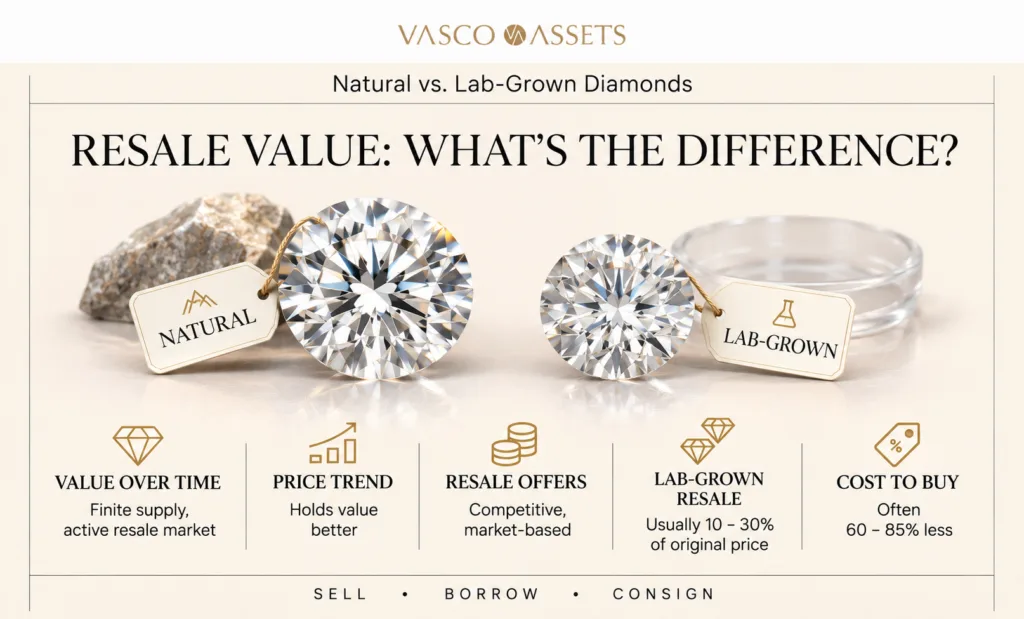
For lab-grown owners, the numbers can be sobering. One jeweler reports that lab-grown stones typically resell for 10–30% of their price, often less, with no established secondary market to speak of. Many retailers won’t buy them back at all, or will offer only store credit toward a new purchase.
Natural diamonds are priced differently. Offers are anchored to live wholesale trading values, so a well-cut, certified natural stone has a real, verifiable floor. Competitive buyers bid against that benchmark, which is why working with certified diamond buyers often beats a local jeweler’s quick offer.
Certification, Size, and Quality Drive the Number
For natural diamonds, a grading report from GIA or another respected lab gives buyers confidence about cut, color, clarity, and carat. Rarer combinations, especially larger stones with strong color and clean clarity, attract the most competitive offers. A missing or outdated report can quietly reduce what you’re paid.
Lab-grown certification works differently. Since GIA stopped issuing 4Cs reports for colorless lab-grown stones, IGI has become the working standard for lab certification. A report confirms exactly what you own, but it can’t create resale demand where little exists.
Should You Still Buy a Lab-Grown Diamond?
Lab-grown stones make sense if your goal is maximum size and sparkle for your budget. They generally cost a fraction of mined stones of comparable quality, often 60–85% less. Just treat the purchase as a consumer good you’ll enjoy wearing, not an asset you’ll cash out later.
If you want something you can sell, borrow against, or pass down with lasting value, natural is the stronger choice. Lab-grown center stones made up 61% of engagement ring sales in 2025, according to The Knot, so understanding this difference matters more than ever.
How Vasco Assets Helps You Unlock Your Diamond’s Value
Vasco Assets gives you more than one path forward. You can sell your diamond outright, use our consignment services to reach industrial buyers and accredited investors, or borrow against your stone through collateral loans and the LuxLoc line of credit. Sure Secure Shipping lets clients worldwide work with us safely.
The process starts with a free online valuation. Tell us about your diamond, receive an estimate, and then our certified buyers evaluate it in person to give you our best price. Based in Newport Beach, we’ve earned over 100 five-star reviews on Google and Yelp by communicating clearly, with no hidden agendas.
Know What Your Diamond Is Really Worth
Natural and lab-grown diamonds may look identical, but the resale market treats them very differently. Lab-grown stones face relentless price pressure and a thin secondary market. Natural diamonds, while not immune to cycles, keep a global network of buyers and a value you can actually convert into cash or credit.
If you own a natural diamond, now is the time to learn what it’s truly worth. Request your free valuation from Vasco Assets, or call our certified diamond buyers at 949.674.3575. We’ll give you an honest assessment and help you choose the smartest next step.
Frequently Asked Questions
Do lab-grown diamonds have any resale value?
Some, but usually very little. Because new lab-grown stones keep getting cheaper to produce, the secondary market offers only a small fraction of the original retail price. Many jewelers decline to buy them back at all, and those that do often offer store credit instead of cash.
If you’re shopping now, plan to keep a lab-grown stone long term. Its value lies in how it looks and what it means to you, not in what it might bring back later.
Why do natural diamonds hold value better than lab-grown diamonds?
Natural diamonds are finite and can’t be manufactured on demand. That scarcity supports a deep global network of dealers, manufacturers, and lenders who trade mined stones every day. Lab-grown diamonds can be produced in virtually unlimited quantities, so used stones compete directly with cheaper new ones.
Have natural diamond prices dropped too?
Yes, natural prices have softened in recent years due to weaker demand and competition from lab-grown stones. However, larger and higher-quality natural diamonds have held up better than smaller, lower-grade stones. Even in a soft market, natural diamonds retain active buyers and a measurable trading value.
The key is knowing which value you’re comparing. An insurance appraisal reflects retail replacement cost, while a dealer offer reflects today’s wholesale market, so the two figures will rarely match.
Will lab-grown diamond prices recover?
A full recovery appears unlikely. Most market observers do not expect lab-grown prices to return to 2020 or 2021 levels. That said, declines are slowing, and one-carat rounds rose 1% year over year in Q2 2026, the first time that size has firmed since lab-grown went mainstream.
How can I tell if my diamond is natural or lab-grown?
Start with your grading report, which will state the stone’s origin. Many diamonds also carry a microscopic laser inscription on the girdle that matches the report number. If you have no paperwork, a qualified gemologist can use specialized testing equipment to confirm the origin, which is part of any professional valuation.
Knowing your stone’s origin before you sell protects you from surprises. It also helps you set realistic expectations and compare offers from different buyers on equal terms.
Does a GIA certificate increase my diamond’s resale value?
A respected grading report doesn’t change the stone itself, but it removes uncertainty for buyers. That confidence typically translates into stronger, faster offers for natural diamonds. If your stone has no report or an outdated one, our team can advise whether certification is worth the cost before you sell.
For lab-grown stones, an IGI report confirms quality but won’t meaningfully raise resale offers. Its main benefit is accurate identification for insurance and future owners.
Can I borrow against my diamond instead of selling it?
Yes. Vasco Assets offers collateral loans and the LuxLoc line of credit, letting you access cash while keeping ownership of your diamond. This option works best for natural stones and other luxury assets with established market values. Contact our team to discuss terms that fit your situation.
Borrowing can make sense when you need short-term liquidity but plan to keep the piece, or when the market is soft and you’d rather wait for stronger pricing before selling.