
Sell Vacheron Constantin: Luxury Asset Loans & Liquidation

You own a Vacheron Constantin — an Overseas, a Patrimony, a Traditionnelle, or perhaps a Grand Complication from one of the world’s oldest continuously operating watch manufacturers. You are ready to sell or borrow against it. Before engaging with any buyer or lender, understanding how Vacheron Constantin actually performs in the secondary market — and which channel your specific reference belongs in — will determine how much capital you actually receive.
Vasco Assets offers private luxury watch acquisitions and collateral loans against high-end timepieces, providing certified appraisals, immediate capital, and outcomes that reflect real secondary market conditions rather than a generalist’s flat brand discount.
Vacheron Constantin’s Position in the Secondary Market
270 Years of History and a Highly Concentrated Market
Founded in 1755 in Geneva, Vacheron Constantin is the oldest continuously operating watch manufacturer in the world. That heritage creates genuine collector credibility — but it does not translate into uniform secondary market liquidity. The Chrono24 ChronoPulse index reveals a striking concentration: the Overseas collection and its 222 ancestor account for approximately 80% of Vacheron Constantin’s secondary market transaction volume. Collections like the Patrimony, Traditionnelle, and Métiers d’Art represent the brand’s horological depth but command far smaller buyer pools.
What the Secondary Market Data Shows
The Overseas Self-Winding in stainless steel retails around $25,000 and trades between $30,000 and $33,000 on the secondary market — a 15–25% premium above retail. Blue dial configurations, dual-time models, and perpetual calendar variants attract additional collector premiums. The Patrimony and Traditionnelle, by contrast, trade below retail for most configurations. Grand Complication and Métiers d’Art pieces occupy a separate tier entirely: auction-dependent, event-driven, and highly reliant on matching the right collector at the right moment.
The Internal Liquidity Divide
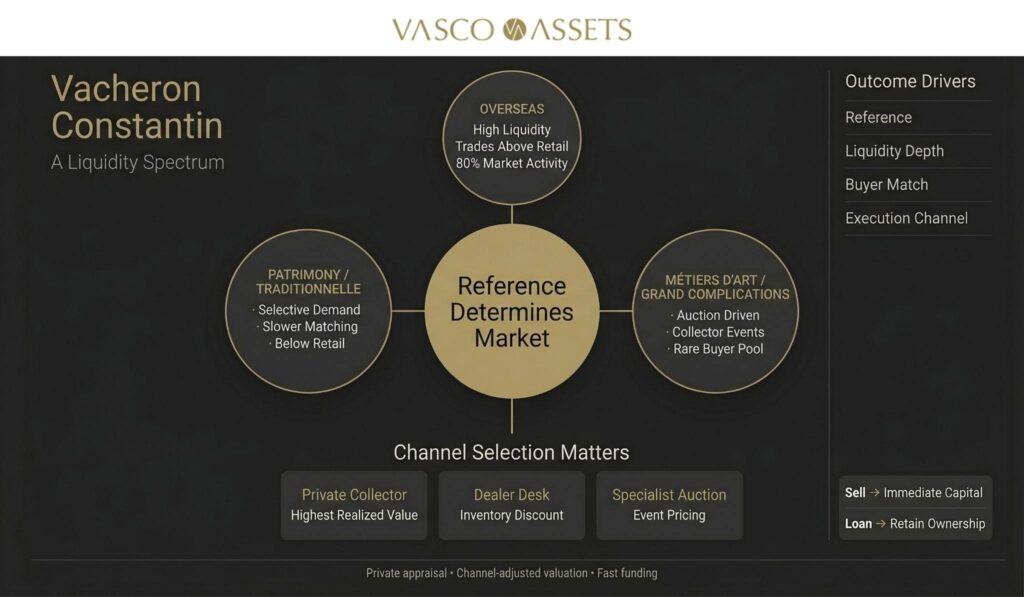
The data point that most Vacheron resale content overlooks is the extreme internal divide. The Overseas behaves like a continuously traded luxury sports watch with a defined buyer profile. Everything else in the catalog, however distinguished technically or artistically, operates in a thinner, more episodic market where the right channel matters more than the headline brand name. At Vasco Assets, identifying which side of that divide your piece occupies is the first step of every appraisal.
Vacheron Constantin Is Not One Market — It Is a Liquidity Spectrum
Why Brand-Level Retention Rates Are Structurally Misleading
Most Vacheron Constantin resale content reduces value to a brand-level shorthand: “Overseas holds value best,” “Patrimony loses value,” or “VC retains 60–75% of retail.” This framing appears across dealer blogs and secondary-market summaries, but it hides the actual pricing mechanism. Vacheron Constantin does not behave as a single valuation curve. It operates as a reference-level liquidity map where each model clears in a fundamentally different market structure.
Reference-Level Variance Exceeds 40 Percentage Points
Secondary market data consistently shows this dispersion. The Overseas 4500V and 4520V function as a high-liquidity micro-market, with steel references often trading at or above retail due to continuous demand and tight bid-ask spreads. Patrimony and Traditionnelle references frequently trade 25–40% below retail, reflecting thinner dealer absorption and slower inventory turnover. At the far end of the spectrum, Métiers d’Art and Grand Complication pieces clear in auction-driven, episodic liquidity events, where pricing is determined less by listing value and more by competitive collector convergence.
Multiple Liquidity Regimes Operating Simultaneously
A single brand-level retention metric is structurally misleading. The more accurate model is that Vacheron Constantin spans multiple liquidity regimes simultaneously, with reference-level variance exceeding 40 percentage points depending on execution channel and market depth. The Bank for International Settlements confirms that in dealer-intermediated markets, prices are shaped not just by supply and demand, but by liquidity depth, inventory holding costs, and execution constraints.
The Reference Number Determines the Market Itself
In practice, this reframes value entirely. Vacheron Constantin is not a single resale market — it is a tiered liquidity system where the reference number determines the market itself. A buyer offering a flat “VC discount” regardless of reference is applying the wrong model to the wrong piece. Understanding which liquidity regime your specific reference occupies — and routing it to the channel that matches — is what Vasco Assets delivers where generalist buyers cannot.
Vacheron Constantin as a Three-Channel Pricing System
Why Collection-Level Segmentation Misses the Real Mechanism
Even with the liquidity spectrum understood, Vacheron’s secondary market adds another execution layer. The brand trades across three structurally distinct channels, each with its own pricing logic. The channel a piece enters determines the outcome more than the reference itself — which means two identical Vacheron watches can produce materially different results depending entirely on where they are taken.
The Retail-to-Collector Private Channel
The first channel is the retail-to-end-buyer private transfer, where specialist intermediaries connect Overseas references, Grand Complications, and vintage Historiques pieces directly to collectors. Here, pricing is driven by scarcity, provenance, and buyer urgency — with no institutional spread compression. This is where Vacheron’s premium references achieve their highest realized prices, particularly for the Overseas perpetual calendar, ultra-thin tourbillon, and vintage references from the brand’s history.
The Dealer Absorption Desk and Specialist Auction Channels
The second channel is the dealer absorption desk, where professional buyers price based on balance-sheet constraints and inventory recycling speed. Federal Reserve research on market frictions confirms that execution environment materially changes realized price outcomes — for Vacheron’s slower-moving dress references, the absorption desk discount is the pricing of storage, time, and exit uncertainty. The third channel applies to the brand’s highest-tier complications: specialist auction, where Grand Complications and Métiers d’Art pieces achieve event-driven results through competitive bidding — not continuous market depth.
Routing Determines Outcome
The same Vacheron Constantin reference can produce materially different values depending on which channel absorbs it. A generalist buyer defaults to the dealer absorption desk — the channel that serves their capital recycling, not the seller’s realized price. A specialist like Vasco Assets identifies which of the three channels best serves each specific reference and routes it to the appropriate liquidity regime.
What to Avoid When Selling a Vacheron Constantin
Generalist Buyers Who Apply a Single Retention Rate
Generalist buyers and pawn shops apply a flat brand discount without understanding which liquidity regime your piece occupies, which channel it belongs in, or how far the reference-level variance within the Vacheron catalog actually runs. For a Grand Complication or vintage Historiques reference that belongs in the collector private channel or specialist auction, that mismatch can represent tens of thousands of dollars in unrealized value.
Platform Fees and the Wrong Channel Problem
Peer-to-peer platforms introduce counterparty fraud and eBay’s final value fees of 5.5–7.8% on high-value transactions — before shipping, insurance, and the time cost of managing a listing. More critically, they route every piece into the peer-to-peer channel regardless of whether the collector private channel would serve it better. A private acquisition through Vasco Assets removes all of that friction and routes the piece to the channel that maximizes the realized price.
Vasco Assets: Private Vacheron Constantin Acquisition and Expert Lending
Expertise Across Every Reference, Channel, and Liquidity Regime
Vasco Assets is a private international investment firm based in Newport Beach, California, with certified expertise across luxury watches, jewelry, diamonds, gold, and rare collectibles. Their appraisers follow Vacheron Constantin’s secondary market actively — across Overseas, Patrimony, Traditionnelle, Métiers d’Art, Grand Complications, and vintage references — identifying which liquidity regime and which exit channel each piece belongs in, and pricing accordingly.
Immediate Funding, Maximum Discretion
The process begins with a complimentary TruValue valuation. Once Vasco’s certified appraisers assess your Vacheron, you receive a transparent, channel-adjusted offer based on actual market data. If you accept, payment is issued promptly — no commissions, no listing delays, no fraud exposure. Contact Vasco Assets or call 949.674.3575 to schedule your appraisal — no obligation, no pressure, and a result in as little as 24 hours.
FAQs
1. How does Vasco Assets determine the value of my Vacheron Constantin?
Vasco Assets uses a certified TruValue appraisal process that accounts for the specific reference, generation, movement type, Geneva Seal documentation, strap configuration completeness, condition, and current secondary market data. Critically, the appraisal also identifies which liquidity regime and exit channel best serves your specific piece — maximizing the realized price rather than defaulting to the most conservative option.
2. Why does the same brand produce such different resale outcomes across its collections?
Vacheron Constantin is not a single resale market — it is a tiered liquidity system where the reference number determines the market itself. The Overseas operates in a high-liquidity micro-market with tight spreads; Patrimony and Traditionnelle trade 25–40% below retail in a thinner absorption environment; Métiers d’Art and Grand Complications clear episodically through specialist auction. Reference-level variance exceeds 40 percentage points. A specialist from Vasco Assets identifies the right regime and routes your piece accordingly.
3. Will I owe capital gains tax when I sell my Vacheron Constantin?
Potentially. The IRS classifies collectibles — including luxury watches sold at a gain — as subject to a maximum federal capital gains rate of 28% on long-term gains. For an Overseas trading above retail or an appreciated complication, consult a tax professional before completing the sale to understand your net proceeds after tax.
4. Can I borrow against my Vacheron Constantin instead of selling it?
Yes. Vasco Assets offers collateral loans against Vacheron Constantin watches and other luxury timepieces, with loan terms of 30 to 120 days, no credit check required, and funds available in as little as 24 hours. Your watch is stored securely and returned in the same condition upon full repayment.
5. Does having box, papers, and the complete strap set affect the sale price?
Yes — significantly. A full-set Vacheron Constantin Overseas with all three interchangeable straps, original box, and warranty card commands a measurable premium over an incomplete example. For Grand Complications and vintage references, documentation including Geneva Seal certification can be the difference between a standard market offer and a collector-grade result.
6. Why is a private sale through Vasco better than an online marketplace?
Online platforms charge final value fees of 5.5–7.8% on high-value transactions, introduce fraud risk, and route every piece into the peer-to-peer channel regardless of which liquidity regime would better serve it. Vasco Assets routes each piece to the optimal exit channel, with no fees, no fraud exposure, and payment issued promptly on agreement.
7. Can I sell other watches or luxury assets alongside my Vacheron Constantin?
Yes. Vasco Assets acquires a broad range of luxury assets including other watch brands, fine jewelry, diamonds, gold, fine art, and rare collectibles. Multiple items can be evaluated together in a single confidential transaction, streamlining the process for sellers with broader collections.