
Sell Designer Jewelry: Premier Asset Monetization for Luxury Pieces

You own signed jewelry from one of the great houses — Van Cleef & Arpels, Bulgari, Tiffany & Co., Harry Winston, Chanel, Chopard, or another recognized maison. You are considering liquidating it, borrowing against it, or simply understanding what it is genuinely worth in today’s market. The answer is more nuanced — and more valuable — than most buyers will tell you.
Vasco Assets offers private luxury jewelry acquisitions and collateral loans against high-value signed pieces, providing certified appraisals, immediate capital, and outcomes that reflect what designer jewelry from the world’s leading houses actually commands in the secondary market today.
Why the Designer Signature Changes Everything
Signed Pieces Outperform Unsigned by a Measurable Margin
A designer signature is not decorative — it is financial. Signed pieces from recognized luxury houses command a 25–30% premium over comparable unsigned pieces of equivalent gold weight and stone quality in the secondary market. That premium reflects provenance, brand liquidity, auction visibility, and the collector demand that sustained heritage creates. For the strongest houses — Cartier, Van Cleef & Arpels, and Harry Winston — that premium is not just maintained over time. It grows.
The Broader Market Confirms the Trend
Van Cleef & Arpels saw a 35% increase in auction values between 2020 and 2025, with the Alhambra collection appreciating 20% in the year through 2025 alone. The Real Real’s 2025 Resale Report identifies Van Cleef & Arpels Alhambra as among the top-appreciating luxury assets, ahead of most luxury watches and all major handbag categories. With gold trading above $5,000 per ounce in early 2026, the material floor beneath gold-set designer pieces has also risen sharply — compressing downside risk while the brand premium creates upside potential.
Each House Is a Stacked Liquidity Structure, Not a Single Market
The Simplified Brand Average Misses the Real Mechanism
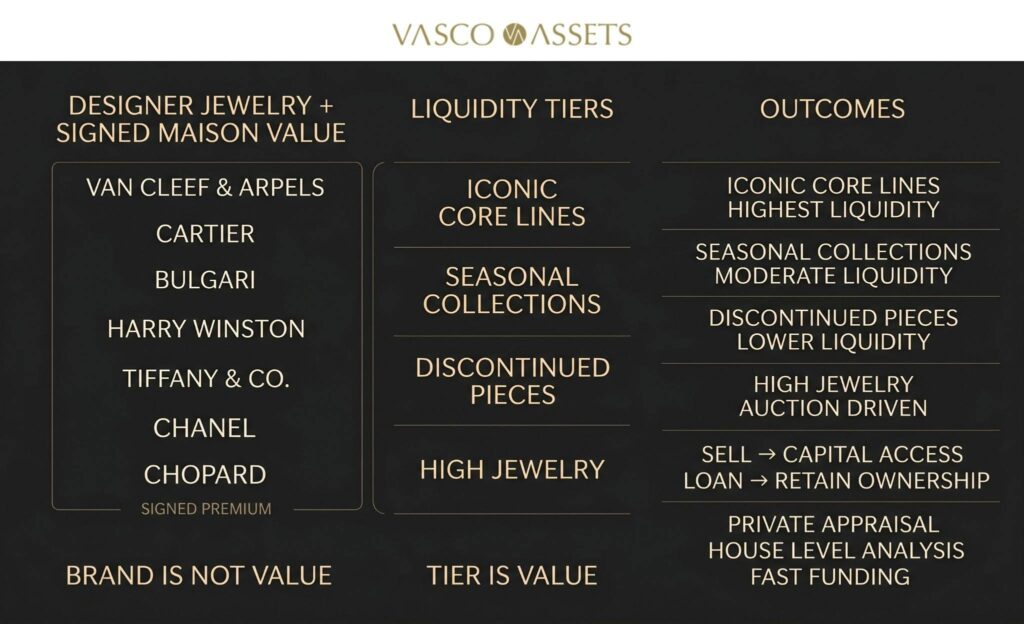
Most market explanations of designer jewelry value rely on a simplified assumption: that a house like Cartier, Van Cleef & Arpels, or Tiffany & Co. behaves as a single, unified resale profile. In reality, each maison operates as a stacked liquidity structure, where different product families clear at fundamentally different speeds, spreads, and buyer depths. Brand averages like “112% retention” obscure the real structure — what determines outcome is not the maison alone, but which liquidity tier within that maison your piece occupies at the moment of sale.
Four Tiers of Liquidity Within Each House
At the top sit iconic core lines — Cartier’s Love bracelet, Van Cleef & Arpels’ Alhambra — which benefit from deep global buyer pools, frequent transaction flow, and tight bid-ask spreads. These pieces behave more like continuously traded assets, with faster absorption and more stable pricing. In the middle are fashion or seasonal jewelry lines, where demand is thinner and pricing is more sensitive to condition, timing, and presentation. Below that are discontinued, niche, or less-recognized references, which often shift into auction-dependent liquidity where pricing is episodic rather than continuous.
High Jewelry as an Event-Driven Asset
At the far end of the spectrum are high jewelry and one-off creations, where value is largely event-driven, negotiated individually, and highly dependent on collector alignment rather than market depth. A Harry Winston diamond suite sold at Sotheby’s Geneva achieves a result shaped by room competition and auction timing — not by a continuous secondary market bid. This is a fundamentally different pricing mechanism than the Love bracelet, even within a portfolio that includes both.
What Research Confirms About Stacked Liquidity
This stratification is consistent with how liquidity functions in dealer-based markets, where price formation is heavily influenced by inventory risk and holding constraints. The Bank for International Settlements confirms that price is shaped as much by how long a dealer must hold an asset as by who eventually buys it. Federal Reserve research further shows that market depth and execution urgency materially affect realized pricing even within the same asset category. And from a compliance standpoint, the FTC’s Jewelry Guides assume that valuation depends on specific material and contextual factors — not brand-level generalizations — reinforcing why a tiered, reference-specific appraisal is the only approach that produces accurate outcomes.
The Leading Houses and Their Market Positions
Van Cleef & Arpels, Cartier, and the Top Tier
Van Cleef & Arpels leads the signed jewelry secondary market in 2025, with pieces averaging 112% of retail value retention and the Sweet Alhambra bracelet reaching 117%. About 90% of Alhambra pieces sell within 30 days of listing — liquidity that rivals the most traded Rolex references. Cartier’s Love and Juste un Clou follow at 95–97%, with tight bid-ask spreads and fast clearing cycles across their core lines. Both houses demonstrate what top-of-the-liquidity-stack performance looks like in practice.
Bulgari, Harry Winston, and Tiffany
Bulgari occupies a strong mid-position — particularly for vintage Serpenti and B.zero1 pieces, and 1960s–1970s archive jewelry that has outperformed the broader estate market. Harry Winston sits at the ultra-high end, where rarity and exceptional gemstone quality drive outcomes that are auction-clearing dependent rather than continuously traded. Tiffany & Co. retains 50–70%, with platinum and vintage gold pieces significantly outperforming the brand’s silver collections — a clear example of the liquidity tiers operating within a single house. At Vasco Assets, every appraisal identifies which tier within the house your specific piece occupies, not just which house it came from.
Should You Sell Your Designer Jewelry or Borrow Against It?
When Selling Is the Right Decision
Selling is the right choice when the need for capital is long-term, when the piece no longer fits your collection, or when a reference has reached a pricing peak you wish to lock in. For sellers who have moved on from the piece, a private acquisition through Vasco Assets delivers immediate, final liquidity — with a certified appraisal ensuring the price reflects the piece’s genuine position in today’s market.
The Tax Dimension
Before completing a sale, the tax implications deserve careful consideration. The IRS classifies collectibles — including fine jewelry sold at a gain — as subject to a maximum federal capital gains rate of 28% on long-term gains. For Van Cleef, Cartier, and Harry Winston pieces that have appreciated significantly, the net proceeds after tax may be meaningfully lower than the headline sale price. A tax professional should be consulted before completing any significant transaction.
When a Collateral Loan Is Smarter
If you still value the piece and your capital need is short-term, a collateral loan from Vasco Assets preserves long-term ownership while unlocking immediate liquidity. Loan terms run 30 to 120 days with no credit check required, and your piece is stored securely and returned in full upon repayment. For those considering securities-backed credit as an alternative, the Financial Industry Regulatory Authority (FINRA) cautions that these facilities carry risks including potential forced liquidation if portfolio values decline — a risk that a jewelry-backed loan does not carry.
What to Avoid When Selling Designer Jewelry
Generalist Buyers Who Price Metal, Not Maison
Generalist buyers and pawn shops price designer jewelry against metal weight and generic stone estimates — not against the brand premium, tier-specific demand, or the collector market that makes signed pieces from the great houses worth significantly more than their material components. The result is a systematic undervaluation that can represent tens of thousands of dollars in unrealized capital for a well-documented Alhambra collection or a rare Harry Winston suite.
Platform Fees and Auction Commission Structures
Peer-to-peer platforms introduce counterparty fraud and eBay’s final value fees of 5.5–7.8% on high-value transactions before shipping and insurance. Auction houses charge 15–25% commission on the hammer price and operate on extended timelines. A private acquisition through Vasco Assets delivers certified, market-accurate pricing and immediate payment with no commissions, no delays, and no fraud exposure.
Vasco Assets: Private Acquisition and Expert Lending for Signed Jewelry
Expertise Across Every Major House and Every Liquidity Tier
Vasco Assets is a private international investment firm based in Newport Beach, California, with certified expertise across signed jewelry from all major luxury houses — Van Cleef & Arpels, Cartier, Bulgari, Harry Winston, Tiffany & Co., Chanel, Chopard, and others — alongside diamonds, luxury watches, gold, and rare collectibles. Their appraisers follow the secondary market actively at the house and reference level, identifying which liquidity tier each piece occupies and pricing accordingly.
Immediate Funding, Maximum Discretion
The process begins with a complimentary TruValue valuation. Once Vasco’s certified appraisers assess your piece, you receive a transparent, liquidity-adjusted offer based on actual market data. If you accept, payment is issued promptly — no commissions, no listing delays, no fraud exposure. Contact Vasco Assets or call 949.674.3575 to schedule your appraisal — no obligation, no pressure, and a result in as little as 24 hours.
FAQs
1. Which designer jewelry brands does Vasco Assets acquire?
Vasco Assets acquires signed pieces from all major luxury jewelry houses including Van Cleef & Arpels, Cartier, Bulgari, Harry Winston, Tiffany & Co., Chanel, Chopard, Graff, Boucheron, Chaumet, and others. A complimentary TruValue valuation will confirm the offer for your specific piece and its position within the house’s liquidity structure.
2. Why does the same house produce such different resale outcomes across its collections?
Each maison is a stacked liquidity structure, not a single resale market. Iconic core lines like the Love bracelet or Alhambra sit at the top — continuously traded with tight spreads. Seasonal, discontinued, or niche references occupy middle and lower tiers with slower turnover and wider discounts. High jewelry sits at the bottom as an event-driven asset. A specialist appraisal from Vasco Assets identifies exactly which tier your piece occupies and prices accordingly.
3. Will I owe capital gains tax when I sell my designer jewelry?
Potentially. The IRS classifies collectibles — including fine jewelry sold at a gain — as subject to a maximum federal capital gains rate of 28% on long-term gains. For significantly appreciated pieces from major houses, consult a tax professional before selling to understand your net proceeds after tax.
4. Can I borrow against my designer jewelry instead of selling it?
Yes. Vasco Assets offers collateral loans against signed jewelry and other luxury assets, with loan terms of 30 to 120 days, no credit check required, and funds available in as little as 24 hours. Your piece is stored securely and returned in the same condition upon full repayment.
5. Does having original packaging and documentation affect the sale price?
Yes — significantly. Original boxes, certificates of authenticity, purchase receipts, and service records contribute to the provenance premium that drives the strongest secondary market outcomes for designer jewelry. A GIA-certified stone in a signed setting is appraised with greater confidence and supports a stronger offer. Vasco’s appraisers factor every element of your piece’s presentation into the valuation.
6. Why is a private sale through Vasco better than auction or online platforms?
Auction houses charge 15–25% commissions and operate on extended timelines. Online platforms charge 5.5–7.8% in final value fees and introduce fraud risk. Vasco Assets provides a direct, private acquisition with no fees, no delays, and payment issued promptly on agreement — with a certified appraisal ensuring the offer reflects genuine tier-level market value.
7. Can I sell multiple pieces from different houses in one transaction?
Yes. Vasco Assets evaluates collections across multiple houses simultaneously — Van Cleef & Arpels, Cartier, Bulgari, Harry Winston, and others — in a single confidential transaction. Each piece is appraised at its own tier level, and the combined valuation may unlock a more comprehensive offer across the full portfolio.