
Sell Cartier Jewelry: Private Liquidation for High-Value Collections
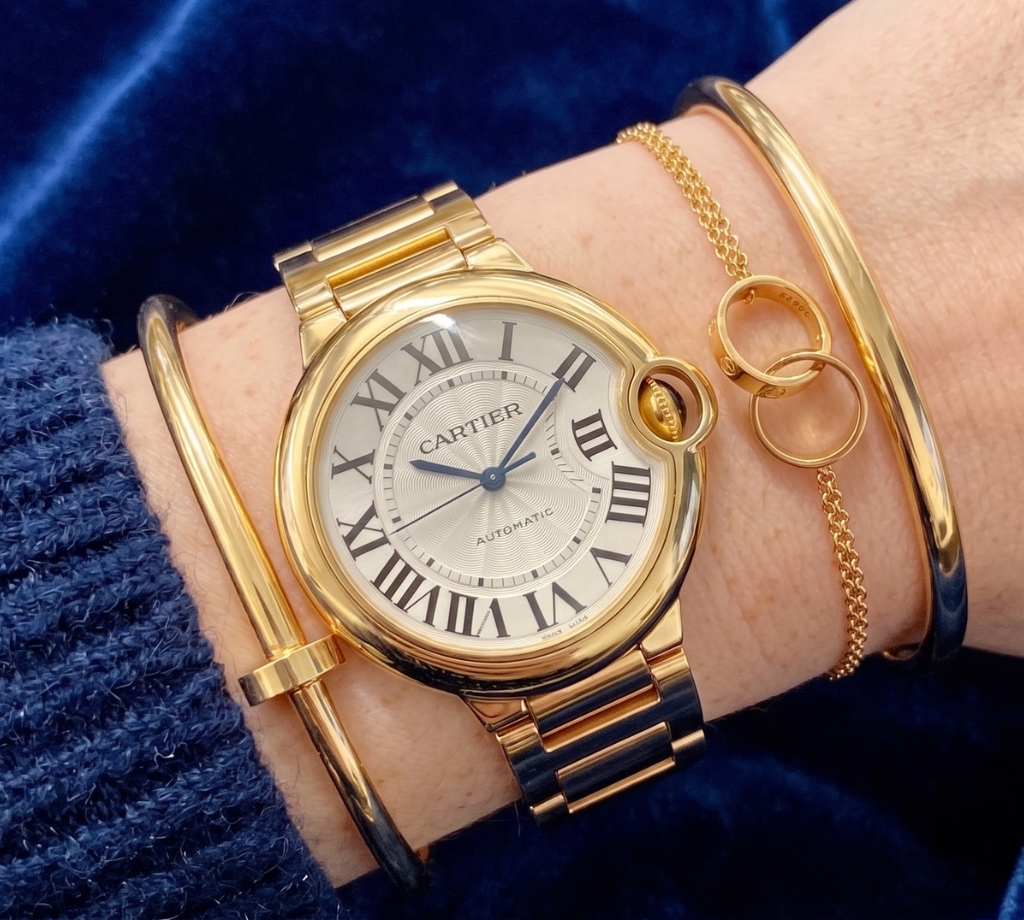
You own Cartier — a Love bracelet, a Juste un Clou, a Panthère piece, or perhaps a high jewelry creation from one of the world’s most recognized luxury houses. You are ready to liquidate some or all of it, and you need to know what it is genuinely worth before you engage with any buyer.
Vasco Assets offers private luxury jewelry acquisitions and collateral loans against high-value pieces, providing certified appraisals, immediate capital, and outcomes that reflect the genuine secondary market conditions that make Cartier one of the strongest-performing jewelry assets in the world.
Why Cartier Holds Value Unlike Almost Any Other Jewelry Brand
Value Retention That Outperforms Luxury Broadly
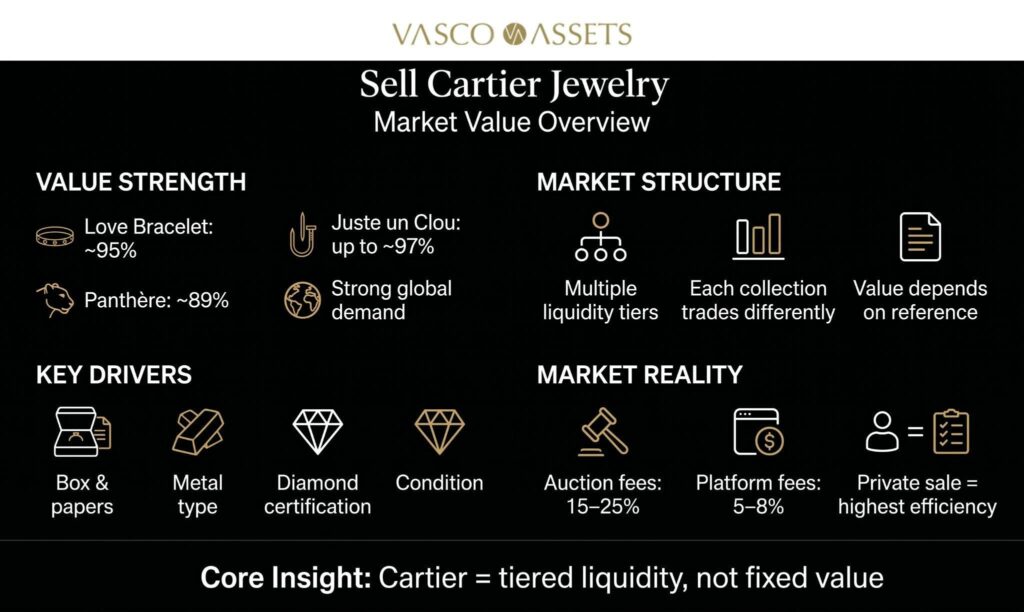
Cartier jewelry occupies a category that few luxury goods can match in secondary market performance. The Juste un Clou leads the brand’s lineup with resale values up to 97% of retail — outperforming the average luxury watch, handbag, and nearly every competing jewelry house. The Love bracelet follows at approximately 95%, the Amulette de Cartier at 93%, the Panthère de Cartier at 89%, and the Trinity at around 82%. The average luxury handbag retains 30–40% of retail. The average luxury watch, excluding Rolex sport references, retains 50–70%. Cartier’s flagship pieces are not performing like luxury goods — they are performing like commodities with a brand premium attached.
The Auction Market Tells the Same Story
The global auction market for Cartier jewelry exceeded 250 million euros in 2024 — a 37% increase over three years. Animal jewelry, particularly the Panthère collection, recorded average value growth of 55% between 2020 and 2025. Belle Époque and Art Deco Cartier pieces achieve an average premium of 80% above high estimates at major auction houses. These are not isolated results — they reflect a structural shift in how serious collectors and institutional buyers approach signed Cartier pieces at every tier of the market.
What Gold Prices Add to the Picture
With gold trading above $5,000 per ounce in early 2026 — up more than 70% year-on-year — the intrinsic material value of Cartier’s gold pieces has appreciated significantly alongside their brand premium. For gold-heavy pieces like the Love bracelet, now retailing at $7,950 in yellow gold, the material floor provides meaningful downside protection that most luxury collectibles lack. At Vasco Assets, both the brand premium and the material value are factored into every appraisal.
Cartier’s Internal Spreads: Why a Single Retention Rate Is Misleading
The Uniform Retention Claim Is Incomplete
Most competitors describe the Love Bracelet, Juste un Clou, and Panthère de Cartier under a single simplified claim: “Cartier retains 85–95% of retail value.” That framing is incomplete because it assumes a uniform resale rate across the brand. In reality, Cartier operates as a liquidity system with internal spreads, where each collection behaves like a distinct micro-market with its own bid depth, turnover speed, and price elasticity. By collapsing Cartier into a single retention percentage, most resale content produces a structured misleading picture rather than a genuine liquidity hierarchy.
The Love Bracelet, Juste un Clou, and Panthère Behave Differently
The Love Bracelet sits at the top of liquidity efficiency: globally recognized, heavily standardized, and frequently traded, resulting in tight bid-ask spreads and fast clearing cycles. The Juste un Clou remains highly liquid, but slightly more elastic — pricing varies by configuration, metal, and condition in ways that the Love does not. The Panthère introduces a different dynamic entirely: valuation is often event-driven, with pricing spikes tied to collector demand and auction visibility rather than continuous trading depth.
High Jewelry Operates as a Thinly Traded Asset
At the opposite end of the spectrum, high jewelry Cartier pieces behave more like thinly traded assets, where pricing is not continuous but auction-clearing dependent. This creates wider spreads and higher volatility between asking and realized prices. A piece that achieves a strong result at Sotheby’s Geneva does not imply the same outcome in a private sale — the channel, the audience, and the timing all shape the realized price in ways that a static retention percentage cannot capture.
What the Research Confirms
This structure aligns with broader market research on liquidity fragmentation and price impact under constrained depth. The Bank for International Settlements highlights how dealer markets exhibit varying liquidity conditions based on inventory risk and holding capacity. Federal Reserve research similarly shows that price formation is heavily influenced by market depth rather than headline demand alone. Understanding where your specific Cartier piece sits within this internal spread structure — and choosing a specialist like Vasco Assets who appraises at the reference level — is what determines the gap between what your piece is worth and what you actually receive.
What Your Cartier Is Actually Worth
The Documentation Premium for Signed Pieces
For Cartier, documentation is not peripheral — it is foundational. Original boxes, certificates of authenticity, purchase receipts, and service records each contribute to the provenance that drives premium pricing at every tier of the market. The FTC’s Jewelry Guides reinforce that accurate representation of a luxury piece’s authenticity and history is a standard only specialist appraisers are equipped to apply. A Love bracelet with its original red box and papers commands measurably more than an unpapered example — and a signed Haute Joaillerie piece with full provenance documentation can command a multiple of an equivalent without it.
Stone Quality, Metal, and Condition
Beyond documentation, the quality and certification of any accompanying stones, metal type and karat, condition, and the absence of aftermarket modifications all drive the final offer. GIA-certified diamonds in Cartier settings receive more confident appraisals and stronger loan-to-value ratios because independent grading removes valuation uncertainty. Specialist appraisers at Vasco Assets are trained to assess all of these variables and reflect them accurately in the valuation.
Should You Sell Your Cartier or Borrow Against It?
When Selling Is the Right Decision
Selling makes the most sense when the need for capital is permanent, when the piece no longer fits your collection, or when a high-performing reference has reached a secondary market peak you wish to lock in. For Cartier sellers who have moved on from a piece, a private acquisition through Vasco Assets delivers immediate, final liquidity — with a certified appraisal ensuring the price reflects genuine reference-level conditions.
The Tax Dimension
Before completing a sale, tax implications deserve consideration. The IRS classifies collectibles — including fine jewelry sold at a gain — as subject to a maximum federal capital gains rate of 28% on long-term gains. Given how significantly certain Cartier pieces have appreciated, the net proceeds after tax may be meaningfully lower than the headline sale price. A tax professional should be consulted before completing any significant transaction.
When a Collateral Loan Is Smarter
If you still value the piece and your capital need is short-term, a collateral loan from Vasco Assets preserves long-term ownership while accessing immediate liquidity. Loan terms run 30 to 120 days with no credit check required, and your piece is stored securely and returned in full upon repayment. For those considering securities-backed credit as an alternative, the Financial Industry Regulatory Authority (FINRA) cautions that these facilities carry risks including potential forced liquidation if portfolio values decline — a risk that a jewelry-backed loan does not carry.
Vasco Assets: Private Cartier Acquisition and Expert Lending
Specialist Knowledge Across the Cartier Range
Vasco Assets is a private international investment firm based in Newport Beach, California, with certified expertise across fine jewelry, diamonds, luxury watches, gold, and rare collectibles. Their appraisers follow Cartier’s secondary market actively — across Love, Juste un Clou, Panthère, Trinity, Haute Joaillerie, and vintage signed pieces — ensuring every offer reflects real current conditions at the reference level, not a blanket retention percentage.
Immediate Capital, No Friction
The process begins with a complimentary TruValue valuation. Once Vasco’s certified appraisers assess your piece, you receive a transparent, liquidity-adjusted offer based on actual market data. If you accept, payment is issued promptly — no commissions, no listing delays, and no fraud exposure. Contact Vasco Assets or call 949.674.3575 to schedule your appraisal — no obligation, no pressure, and a result in as little as 24 hours.
FAQs
1. How does Vasco Assets determine the value of my Cartier jewelry?
Vasco Assets uses a certified TruValue appraisal process that accounts for the specific collection and reference, metal type and karat, stone quality and certification, condition, documentation, provenance, and current secondary market data. Whether your piece is a standard Love bracelet or a signed Haute Joaillerie creation, the appraisal reflects its actual position in Cartier’s internal spread hierarchy.
2. Why does a single retention percentage fail to describe Cartier’s secondary market accurately?
Cartier operates as a liquidity system with internal spreads, not a single asset class. The Love bracelet clears fast with tight bid-ask spreads, the Juste un Clou is slightly more elastic by configuration, the Panthère is event-driven, and high jewelry pieces are auction-clearing dependent. Each behaves as a distinct micro-market. A specialist appraisal from Vasco Assets prices each piece according to its actual position in that hierarchy.
3. Will I owe capital gains tax when I sell my Cartier jewelry?
Potentially. The IRS classifies collectibles — including fine jewelry sold at a gain — as subject to a maximum federal capital gains rate of 28% on long-term gains. Given how significantly certain Cartier pieces have appreciated, consult a tax professional before selling to understand your net proceeds after tax.
4. Can I borrow against my Cartier jewelry instead of selling it?
Yes. Vasco Assets offers collateral loans against Cartier jewelry and other luxury assets, with loan terms of 30 to 120 days, no credit check required, and funds available in as little as 24 hours. Your piece is stored securely and returned in the same condition upon full repayment.
5. Does documentation affect the sale price of my Cartier?
Yes — significantly. Original boxes, certificates of authenticity, purchase receipts, and service records all contribute to the provenance premium that drives Cartier’s strongest secondary market outcomes. Vasco’s appraisers factor every element of your piece’s presentation into the offer.
6. Why is a private sale through Vasco better than auction or online platforms?
Auction houses charge 15–25% commissions and operate on extended timelines. Online platforms charge 5.5–7.8% in final value fees and introduce fraud risk. Vasco Assets provides a direct, private acquisition with no fees, no delays, and payment issued promptly on agreement — with a certified appraisal ensuring the offer reflects genuine reference-level market value.
7. Can I sell other jewelry or luxury assets alongside my Cartier?
Yes. Vasco Assets acquires a broad range of luxury assets including other signed jewelry brands, diamonds, luxury watches, gold, fine art, and rare collectibles. Multiple pieces can be evaluated together in a single confidential transaction, streamlining the process for sellers with broader collections.