
Sell Richard Mille: Asset Loans & Liquidation
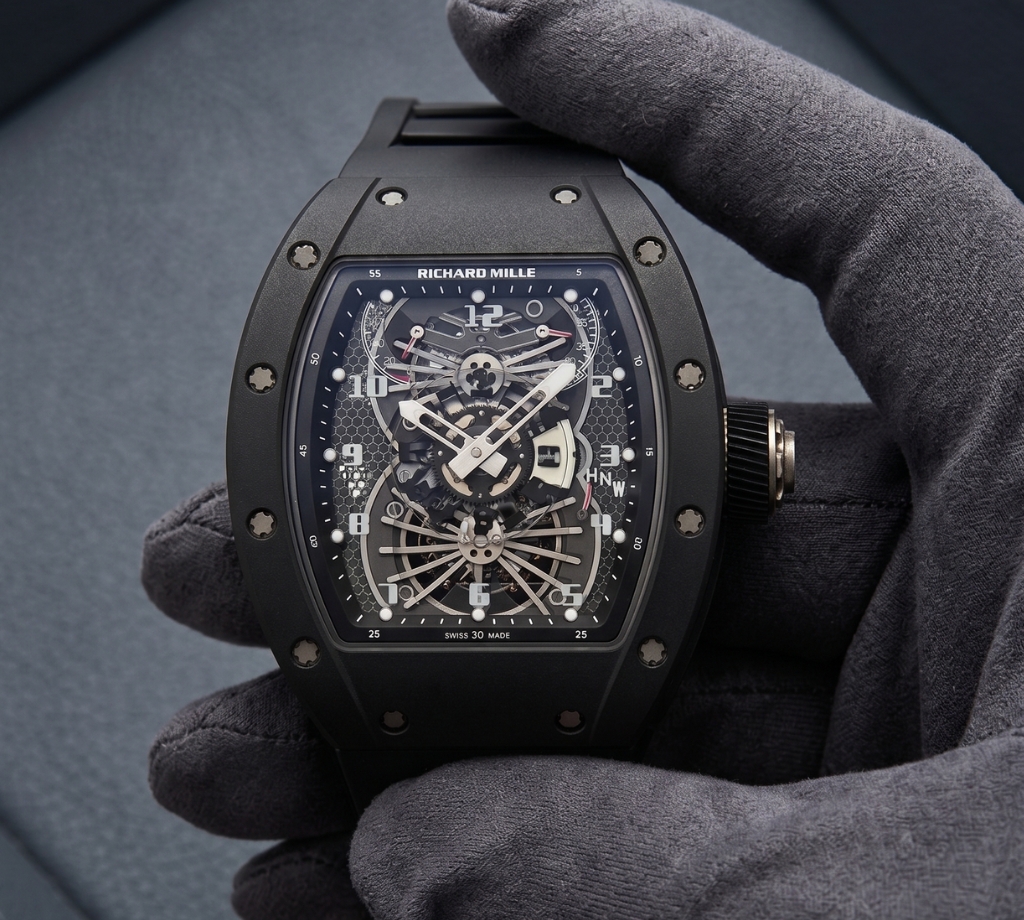
You own a Richard Mille — an RM 011, an RM 055, an RM 027, or perhaps a limited tourbillon from one of the most exclusive watch manufacturers in the world. You are considering liquidating it or borrowing against it. Before engaging with any buyer or lender, understanding how Richard Mille actually performs in the secondary market — and which channel your specific reference belongs in — will determine how much capital you actually receive.
Vasco Assets offers private luxury watch acquisitions and collateral loans against high-end timepieces, providing certified appraisals, immediate capital, and outcomes that reflect real secondary market conditions for one of the most complex and high-value watch categories in the world.
Richard Mille’s Position in the Secondary Market
Ultra-Limited Production and Exceptional Value Retention
Richard Mille produces fewer than 5,500 watches annually — an extraordinarily small number for a brand with global collector demand. That scarcity, combined with celebrity and motorsport associations and the use of aerospace-grade materials like Carbon TPT, Grade 5 titanium, and ATZ ceramic, has created a secondary market where most references trade at or above retail.
The RM 055 Bubba Watson originally retailed around $100,000 at its 2015 launch and now trades above $440,000. The RM 011 Felipe Massa has seen pre-owned values climb as much as 150% over retail. These are not outliers — they are the expected outcome for well-selected, well-documented references from a brand that controls supply with unusual discipline.
The Internal Divide: Celebrity References vs. Core Catalog
Not every Richard Mille reference appreciates, and this is the distinction most resale content glosses over. Celebrity-associated references — the RM 027 Rafael Nadal, the RM 055 Bubba Watson, the RM 035 Rafael Nadal — benefit from scarcity, documented sporting use, and global collector visibility. Core catalog pieces without strong celebrity or limited-edition identity can trade below their original retail price.
The RM 010 in rose gold, once a core catalog piece, now clears below MSRP at auction. Understanding which side of that divide your piece occupies is the most important variable before any sale or loan decision.
The Liquidity Challenge That Even Appreciating References Face
Richard Mille is largely absent from major secondary market tracking indices because transaction volumes are too low for meaningful statistical tracking. This is not a weakness of the brand — it is a structural feature of ultra-luxury markets where fewer buyers, higher price points, and longer timelines define the execution environment. A popular Rolex can sell through dozens of channels in days. A Richard Mille appraises well on paper but realizing that value requires the right buyer network. At Vasco Assets, that network is the core asset.
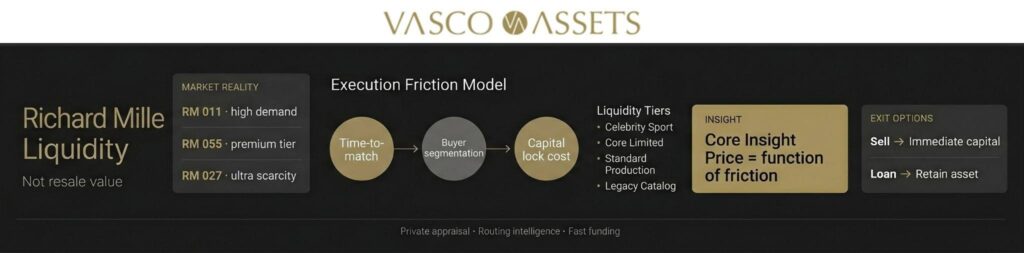
Richard Mille Is Not a Price System — It Is an Execution-Friction Economy
The Framing Most Competitors Get Wrong
Most competitors frame Richard Mille as a premium retention story — emphasizing scarcity, celebrity association, and the idea that “RM often trades above retail.” This framing is incomplete because it assumes that price is a stable attribute of the asset itself. In reality, realized value in the Richard Mille secondary market is not determined by price levels, but by execution conditions. Richard Mille value is not a price — it is a settlement discount curve determined by execution friction.
Three Variables That Govern Friction
Three variables govern this friction. First is time-to-match, which ranges from near-instant execution for highly networked celebrity references to multi-month settlement cycles for less liquid configurations. Second is buyer segmentation, where collector demand, dealer absorption capacity, and allocator-driven purchasing power each operate in separate liquidity pools with different willingness-to-pay thresholds.
Third is capital lock cost, where intermediaries adjust bids not based on desirability of the watch, but on the opportunity cost of holding $200,000–$1,000,000 in illiquid inventory while waiting for the right exit.
Price as a Function of Friction, Not Intrinsic Value
This reframes the entire pricing model. A Richard Mille is not “worth” a single number — it is a distribution of possible outcomes shaped by liquidity delay and matching probability. The Bank for International Settlements confirms that in dealer-intermediated markets, prices are shaped by inventory risk and holding costs rather than headline demand alone. Federal Reserve research on market frictions further confirms that execution environment materially changes realized price outcomes. The same reference can clear at materially different levels depending on routing efficiency, not intrinsic value.
Why Routing Efficiency Is the Real Valuation Variable
Competitors treat Richard Mille price as static — a number attached to a reference. In practice, it behaves like a function of friction. The difference between an RM 027 sold through a specialist with an active buyer relationship and the same watch offered to a dealer absorption desk with no known buyer is not a negotiating gap. It is a structural difference in execution architecture. Understanding this is why working with a specialist like Vasco Assets — who operates within the buyer networks that reduce friction to near-zero for the right references — changes the outcome more than any other single factor.
Richard Mille as a Four-Tier Liquidity Structure
The Four Tiers That Govern Outcomes
Richard Mille’s secondary market operates across four distinct liquidity tiers, each with fundamentally different execution dynamics. At the top sit celebrity sport references — RM 027, RM 035, RM 055, RM 011 — where documented scarcity, sporting provenance, and global collector visibility create fast-clearing markets with strong bid support and tight time-to-match. Below that sit active sport references and limited editions — the RM 11-03, RM 67-02, and collaboration pieces — where demand is real but matching requires a more specific buyer relationship.
The Lower Tiers and Their Pricing Logic
Further down sit standard production references in precious metals or gem-set configurations, where the buyer pool narrows significantly and capital lock costs widen the friction discount. At the base sit older catalog references without celebrity or limited-edition status — where collector depth is thin, time-to-match is longest, and pricing is anchored by auction clearing rather than continuous market demand. An RM 010 in rose gold trading below retail sits in this tier, regardless of its underlying material value. Knowing which tier your reference occupies — and routing it to the channel that minimizes friction — is the determinant of outcome that most sellers never receive.
What Your Richard Mille Is Actually Worth
Reference, Generation, Material, and Provenance
For Richard Mille, six variables move a reference up or down within its tier: the exact reference number and generation, case material, celebrity or sporting association, production count, condition and service history, and documentation completeness. An RM 011 is not just an RM 011 — the 11-01, 11-02, 11-03, and Felipe Massa variants command different prices, sometimes by 40% within the same reference family. At Vasco Assets, all six variables are assessed and reflected in the appraisal.
The Documentation Premium
Original box, papers, service records, and any documentation of sporting use or limited-edition provenance materially affect both the offer and the time-to-match. The FTC’s Jewelry Guides reinforce that accurate representation of a luxury item’s provenance and authenticity is a standard only specialist appraisers are equipped to apply. For the RM 027 or RM 056 series, where fewer than 50 pieces may exist globally, complete documentation is not peripheral — it is the primary determinant of which buyer pool the piece can access and how quickly friction can be reduced to zero.
Vasco Assets: Private Richard Mille Acquisition and Expert Lending
The Buyer Network That Reduces Friction to Near-Zero
Vasco Assets is a private international investment firm based in Newport Beach, California, with certified expertise across luxury watches, jewelry, diamonds, gold, and rare collectibles. Their network and appraisal process is specifically designed for high-value, low-volume assets — including Richard Mille references across all tiers — where realizing full value requires matching the right piece to the right buyer with minimal execution friction, not applying a generic brand discount.
Immediate Capital Against Ultra-High-Value Assets
The process begins with a complimentary TruValue valuation. Once Vasco’s certified appraisers assess your Richard Mille, you receive a transparent, routing-adjusted offer based on actual market data and active buyer network intelligence. If you accept, payment is issued promptly — no commissions, no listing delays, no friction embedded in the price. Contact Vasco Assets or call 949.674.3575 to schedule your appraisal — no obligation, no pressure, and a result in as little as 24 hours.
FAQs
1. How does Vasco Assets determine the value of my Richard Mille?
Vasco Assets uses a certified TruValue appraisal process that accounts for the exact reference number and generation, case material, celebrity or sporting association, production count, condition, service history, documentation completeness, and current secondary market data. Critically, the appraisal also assesses execution friction — time-to-match, buyer segmentation, and capital lock cost — to produce a routing-adjusted offer that reflects real clearing price rather than a static price band.
2. Why does the same Richard Mille reference receive materially different offers from different buyers?
Because Richard Mille value is not a price — it is a settlement discount curve shaped by execution friction. Time-to-match, buyer segmentation, and capital lock costs all produce different bid levels for the same piece depending on who is making the offer. A generalist absorbs maximum friction into their discount; a specialist with active buyer relationships eliminates it. Vasco Assets operates within the networks that minimize friction to near-zero for the right references.
3. Will I owe capital gains tax when I sell my Richard Mille?
Potentially. The IRS classifies collectibles — including luxury watches sold at a gain — as subject to a maximum federal capital gains rate of 28% on long-term gains. For a Richard Mille that has appreciated significantly above retail, consult a tax professional before completing the sale to understand your net proceeds after tax.
4. Can I borrow against my Richard Mille instead of selling it?
Yes. Vasco Assets offers collateral loans against Richard Mille watches and other luxury timepieces, with loan terms of 30 to 120 days, no credit check required, and funds available in as little as 24 hours. Your watch is stored securely and returned in the same condition upon full repayment.
5. Does having original box and papers affect the sale price of a Richard Mille?
Yes — significantly, and especially for limited-production and celebrity references. Documentation completeness reduces matching friction by expanding the buyer pool. For references with fewer than 50 pieces in existence, complete provenance documentation determines which buyer pool the piece can access. Vasco’s appraisers factor every element of presentation into the offer.
6. Why is a private sale through Vasco better than auction or online platforms?
Auction houses charge 15–25% commission and extend the settlement timeline — maximizing capital lock cost for the seller. Online platforms charge 5.5–7.8% in final value fees and introduce fraud risk. Both embed friction into the outcome. Vasco Assets provides a private acquisition routed to the appropriate buyer network, eliminating friction costs and delivering payment promptly on agreement.
7. Can I sell other luxury assets alongside my Richard Mille?
Yes. Vasco Assets acquires a broad range of luxury assets including other watch brands, fine jewelry, diamonds, gold, fine art, and rare collectibles. Multiple items can be evaluated together in a single confidential transaction, streamlining the process for sellers with broader collections.