
Sell Your Tudor Watch: Discretionary Capital, Loans & Private Acquisition
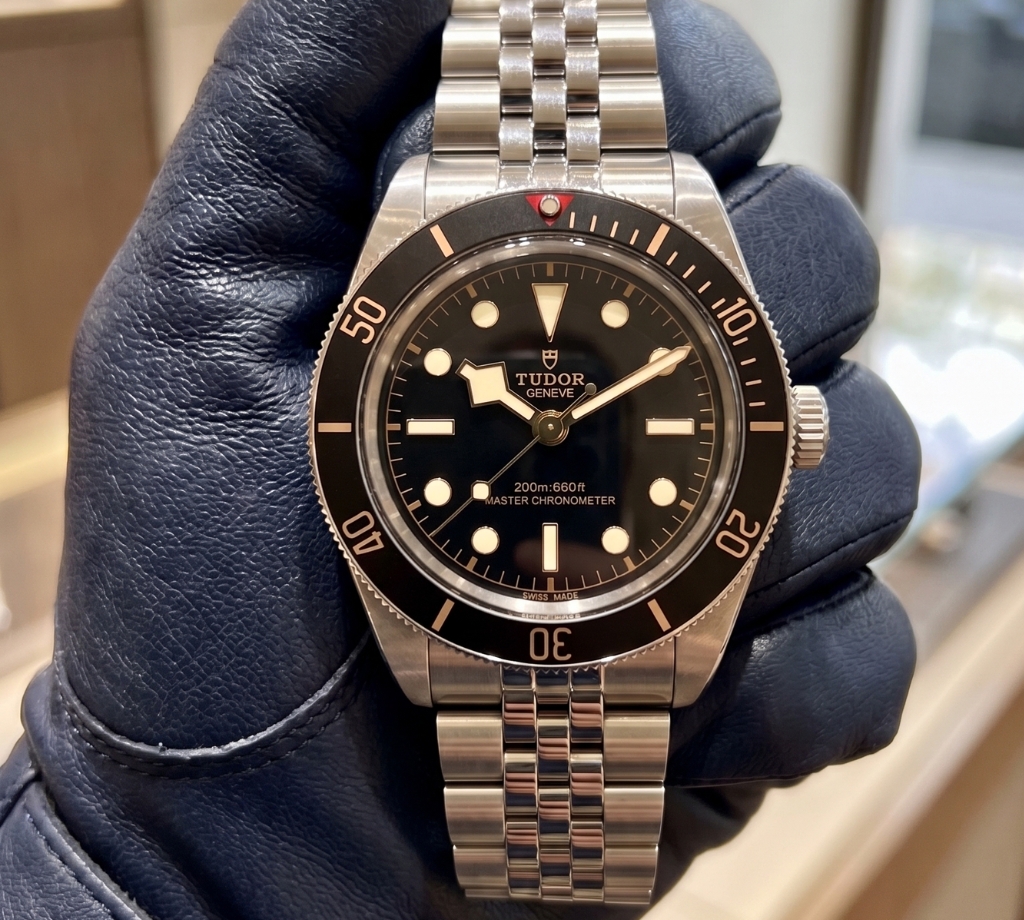
You own a Tudor — a Black Bay, a Pelagos, a Ranger, or perhaps a vintage piece from the brand’s long history alongside Rolex. Whether you are looking to liquidate it, borrow against it, or simply understand what it is worth, the quality of that outcome depends entirely on who you work with.
Vasco Assets offers private luxury watch acquisitions and collateral loans against high-end timepieces — providing certified appraisals, discreet transactions, and returns that reflect what your Tudor is genuinely worth in today’s secondary market, not what a generalist buyer guesses it might fetch.
Tudor’s Position in the Secondary Market
A Brand That Has Earned Its Own Identity
Tudor was founded in 1926 by Hans Wilsdorf — the same man who created Rolex — and for decades it occupied the role of accessible sibling to the world’s most recognized watch brand. That positioning has changed significantly. The launch of the Black Bay collection and the introduction of METAS-certified in-house movements have established Tudor as a brand with genuine collector credibility independent of its heritage connection.
Which Collections Hold Value Best
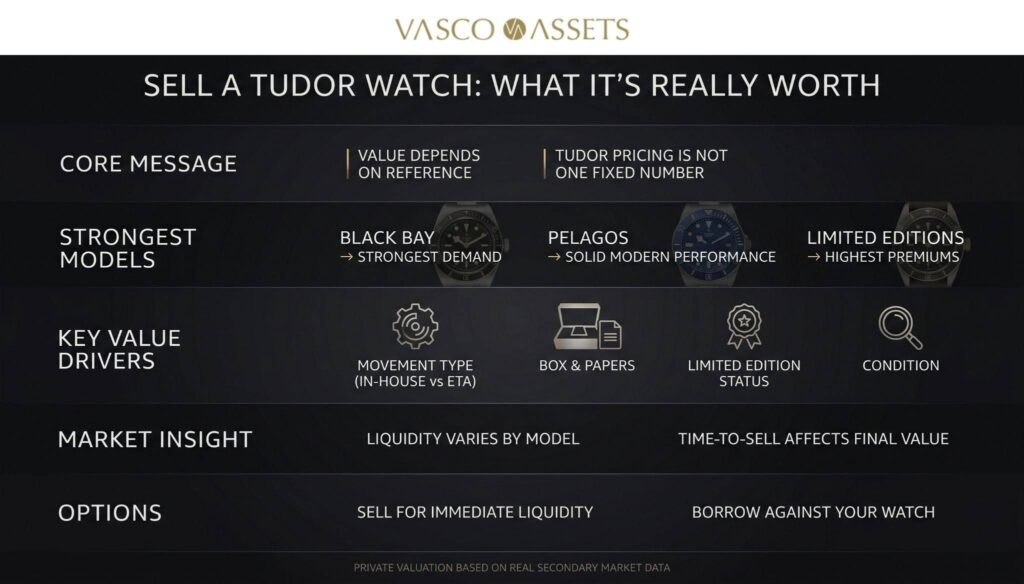
The Black Bay and Pelagos collections lead Tudor’s secondary market performance. Black Bay models average around $4,000 on the secondary market, with limited editions and discontinued references commanding meaningful premiums. The Pelagos 39 has shown particularly strong traction since its release, trading at or above retail on select secondary markets. Limited production models — the Pelagos FXD, the Pelagos Left Hand Drive, and the Black Bay Chrono in special editions — consistently outperform standard production references due to scarcity and collector demand.
The In-House Movement Premium
Tudor’s adoption of METAS-certified in-house movements — the MT5601 and its variants — has been a pivotal shift in how the brand is valued by serious collectors. Watches housing these movements carry a measurable premium over older references powered by ETA or Sellita calibres. A Black Bay 58 or Pelagos with an in-house movement and METAS certification occupies a fundamentally different position in the collector market than its predecessors. At Vasco Assets, movement generation is always a core factor in the appraisal process.
Why Your Tudor Doesn’t Have One Resale Price — It Has a Time-to-Cash Curve
Market Price Ranges Miss the Critical Variable
Most discussions of Tudor resale value focus on a single simplified output — a market price range or a percentage of retail. That framing misses the more important variable shaping real outcomes: how quickly that value can actually be converted into cash. Your Tudor does not have one fixed price; it has a time-to-cash curve, where liquidity conditions determine how much value is retained depending on how fast you need to exit.
How Urgency Shifts Pricing Dynamics
A Black Bay 58 may trade near 90% of retail in strong secondary conditions — but that figure implicitly assumes a well-matched buyer, sufficient demand depth, and no urgency on the seller’s side. When urgency increases, pricing dynamics shift. Selling to a dealer for immediate liquidity introduces an instant absorption discount. Listing privately introduces exposure to time-on-market risk, where price reductions become more likely the longer the asset sits. In thinner demand regions or less active channels, the same watch may clear significantly lower simply to achieve transaction speed.
What Financial Research Confirms
This is consistent with broader financial research showing that liquidity is not a static attribute of an asset, but a function of market depth, urgency, and execution speed. The Bank for International Settlements notes that a market’s ability to absorb transactions is shaped by how readily counterparties exist — and that even similar assets yield different realized prices under different execution conditions. Federal Reserve research on market frictions similarly shows that price impact is inversely related to market depth, meaning that urgency and thin buyer pools materially affect what a seller actually receives.
The Three Tiers of Tudor Liquidity
Highly liquid Tudor references — the Black Bay 58 with an in-house movement, limited edition Pelagos models, and discontinued Black Bay Chronographs — typically trade with tight discounts of 10–20% from retail, reflecting strong buyer demand and fast turnover. Mid-tier models, including standard Pelagos references and current Black Bay 41 variants, sit in a broader 20–35% band where demand is solid but more selective. ETA-driven or older references often require steeper discounts to clear — a distinction that generalist appraisers consistently miss.
Urgency Is a Primary Pricing Force
The key insight most sellers miss is simple but critical: value is not just what your Tudor sells for — it is what it sells for within your required timeframe. Urgency is not a side factor in pricing; it is one of the primary forces shaping it. Knowing where your specific reference sits on that curve, and choosing a partner who can transact with speed and accuracy, is what Vasco Assets is built to deliver.
Should You Sell Your Tudor or Borrow Against It?
When Selling Makes the Most Sense
Selling is the right choice when the need for capital is long-term, when the watch no longer fits your collection, or when you no longer wear it. For sellers who have moved on from the piece, a private acquisition through Vasco Assets delivers immediate, final liquidity with no ongoing obligation. For limited edition or recently discontinued models trading at or near peak secondary market values, selling now may also be the more strategically timed decision.
Understanding the Tax Implications
Before proceeding with a sale, it is worth understanding what a gain means for your tax position. The IRS classifies luxury watches sold at a profit as collectibles, subject to a maximum federal capital gains rate of 28% on long-term gains. If your Tudor has appreciated — particularly a limited edition or discontinued reference — the net proceeds after tax may be meaningfully lower than the headline sale price. A tax professional should be consulted before completing any significant transaction.
When a Collateral Loan Is the Better Path
If you still value owning the watch and your liquidity need is temporary, a collateral loan from Vasco Assets may be the more strategic option. Loan terms run 30 to 120 days with no credit check required, and your watch is stored securely and returned in full upon repayment. For those considering a securities-backed line of credit as an alternative, the Financial Industry Regulatory Authority (FINRA) cautions that these facilities carry real risks — including potential forced liquidation if portfolio values decline — that a watch-backed loan does not.
What to Avoid When Selling a Tudor
Generalist Buyers and Pawn Shops
Pawn shops and generalist buyers do not track Tudor’s secondary market by reference, movement generation, or production status. They cannot differentiate between a Black Bay 58 with an in-house METAS-certified movement and an older ETA-based example — which means sellers consistently receive offers anchored to the lowest common denominator rather than the watch’s true market position. For a limited edition or in-house model Tudor, that gap can represent thousands of dollars in unrealized value.
Online Platforms and Their True Cost
Peer-to-peer marketplaces introduce counterparty fraud, authentication risk, and fee structures that quietly reduce net proceeds. eBay’s final value fees for luxury watches run from 5.5% to 7.8% on high-value transactions — before shipping, insurance, and the time cost of managing listings. A private acquisition through Vasco Assets eliminates all of these friction costs, delivering a clean, direct transaction with no surprises.
The Right Partner Makes All the Difference
Expertise Closes the Gap
A Tudor appraised by someone who understands movement generation, reference-specific demand, and secondary market liquidity will always achieve a better outcome than the same piece handed to a generalist. The difference between the right channel and the wrong one is not marginal — it is often thousands of dollars in capital that most sellers never realize they were entitled to.
Your First Step Is a Free Valuation
Whether you are ready to sell today, weighing your options, or considering a loan against your timepiece, the conversation starts with understanding what you actually own. Request your complimentary valuation at vascoassets.com — privately, quickly, and with no obligation attached.
FAQs
1. How does Vasco Assets determine the value of my Tudor watch?
Vasco Assets uses a certified TruValue appraisal process that accounts for the specific reference, movement calibre and generation, condition, documentation, production status, and current secondary market data. Whether your Tudor has an in-house METAS-certified movement or an older outsourced calibre is a significant factor in the final offer.
2. Why do two Tudor watches with similar retail prices receive different offers?
Tudor resale value follows a time-to-cash curve, not a flat depreciation rate. Urgency, market depth, and reference-specific demand all shape what a watch actually yields at exit. Limited editions and in-house movement references trade with tight discounts of 10–20%, while standard or ETA-driven models may require steeper discounts to clear. A specialist appraisal from Vasco Assets identifies exactly where your reference sits on that curve — and prices accordingly.
3. Will I owe capital gains tax when I sell my Tudor?
Potentially. The IRS classifies collectibles — including luxury watches sold at a profit — as subject to a maximum federal capital gains rate of 28% on long-term gains. If your Tudor has appreciated, consult a tax professional before completing the sale to understand your net proceeds after tax.
4. Can I borrow against my Tudor instead of selling it?
Yes. Vasco Assets offers collateral loans against Tudor watches and other luxury timepieces, with loan terms of 30 to 120 days, no credit check required, and funds available in as little as 24 hours. Your watch is stored securely and returned in the same condition upon full repayment.
5. Does documentation affect the sale price of a Tudor?
Yes — significantly. A Tudor with its original box, warranty card, hang tags, and service history commands a measurable premium over an unpapered example. Vasco’s appraisers factor every element of your watch’s presentation into the offer.
6. Why is a private sale through Vasco better than an online marketplace?
Online platforms charge final value fees of 5.5–7.8% on high-value watch transactions, introduce fraud risk, and require significant time and effort to manage. Vasco Assets provides a direct, private acquisition with no fees, no fraud exposure, and payment issued promptly on agreement — with a certified appraisal ensuring the offer reflects genuine market value.
7. Can I sell other watches or luxury assets at the same time?
Yes. Vasco Assets acquires a broad range of luxury assets including other watch brands, fine jewelry, diamonds, gold, fine art, and rare collectibles. Multiple items can be evaluated together in a single confidential transaction, streamlining the process for sellers with broader collections.