
Sell IWC Watch: Private Luxury Asset Liquidation
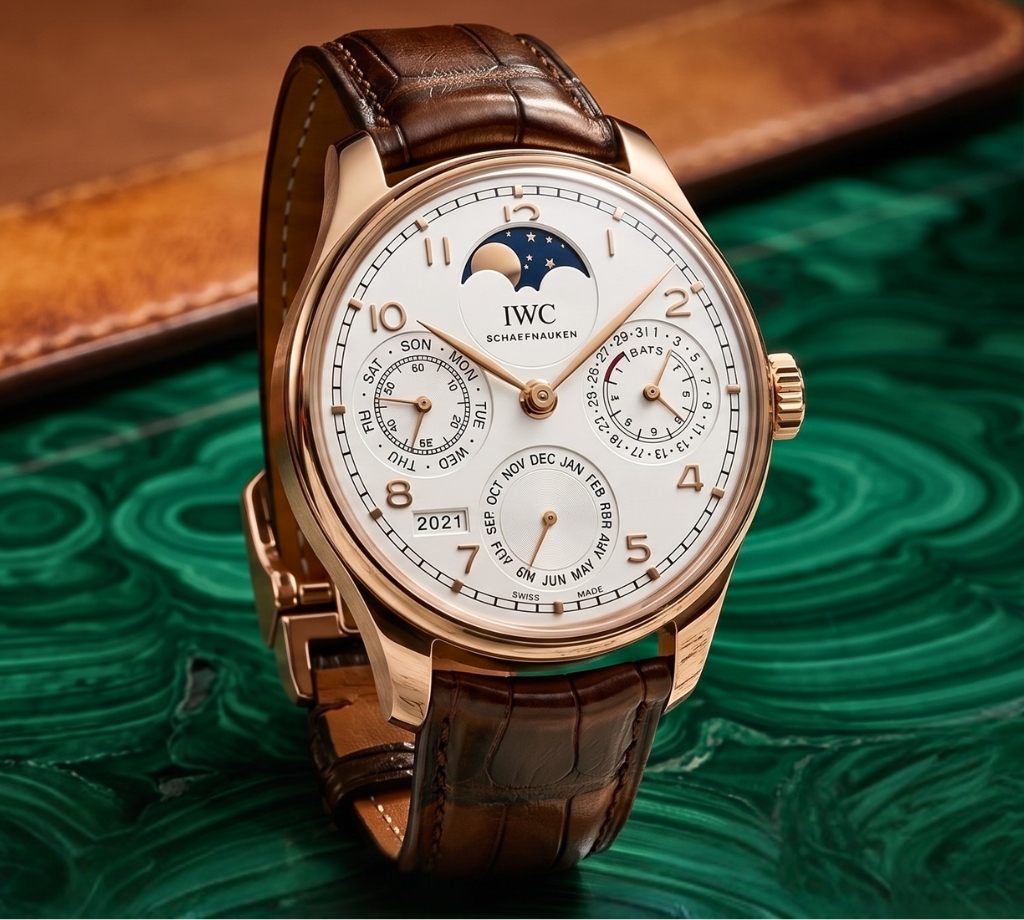
You own an IWC Schaffhausen — a Portugieser, a Big Pilot, a Portofino, or perhaps a vintage piece from the brand’s 150-year history of precision engineering. You are ready to sell or borrow against it. Before you act, understanding how IWC actually performs in the secondary market — and where the real valuation gaps appear — will determine how much capital you walk away with.
Vasco Assets offers private luxury watch acquisitions and collateral loans against high-end timepieces, providing certified appraisals, immediate capital, and outcomes that reflect real secondary market conditions rather than a generalist’s conservative floor.
IWC’s Position in the Secondary Market
Engineering Heritage With a Selective Collector Base
IWC Schaffhausen was founded in 1868 in Schaffhausen, Switzerland, by an American watchmaker who combined American manufacturing innovation with Swiss precision. Today it sits within the Richemont group alongside Cartier and Jaeger-LeCoultre, producing some of the most technically accomplished watches at its price tier. IWC’s secondary market, however, is more selective than its engineering credentials might suggest.
The brand appeals primarily to horological purists who value precision over celebrity — and that narrower audience has a measurable impact on liquidity relative to more broadly recognized names.
What the Secondary Market Data Shows
IWC watches generally retain 50–70% of retail value, with the strongest performers — Big Pilot and Portugieser references in good condition with documentation — trading closer to 70%. A Portugieser Chronograph that retailed for $8,000 typically fetches $5,500 to $7,000 on the secondary market. A Big Pilot 43mm in steel with box and papers trades between $7,000 and $10,000 depending on reference and condition.
Limited edition references — the Le Petit Prince, the AMG Petronas, and Gérald Genta-designed Ingenieur — command collector premiums above standard production examples. Grey market discounts of 15–30% on new IWC further compress the secondary market floor for standard production models.
The In-House Movement Premium
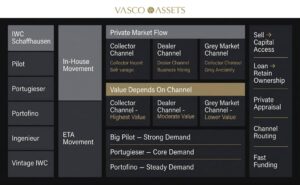
The most important valuation variable for IWC is whether the watch contains an in-house calibre. Entry-level models powered by modified ETA and Sellita movements retain 60–65% of retail. References housing IWC’s proprietary calibres — which generally begin at the Portugieser Automatic 40 and above — retain meaningfully more, as in-house movements signal horological seriousness to the collector market. At Vasco Assets, movement provenance is always factored into the appraisal alongside reference, condition, and documentation status.
The IWC Secondary Market Is Not a Single Pool — It Is a Fragmented Exit Network
Why a Single Retention Rate Misses the Real Mechanism
Most IWC valuation discussions collapse a complex trading environment into a single headline number — “50–70% retention” — as if the brand operates inside one unified market. In reality, that framing misses the core mechanism that actually determines pricing outcomes. The IWC secondary market is not a single pricing pool. It is a fragmented exit network composed of multiple liquidity channels, each with its own pricing logic.
The Three Channels and What They Produce
The first channel is retail-to-collector private transfer, where end buyers acquire watches through direct negotiation or specialist intermediaries. This is where IWC references such as the Big Pilot or Portugieser can achieve the highest realized prices, because there is no institutional spread compression. However, execution is slow, relationship-dependent, and sensitive to matching the right buyer profile.
The second channel is grey-market arbitrage buying, where professional traders price watches against the cost of brand-new inventory already discounted in primary or unauthorized distribution. Here, value is structurally capped by replacement pricing rather than intrinsic demand — regardless of condition or popularity.
Dealer Absorption Desks and the Third Channel
The third channel is dealer absorption desks, which prioritize speed and capital recycling. These buyers price risk, not desirability — discounting for holding time, volatility of reference, and uncertainty of resale exit. A watch that might achieve 70% of retail through a patient private sale may clear at 50–55% through a dealer absorption desk simply because of the holding cost embedded in the offer. The channel chosen is not just a commercial preference — it is a primary determinant of the realized price.
What Research Confirms About Channel-Dependent Pricing
Federal Reserve research on market frictions confirms that execution environment materially changes realized price outcomes rather than simply reflecting them. BIS analysis of dealer-based markets highlights how inventory constraints and balance-sheet risk shape bid pricing behavior rather than pure demand signals. Seen through this lens, IWC retention rates are not contradictions — they are channel-dependent outcomes produced by distinct exit pathways operating simultaneously. Knowing which channel your sale enters, and choosing a specialist who can route it correctly, is the most important decision an IWC seller can make.
IWC Is Not One Asset Class — It Is a Stacked Liquidity Structure
A Brand Average Obscures the Real Tiers
Even within the same channel, IWC operates as a stacked liquidity structure where different collections clear at fundamentally different speeds and spreads. The Big Pilot and Portugieser Chronograph sit at the top — frequently traded, globally recognized, and supported by collector communities that provide a reliable buyer pool. Mid-tier references like the Portofino and Mark series sit in a broader spread band, where demand is real but slower and more condition-sensitive. Further down, ETA-based references and slow-moving complications face thinner buyer pools and wider discounts amplified by the grey market ceiling.
Vintage and Limited Editions as Separate Markets
Vintage IWC pieces and limited editions operate as a separate market with auction-dependent liquidity rather than continuous secondary market trading. A vintage Ingenieur designed by Gérald Genta is not priced the same way as a modern reference — it is priced through collector alignment, historical significance, and provenance documentation.
Dealers never price the IWC brand; they price reference-specific exit risk within the specific channel they operate. This is precisely why a specialist like Vasco Assets — who can route a sale to the right channel and appraise at the reference level — achieves meaningfully better outcomes than a generalist for every tier of the IWC range.
Should You Sell Your IWC or Borrow Against It?
When Selling Is the Right Move
Selling makes the most sense when the need for capital is long-term, when the watch no longer fits your collection, or when a limited edition or vintage reference has reached a collector demand peak. For sellers who have moved on from the piece, a private acquisition through Vasco Assets delivers immediate, final liquidity — with a certified appraisal that accounts for grey market context, movement provenance, and reference-specific secondary market conditions.
The Tax Dimension
Before completing a sale, tax implications deserve consideration. The IRS classifies collectibles — including luxury watches sold at a gain — as subject to a maximum federal capital gains rate of 28% on long-term gains. If your IWC has appreciated — a vintage Ingenieur, a discontinued limited edition — consult a tax professional before completing the sale to understand your net proceeds after tax.
When a Collateral Loan Is Smarter
If you still value the piece and your capital need is short-term, a collateral loan from Vasco Assets may preserve more long-term value. Loan terms run 30 to 120 days with no credit check required, and your watch is stored securely and returned in full upon repayment. For those considering securities-backed credit as an alternative, the Financial Industry Regulatory Authority (FINRA) cautions that these facilities carry risks including potential forced liquidation if portfolio values decline — a risk that a watch-backed loan does not carry.
Vasco Assets: Private IWC Acquisition and Expert Lending
Specialist Knowledge Across Every Reference and Every Channel
Vasco Assets is a private international investment firm based in Newport Beach, California, with certified expertise across luxury watches, jewelry, diamonds, gold, and rare collectibles. Their appraisers follow IWC’s secondary market actively — across Pilot, Portugieser, Portofino, Ingenieur, Da Vinci, and vintage references — identifying which liquidity tier and which exit channel best serves each piece, and ensuring every offer reflects real current market conditions.
Immediate Funding, No Friction
The process begins with a complimentary TruValue valuation. Once Vasco’s certified appraisers assess your IWC, you receive a transparent, liquidity-adjusted offer based on actual market data. If you accept, payment is issued promptly — no commissions, no listing delays, no fraud exposure. Contact Vasco Assets or call 949.674.3575 to schedule your appraisal — no obligation, no pressure, and a result in as little as 24 hours.
FAQs
1. How does Vasco Assets determine the value of my IWC?
Vasco Assets uses a certified TruValue appraisal process that accounts for the specific reference, movement calibre and generation, condition, documentation, grey market context, production status, and current secondary market data. The appraisal also identifies which liquidity channel best serves the piece — maximizing the realized price rather than defaulting to the most conservative exit.
2. Why does the same IWC watch receive such different offers from different buyers?
IWC’s secondary market is a fragmented exit network, not a single pricing pool. A retail-to-collector private transfer, a grey-market arbitrage desk, and a dealer absorption desk each apply different pricing logic to the same watch. The collector channel produces the highest realized price; the absorption desk produces the lowest. A specialist from Vasco Assets routes your piece to the channel that best matches its reference, tier, and condition — rather than defaulting to the fastest option.
3. Which IWC models hold value best?
The Big Pilot and Portugieser Chronograph with in-house movements lead IWC’s secondary market, trading at 65–70% of retail in good condition with documentation. Vintage Ingenieur references and limited editions with collector significance can command premiums above this range. Entry-level ETA-based models retain 60–65% and are more significantly affected by the grey market ceiling.
4. Will I owe capital gains tax when I sell my IWC?
Potentially. The IRS classifies collectibles — including luxury watches sold at a gain — as subject to a maximum federal capital gains rate of 28% on long-term gains. If your IWC has appreciated, consult a tax professional before completing the sale to understand your net proceeds after tax.
5. Can I borrow against my IWC instead of selling it?
Yes. Vasco Assets offers collateral loans against IWC watches and other luxury timepieces, with loan terms of 30 to 120 days, no credit check required, and funds available in as little as 24 hours. Your watch is stored securely and returned in the same condition upon full repayment.
6. Does having box and papers affect the sale price of an IWC?
Yes — significantly. A full-set IWC with original box, warranty card, and hang tags commands a measurable premium over an unpapered example of the same reference. For limited editions and vintage pieces, complete documentation can be the difference between a standard market offer and a collector-grade price. Vasco’s appraisers factor every element of your watch’s presentation into the offer.
7. Can I sell other watches or luxury assets alongside my IWC?
Yes. Vasco Assets acquires a broad range of luxury assets including other watch brands, fine jewelry, diamonds, gold, fine art, and rare collectibles. Multiple items can be evaluated together in a single confidential transaction, streamlining the process for sellers with broader collections.