
Sell Chopard Watch: Private Valuation & Liquidation

You own a Chopard — an Alpine Eagle, a Happy Sport, an L.U.C complication, or perhaps a Mille Miglia from the brand’s motorsport heritage. You are ready to sell or borrow against it, and you need to know what it is genuinely worth before engaging with any buyer. The answer depends entirely on which Chopard you own — and who is doing the appraising.
Vasco Assets offers private luxury watch acquisitions and collateral loans against high-end timepieces, providing certified appraisals, immediate capital, and outcomes that reflect what your specific Chopard reference is actually worth in today’s secondary market.
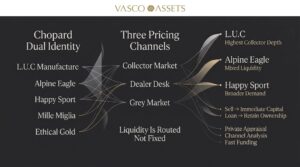
Chopard’s Position in the Secondary Market
A Dual-Identity Brand With Sharply Different Market Dynamics
Chopard occupies a distinctive position in the luxury watch market. Founded in 1860 and family-owned, the brand operates across two fundamentally different creative territories. On one side sits the jewelry watch and lifestyle segment — the Happy Sport, the Imperiale, and diamond-set pieces that attract a fashion and gift-buying audience. On the other sits the L.U.C Manufacture in Fleurier, which since 1995 has produced some of the most technically accomplished in-house movements in Swiss watchmaking, earning Hallmark of Geneva and Qualité Fleurier certifications.
Two Sides That Trade in Different Universes
These two sides of Chopard do not share a secondary market. The Alpine Eagle in steel trades between €7,500 and €15,000 depending on configuration. The Happy Sport trades between €2,000 and €6,500 for standard steel models. The L.U.C range occupies the most extreme spread: time-only pieces trade at €5,500–€15,000, while complicated references — perpetual calendars, minute repeaters, and tourbillons — regularly command €20,000 to over €50,000. At Vasco Assets, the appraisal always begins with which side of the Chopard duality your piece occupies.
The Ethical Gold Premium and L.U.C Distinction
Since July 2018, Chopard has used 100% ethical gold — certified through the Responsible Jewellery Council and Fairmined standards — across all 18-karat gold watches and jewelry. This commitment is increasingly recognized by serious collectors as a differentiator, particularly for L.U.C pieces where provenance and manufacture integrity are already valued. L.U.C complications with Hallmark of Geneva certification, ethical gold cases, and full documentation represent the pinnacle of Chopard’s collectable hierarchy — priced accordingly by specialist buyers who understand what that certification means.
Chopard Is Not One Market — It Is a Three-Channel Pricing System
Why Model-Level Segmentation Is Incomplete
Most content on Chopard resale value relies on a simplified model: L.U.C references retain more value, Happy Sport and Imperiale depreciate more, and Alpine Eagle sits somewhere in between. Even higher-quality dealer analyses stop at this model-level segmentation, implying that condition and collection alone explain pricing outcomes. In reality, this flattens a far more complex mechanism. Chopard does not trade in a single resale market — it trades across three structurally distinct execution channels that continuously arbitrage against one another.
The Retail-to-Collector Private Channel
The first channel is the retail-to-end-buyer private transfer, where specialist intermediaries match specific references — particularly L.U.C complications and select Alpine Eagle configurations — directly to collectors. Here, pricing is driven by scarcity perception, provenance, and buyer urgency, often resulting in tighter spreads and higher realized values. This is where L.U.C pieces with Hallmark of Geneva certification and full documentation achieve outcomes no other channel can replicate.
The Dealer Absorption Desk Channel
The second channel is the dealer absorption desk, where professional buyers acquire inventory based on balance-sheet constraints rather than brand narratives. As the Bank for International Settlements confirms, dealer pricing is heavily influenced by holding costs, inventory risk, and the speed at which assets can be recycled rather than intrinsic desirability alone. This creates systematic downward pressure on slower-moving Chopard references regardless of condition — the dealer’s discount is the pricing of storage, time, and exit uncertainty.
The Grey-Market Arbitrage Channel
The third channel is grey-market arbitrage, where new and near-new watches flow through discounted distribution networks, establishing a structural price ceiling for many entry and mid-tier models. This is especially relevant for Alpine Eagle and Mille Miglia references, where supply leakage and retail discounting compress pre-owned valuation bands. Federal Reserve research on market frictions confirms that execution environment materially changes realized price outcomes — the channel a watch enters is not a preference but a primary determinant of the final number.
Routing Determines Outcome
The same Chopard reference can produce materially different values depending on which channel absorbs it. Liquidity is not fixed — it is routed. And routing determines outcome more than condition, age, or even model hierarchy. The question is no longer “what is it worth?” but “which market mechanism will clear it, and at what speed?” That shift — from static depreciation logic to execution architecture — is what most Chopard resale content fails to address, and what Vasco Assets is built to navigate.
Chopard as a Stacked Liquidity Structure
Four Tiers Within the Three Channels
Even within each channel, Chopard operates as a stacked liquidity structure where different collections clear at fundamentally different speeds and spreads. At the top sit L.U.C complications with in-house movements and Hallmark of Geneva certification — routed to the collector channel and priced accordingly. Below that sits the Alpine Eagle, subject to both the collector channel for in-demand configurations and the grey market ceiling for standard references. Further down are Happy Sport and Imperiale, where demand is broader but thinner in collector depth, and condition sensitivity is high.
Where Your Reference Sits Determines Everything
Understanding where a specific Chopard reference sits in the three-channel architecture — and which channel a specialist can route it to — is the most important variable in maximizing the realized price. A generalist buyer defaults to the dealer absorption desk by definition: the channel that serves their capital recycling, not your outcome. A specialist like Vasco Assets understands the full architecture and routes each piece to the channel that best serves the seller.
Should You Sell Your Chopard or Borrow Against It?
When Selling Is the Right Decision
Selling makes the most sense when the need for capital is long-term, when the watch no longer fits your collection, or when a limited L.U.C edition has reached a pricing peak you wish to lock in. For sellers who have moved on from the piece, a private acquisition through Vasco Assets delivers immediate, final liquidity — with a certified appraisal that accounts for the collection’s tier, the optimal exit channel, and current secondary market conditions.
The Tax Dimension
Before completing a sale, tax implications deserve consideration. The IRS classifies collectibles — including luxury watches sold at a gain — as subject to a maximum federal capital gains rate of 28% on long-term gains. For an L.U.C complication or limited Alpine Eagle that has appreciated, the net proceeds after tax may be meaningfully lower than the headline sale price. A tax professional should be consulted before completing any significant transaction.
When a Collateral Loan Is Smarter
If you still value the piece and your capital need is short-term, a collateral loan from Vasco Assets may preserve more long-term value. Loan terms run 30 to 120 days with no credit check required, and your watch is stored securely and returned in full upon repayment. For those considering securities-backed credit as an alternative, the Financial Industry Regulatory Authority (FINRA) cautions that these facilities carry risks including potential forced liquidation if portfolio values decline — a risk that a watch-backed loan does not carry.
Vasco Assets: Private Chopard Acquisition and Expert Lending
Expertise Across Every Tier and Every Channel
Vasco Assets is a private international investment firm based in Newport Beach, California, with certified expertise across luxury watches, jewelry, diamonds, gold, and rare collectibles. Their appraisers follow Chopard’s secondary market actively — across L.U.C complications, Alpine Eagle, Happy Sport, Mille Miglia, and vintage references — identifying which tier and which exit channel each piece belongs in, and pricing accordingly.
Immediate Funding, Maximum Discretion
The process begins with a complimentary TruValue valuation. Once Vasco’s certified appraisers assess your Chopard, you receive a transparent, channel-adjusted offer based on actual market data. If you accept, payment is issued promptly — no commissions, no listing delays, no fraud exposure. Contact Vasco Assets or call 949.674.3575 to schedule your appraisal — no obligation, no pressure, and a result in as little as 24 hours.
FAQs
1. How does Vasco Assets determine the value of my Chopard?
Vasco Assets uses a certified TruValue appraisal process that accounts for the specific collection and reference, movement certification, ethical gold provenance where applicable, condition, documentation, grey market context, and current secondary market data. Critically, the appraisal also identifies which of the three exit channels best serves your specific piece — maximizing the realized price rather than defaulting to the most conservative option.
2. Why does the same Chopard reference receive such different offers from different buyers?
Chopard’s secondary market is a three-channel pricing system — retail-to-collector private transfer, dealer absorption desk, and grey-market arbitrage — each operating with different pricing logic. The same watch can produce materially different values depending on which channel absorbs it. Liquidity is routed, not fixed. A specialist from Vasco Assets identifies the right channel for your reference rather than defaulting to the fastest one.
3. Will I owe capital gains tax when I sell my Chopard?
Potentially. The IRS classifies collectibles — including luxury watches sold at a gain — as subject to a maximum federal capital gains rate of 28% on long-term gains. If your Chopard has appreciated, consult a tax professional before completing the sale to understand your net proceeds after tax.
4. Can I borrow against my Chopard instead of selling it?
Yes. Vasco Assets offers collateral loans against Chopard watches and other luxury timepieces, with loan terms of 30 to 120 days, no credit check required, and funds available in as little as 24 hours. Your watch is stored securely and returned in the same condition upon full repayment.
5. Does having box, papers, and certification affect the sale price?
Yes — significantly, and especially for L.U.C pieces. An L.U.C complication with its Hallmark of Geneva certificate, original box, warranty card, and ethical gold documentation commands a measurable premium over an unpapered example. Vasco’s appraisers factor every element of your watch’s presentation into the offer.
6. Why is a private sale through Vasco better than an online marketplace?
Online platforms charge final value fees of 5.5–7.8% on high-value transactions, introduce fraud risk, and deposit your piece into the default peer-to-peer channel rather than the optimal one for your reference. Vasco Assets routes each piece to the appropriate exit channel, with no fees, no fraud exposure, and payment issued promptly on agreement.
7. Can I sell other watches or luxury assets alongside my Chopard?
Yes. Vasco Assets acquires a broad range of luxury assets including other watch brands, fine jewelry, diamonds, gold, fine art, and rare collectibles. Multiple items can be evaluated together in a single confidential transaction, streamlining the process for sellers with broader collections.