
Sell Piaget Watch: Discretionary Asset Loans & Liquidation

You own a Piaget — an Altiplano, a Polo, an Emperador, or perhaps a vintage piece with a stone dial from the brand’s celebrated 1960s and 1970s era. You are ready to sell or borrow against it. Before engaging with any buyer or lender, understanding exactly how Piaget performs in the secondary market — and which exit channel your reference belongs in — will determine how much capital you actually receive.
Vasco Assets offers private luxury watch acquisitions and collateral loans against high-end timepieces, providing certified appraisals, immediate capital, and outcomes that reflect real secondary market conditions — not a generalist’s flat brand discount.
Piaget’s Position in the Secondary Market
Haute Horlogerie With a Selective Buyer Pool
Piaget was founded in 1874 in La Côte-aux-Fées, Switzerland, and today sits within the Richemont group alongside Cartier and IWC. The brand has built its reputation on two pillars: ultra-thin movement engineering — with records including the world’s thinnest hand-wound mechanical watch at 2mm — and high jewelry watchmaking, where precious metals and stone dials meet horological craftsmanship.
On the secondary market, Piaget appeals to a selective buyer pool of collectors who understand what they are acquiring and connoisseurs drawn to the brand’s technical and aesthetic distinctiveness.
What the Secondary Market Data Shows
Piaget’s secondary market performance is highly reference-dependent. The Polo averages around $9,000 and benefits from broader modern appeal. The Altiplano spans a wide range: entry models trade from approximately $5,000 to $6,500, while ultra-thin skeleton and precious metal references command $20,000 to over $80,000.
The Limelight, Possession, and Gouverneur references face wider depreciation, with some pieces trading at 50–70% below retail depending on configuration. Vintage Piaget from the 1960s and 1970s — particularly stone-dial references and gold integrated bracelet pieces — commands serious collector premiums at specialist auction houses.
Where Piaget Faces Its Biggest Valuation Risk
The WatchCharts Piaget Index has seen meaningful softening, with the Altiplano Index declining 14% over recent periods and some individual references showing short-term declines exceeding 30%. This thin market depth is not a reflection of the brand’s quality. It is a structural feature of a niche where buyer pools are selective and matching the right reference to the right buyer matters enormously. At Vasco Assets, this is precisely the challenge a specialist appraisal is built to navigate.
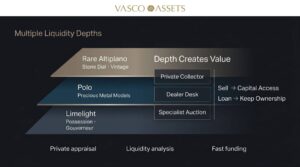
Piaget Does Not Have One Resale Price — It Has Multiple Liquidity Depths
Why Average Price Bands Create a False Picture
Most Piaget resale content reduces the brand to narrow average price bands per collection — Altiplano trading in the mid-four-figure range, Polo extending into higher five-figure configurations. This creates the illusion that Piaget behaves like a single, stable pricing surface where value can be read directly from a chart or collection label. That framing is incomplete. It ignores how luxury watch markets actually function: not as fixed-price ladders, but as liquidity-dependent execution systems where value is determined by how easily a reference can convert into cash at a given moment.
How Liquidity Depth Shapes Price Formation
Financial market research shows that price formation is strongly influenced by liquidity depth — specifically the availability of counterparties and the density of executable demand at each price level, rather than headline supply alone. When liquidity is thin, even small differences in buyer presence can produce disproportionately large valuation gaps. The Bank for International Settlements confirms this: in dealer markets, price is shaped as much by how long a dealer must hold an asset as by who eventually buys it.
Piaget as a Fragmented Liquidity Architecture
Piaget does not operate as a uniform resale market. It behaves like a fragmented liquidity architecture, where each reference sits in a different depth layer of market access — from highly matched collector demand in rare Altiplano complications and vintage stone-dial pieces, to shallow dealer absorption environments where pricing is constrained by inventory risk rather than desirability. Federal Reserve research on market frictions similarly shows that execution environment materially changes realized price outcomes — the channel a watch enters is not a preference but a primary determinant of the final number.
The Critical Variable Is Counterparty Access
Piaget does not have one resale price — it has multiple liquidity depths that determine whether value is fully realized, partially discounted, or never efficiently surfaced at all. The critical variable is not just what the watch is, but how easily it can find the right counterparty under real market conditions. A rare Altiplano Ultimate routed to a collector who has been looking for exactly that reference will always outperform the same piece offered to a generalist dealer who has no natural buyer for it. This is what most Piaget resale content fails to address — and what a specialist like Vasco Assets is built to deliver.
Piaget Is Not One Market — It Is a Three-Channel Pricing System
Why Collection-Level Segmentation Is Still Incomplete
Even after understanding liquidity depth, Piaget’s secondary market adds another layer of complexity. The brand trades across three structurally distinct execution channels, each with its own pricing logic. The channel a piece enters determines the outcome more than the reference itself — which means that two identical Piaget watches can produce materially different results depending entirely on where they are taken.
The Retail-to-Collector Private Channel
The first channel is the retail-to-end-buyer private transfer, where specialist intermediaries connect ultra-thin complications, precious metal Altiplanos, and vintage stone-dial references directly to collectors. Here, pricing is driven by scarcity, provenance, and buyer urgency — with no institutional spread compression between seller and end buyer. This is where Piaget’s highest realized prices occur, and it is the channel that thin-market depth makes most difficult to access without specialist relationships.
The Dealer Absorption Desk and Thin Market Auction Channels
The second channel is the dealer absorption desk, where professional buyers price based on balance-sheet constraints and inventory recycling speed rather than brand narratives. For Piaget — a brand with thin secondary market volume — holding cost uncertainty drives bids more conservatively than the reference’s collector value would suggest.
The third channel applies to Piaget’s highest-tier pieces: specialist auction, where Altiplano Ultimate references, Emperador complications, and vintage integrated gold bracelet models achieve event-driven pricing through auction house competition. These pieces are not continuously traded — their value is realized through the right room, the right timing, and the right audience.
Routing Determines Outcome
The same Piaget reference can produce materially different values depending on which channel absorbs it. A generalist buyer defaults to the dealer absorption desk — the channel that serves their capital recycling, not the seller’s realized price. A specialist like Vasco Assets identifies which of the three channels best serves each specific reference and routes it accordingly, producing outcomes that collection-level price bands cannot predict.
What Your Piaget Is Actually Worth
The Documentation and Provenance Premium
For Piaget, documentation carries particularly high weight at the upper end of the range. An Altiplano Ultimate or Emperador complication with original box, warranty card, and service records commands measurably more than an unpapered example. The FTC’s Jewelry Guides reinforce that accurate representation of a luxury item’s provenance is a standard only specialist appraisers are equipped to apply. For vintage references with distinctive dials or integrated precious metal bracelets, documented provenance can be the difference between a private sale price and an auction result.
Material, Configuration, and Ultra-Thin Engineering
Beyond documentation, case material — rose gold, white gold, platinum, or the proprietary cobalt alloy used in select Altiplano Ultimate references — significantly affects the offer. Diamond-set configurations, skeleton movements, and references with record-breaking thinness carry collector premiums that require specialist knowledge to price accurately. Specialist appraisers at Vasco Assets assess all material and configuration variables and reflect them in the valuation — ensuring sellers receive the full benefit of what makes their specific reference distinctive.
Vasco Assets: Private Piaget Acquisition and Expert Lending
Specialist Knowledge Across Every Reference and Channel
Vasco Assets is a private international investment firm based in Newport Beach, California, with certified expertise across luxury watches, jewelry, diamonds, gold, and rare collectibles. Their appraisers follow Piaget’s secondary market actively — across Altiplano, Polo, Emperador, Gouverneur, Limelight, and vintage references — identifying which liquidity depth and which exit channel each piece belongs in, and pricing accordingly.
Immediate Funding, Maximum Discretion
The process begins with a complimentary TruValue valuation. Once Vasco’s certified appraisers assess your Piaget, you receive a transparent, channel-adjusted offer based on actual market data. If you accept, payment is issued promptly — no commissions, no listing delays, no fraud exposure. Contact Vasco Assets or call 949.674.3575 to schedule your appraisal — no obligation, no pressure, and a result in as little as 24 hours.
FAQs
1. How does Vasco Assets determine the value of my Piaget?
Vasco Assets uses a certified TruValue appraisal process that accounts for the specific reference, movement type, case material, ultra-thin engineering credentials, condition, documentation, and current secondary market data. Critically, the appraisal also identifies which of the three exit channels and which liquidity depth layer best serves your specific piece — maximizing the realized price rather than defaulting to the most conservative option.
2. Why does Piaget produce such different resale outcomes across references?
Piaget operates as a fragmented liquidity architecture — not a single pricing surface. Each reference sits in a different depth layer of market access, from highly matched collector demand in rare Altiplano and vintage stone-dial pieces, to shallow dealer absorption environments where pricing is constrained by inventory risk. A specialist from Vasco Assets identifies the right layer and the right channel rather than applying a collection-level average.
3. Will I owe capital gains tax when I sell my Piaget?
Potentially. The IRS classifies collectibles — including luxury watches sold at a gain — as subject to a maximum federal capital gains rate of 28% on long-term gains. If your Piaget has appreciated, consult a tax professional before completing the sale to understand your net proceeds after tax.
4. Can I borrow against my Piaget instead of selling it?
Yes. Vasco Assets offers collateral loans against Piaget watches and other luxury timepieces, with loan terms of 30 to 120 days, no credit check required, and funds available in as little as 24 hours. Your watch is stored securely and returned in the same condition upon full repayment.
5. Does having box and papers affect the sale price of a Piaget?
Yes — significantly. A full-set Piaget with original box, warranty card, and hang tags commands a measurable premium over an unpapered example. For vintage references and Altiplano Ultimate complications, complete documentation can be the difference between a standard market offer and a collector-grade result. Vasco’s appraisers factor every element of your watch’s presentation into the offer.
6. Why is a private sale through Vasco better than an online marketplace?
Online platforms charge final value fees of 5.5–7.8% on high-value transactions, introduce fraud risk, and route every piece into the peer-to-peer channel regardless of whether a deeper liquidity layer would serve it better. Vasco Assets routes each piece to the optimal exit channel, with no fees, no fraud exposure, and payment issued promptly on agreement.
7. Can I sell other watches or luxury assets alongside my Piaget?
Yes. Vasco Assets acquires a broad range of luxury assets including other watch brands, fine jewelry, diamonds, gold, fine art, and rare collectibles. Multiple items can be evaluated together in a single confidential transaction, streamlining the process for sellers with broader collections.