
Sell Zenith Watch: High-End Valuation & Acquisition
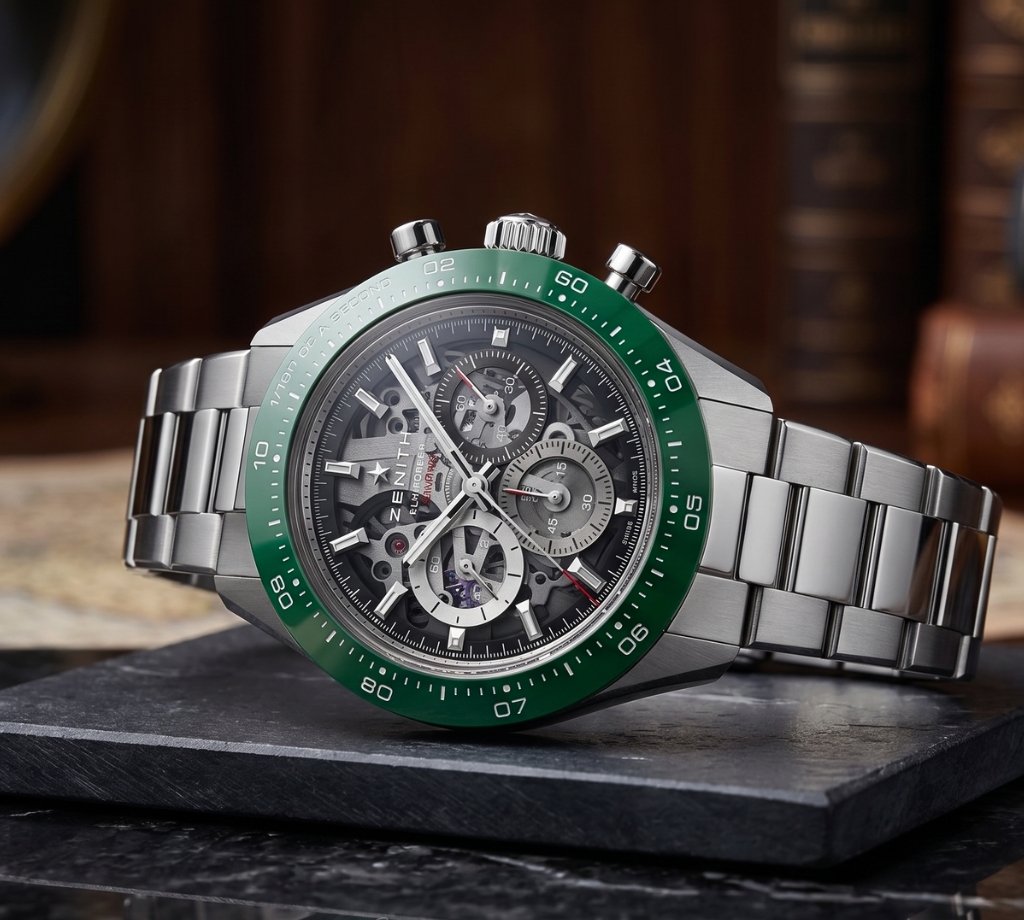
You own a Zenith — a Chronomaster with the legendary El Primero movement, a Defy in high-tech materials, a Pilot, or perhaps a vintage reference from the brand’s storied history. You are ready to sell or borrow against it. Before engaging with any buyer or lender, understanding how Zenith actually performs in the secondary market — and which channel your specific reference belongs in — will determine how much capital you actually receive.
Vasco Assets offers private luxury watch acquisitions and collateral loans against high-end timepieces, providing certified appraisals, immediate capital, and outcomes that reflect real secondary market conditions rather than a generalist’s flat brand discount.
Zenith’s Position in the Secondary Market
The El Primero: Horological Significance as a Valuation Driver
Zenith was founded in 1865 in Le Locle, Switzerland, and is now part of the LVMH group. The brand’s defining achievement is the El Primero — announced on January 10, 1969, as the world’s first high-frequency automatic chronograph, running at 36,600 vibrations per hour and measuring elapsed time to one-tenth of a second.
This is not just brand history. It is a genuine horological milestone that drives collector demand across more than five decades of Zenith production. A watch housing an El Primero movement is not just a timepiece — it is a piece of mechanical history with a documented collector community behind it.
What the Secondary Market Data Shows
Zenith’s secondary market is movement-led rather than brand-led. The Chronomaster Sport with the El Primero 3600 has shown positive year-on-year performance, up approximately 3% while the broader Zenith index declined — confirming that movement identity and reference-specific demand diverge sharply within the same brand.
Chronomaster references with the El Primero movement typically trade between $6,000 and $10,000 depending on generation, condition, and documentation. Vintage references from 1969–1975 — particularly the A386 with only approximately 2,500 produced — trade significantly higher among specialist collectors. Entry-level Elite and standard Defy references trade between $3,000 and $6,000 with more limited collector depth.
The Movement Divide That Shapes Every Offer
The fundamental valuation divide within Zenith is between pieces housing the El Primero and those that do not. A Chronomaster Sport assessed by someone who understands the movement’s significance occupies a different market than a standard Elite dress watch from the same era. Generalist buyers who cannot make this distinction anchor the offer to the lower tier. At Vasco Assets, movement identity is always the starting point of every Zenith appraisal.
Zenith Is Not a Price Curve — It Is a Liquidity Routing System
The Analytical Error in Standard Resale Content
Most Zenith resale content incorrectly frames value as a flat depreciation curve — typically quoting “60–70% retention” or grouping Zenith with Omega and Breitling as if the entire brand behaves uniformly. This framing creates a fundamental analytical error: it assumes Zenith has one market price path when in reality it operates across multiple disconnected liquidity environments. Enthusiast discussions that reduce the brand to a single narrative of “post-purchase value loss” miss how dramatically outcomes diverge at the reference level.
Exit Path Selection Is the Real Valuation Driver
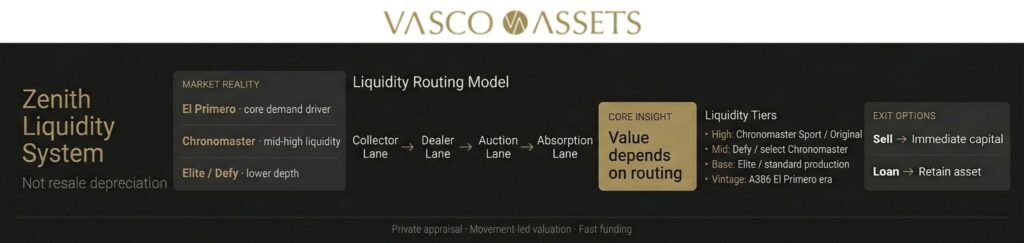
Zenith is not a price curve — it is a liquidity routing system. Each watch does not “hold value” in a vacuum; it clears through a specific exit lane that determines realized price. A Chronomaster Sport may move through an active collector market with tight bid-ask spreads, while an Elite dress reference may only clear through dealer absorption desks where holding costs and inventory risk compress bids before they are even made. Valuation is not primarily driven by MSRP discounting — it is driven by exit path selection.
Two Identical Watches, Materially Different Outcomes
Two physically identical Zenith watches can produce materially different outcomes depending on whether they are routed to a specialist collector channel, a generalist dealer network, or a peer-to-peer marketplace with asymmetric information and fees. Research on market structure confirms that price formation is heavily shaped by transaction frictions and the depth of available buyers rather than intrinsic value alone — a principle the Bank for International Settlements applies directly to dealer-intermediated markets where inventory risk and holding costs shape bids before demand is even assessed.
The Question That Unlocks Real Value
Reframing Zenith in this way changes the central question entirely. Instead of asking “How much does Zenith depreciate?”, the correct question becomes: “Which market structure will actually absorb this specific reference at full clearing price?” That shift — from percentage loss to liquidity routing — is where real valuation differentiation begins, and it is the lens through which Vasco Assets approaches every Zenith acquisition.
Zenith as a Tiered Liquidity System
Three Tiers of Clearing Speed and Buyer Depth
Even within the routing framework, Zenith’s references sit in structurally different liquidity tiers. At the top sit the most liquid references — the Chronomaster Sport, the Chronomaster Original, and select A386-inspired models — where El Primero identity creates an active collector community with tight bid-ask spreads and fast turnover. In the middle sit moderate-depth references — other Chronomaster configurations and Defy models with in-demand specifications — where collector interest exists but matching takes longer.
The Base Tier and Vintage as a Separate Market
At the base sit entry-level Elite and standard Defy references, where buyer pools are thin and the secondary market closely mirrors the grey market discount environment common to mid-tier Swiss brands. Vintage Zenith — particularly original 1969–1975 El Primero references like the A386 — operates as a largely separate market from modern production, where pricing is auction-dependent and collector-convergent.
Federal Reserve research on market frictions confirms that execution environment materially changes realized price outcomes — vintage Zenith routed to the specialist collector channel will always outperform the same piece handled by a dealer absorption desk with no natural buyer for it.
What Your Zenith Is Actually Worth
Documentation, Originality, and Movement Provenance
For Zenith, documentation carries particular weight across all tiers. An El Primero reference with original box, warranty card, and service records commands measurably more than an unpapered example. The FTC’s Jewelry Guides reinforce that accurate representation of a luxury item’s provenance and authenticity is a standard only specialist appraisers are equipped to apply. For vintage references, dial originality, tritium lume condition, and period-correct components are valuation factors that generalist buyers routinely undervalue.
The El Primero Paradox: Significance vs. Recognition
Zenith presents a specific valuation paradox: the El Primero’s horological significance is recognized by collectors who understand watchmaking, but not by the broader market that drives most resale activity. This means the gap between what a generalist offers and what the collector channel produces is wider for Zenith than for brands with more universal recognition. A specialist appraiser from Vasco Assets who understands the movement’s place in horological history will always produce a higher offer than one who prices Zenith as a generic mid-tier Swiss brand.
Vasco Assets: Private Zenith Acquisition and Expert Lending
Expertise Across Every Reference and Every Exit Lane
Vasco Assets is a private international investment firm based in Newport Beach, California, with certified expertise across luxury watches, jewelry, diamonds, gold, and rare collectibles. Their appraisers follow Zenith’s secondary market actively — across Chronomaster, Defy, Pilot, vintage El Primero, and limited edition references — identifying which liquidity tier and which exit lane each piece belongs in, and pricing accordingly.
Immediate Funding, Maximum Discretion
The process begins with a complimentary TruValue valuation. Once Vasco’s certified appraisers assess your Zenith, you receive a transparent, routing-adjusted offer based on actual market data. If you accept, payment is issued promptly — no commissions, no listing delays, no fraud exposure. Contact Vasco Assets or call 949.674.3575 to schedule your appraisal — no obligation, no pressure, and a result in as little as 24 hours.
FAQs
1. How does Vasco Assets determine the value of my Zenith?
Vasco Assets uses a certified TruValue appraisal process that accounts for the specific reference, movement identity and generation, condition, documentation, vintage status, production history, and current secondary market data. Critically, the appraisal also identifies which exit lane and liquidity tier best serves your specific piece — producing a routing-adjusted offer rather than a flat brand discount.
2. Why is Zenith better described as a liquidity routing system than a depreciation curve?
Because two physically identical Zenith watches can produce materially different outcomes depending on which exit lane absorbs them. A Chronomaster Sport routed to an active collector channel produces a tighter spread than the same reference directed to a generalist dealer absorption desk. The correct question is not how much Zenith depreciates — it is which market structure will absorb your specific reference at full clearing price. A specialist from Vasco Assets identifies and routes to the right lane.
3. Will I owe capital gains tax when I sell my Zenith?
Potentially. The IRS classifies collectibles — including luxury watches sold at a gain — as subject to a maximum federal capital gains rate of 28% on long-term gains. If your Zenith has appreciated, consult a tax professional before completing the sale to understand your net proceeds after tax.
4. Can I borrow against my Zenith instead of selling it?
Yes. Vasco Assets offers collateral loans against Zenith watches and other luxury timepieces, with loan terms of 30 to 120 days, no credit check required, and funds available in as little as 24 hours. Your watch is stored securely and returned in the same condition upon full repayment.
5. Does having box and papers affect the sale price of a Zenith?
Yes — significantly. A full-set Zenith with original box, warranty card, and service records commands a measurable premium over an unpapered example. For vintage El Primero references, dial originality and period-correct components are equally important. Vasco’s appraisers factor every element of your watch’s presentation into the offer.
6. Why is a private sale through Vasco better than an online marketplace?
Online platforms charge final value fees of 5.5–7.8% on high-value transactions, introduce fraud risk, and route every piece into the peer-to-peer exit lane regardless of which liquidity tier would better serve it. Vasco Assets selects the optimal exit lane for each piece, with no fees, no fraud exposure, and payment issued promptly on agreement.
7. Can I sell other watches or luxury assets alongside my Zenith?
Yes. Vasco Assets acquires a broad range of luxury assets including other watch brands, fine jewelry, diamonds, gold, fine art, and rare collectibles. Multiple items can be evaluated together in a single confidential transaction, streamlining the process for sellers with broader collections.