
Sell a TAG Heuer: Premium Asset Valuation & Luxury Asset Loans
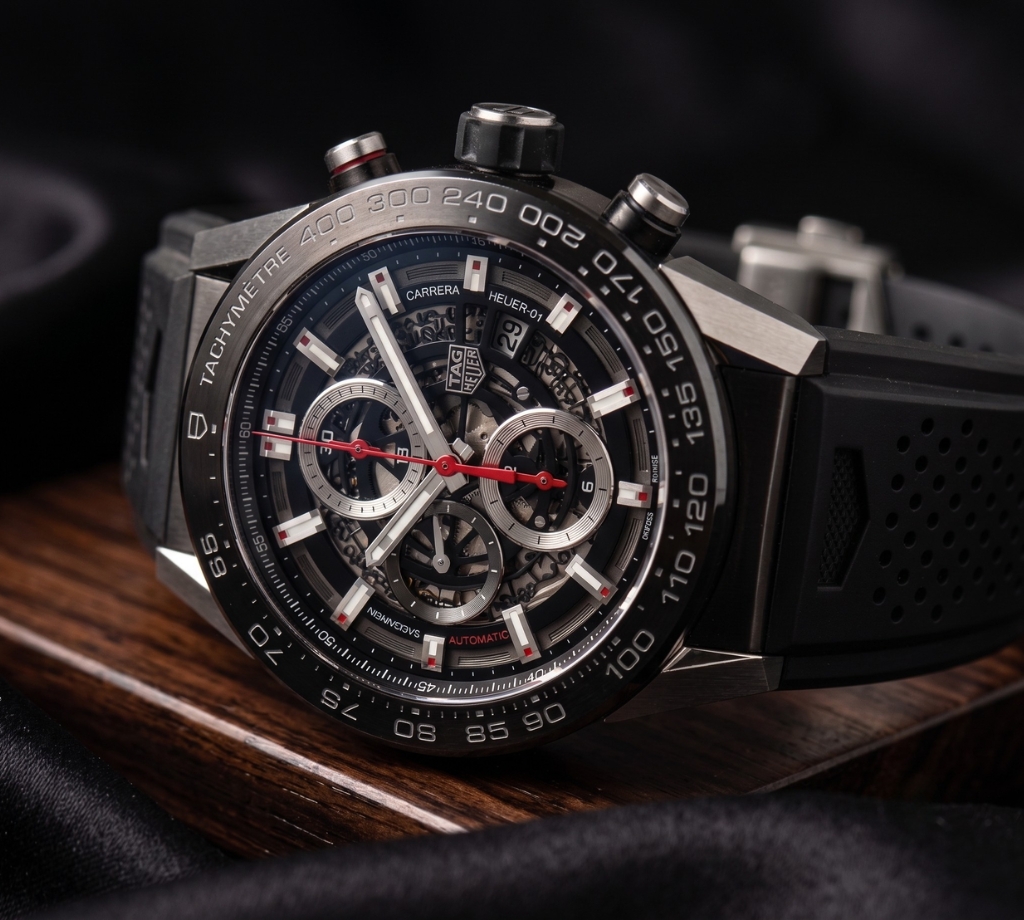
You own a TAG Heuer — a Monaco, a Carrera, an Aquaracer, perhaps a limited motorsport edition that has held its value better than most. You need to either sell it cleanly or borrow against it quickly. Before you act, understanding how TAG Heuer actually performs in the secondary market — and where the real valuation gaps appear — will determine how much capital you walk away with.
Vasco Assets offers private luxury watch acquisitions and collateral loans against high-end timepieces, providing certified appraisals, immediate funding, and outcomes that reflect genuine secondary market conditions — not a generalist’s conservative floor.
How TAG Heuer Holds Value in the Secondary Market
A Brand That Rewards Reference Selection
TAG Heuer occupies the upper mid-range of the Swiss luxury watch market — part of the LVMH group alongside Hublot and Zenith, with a deep motorsport heritage dating to 1860. On the secondary market, the brand typically retains 40–60% of retail value, which is respectable for its price tier. However, that range masks a sharp internal divide: the Monaco and limited-edition Carrera models sometimes appreciate, while entry-level Formula 1 and Link references depreciate significantly. The reference you own matters enormously.
The Collections That Command the Strongest Offers
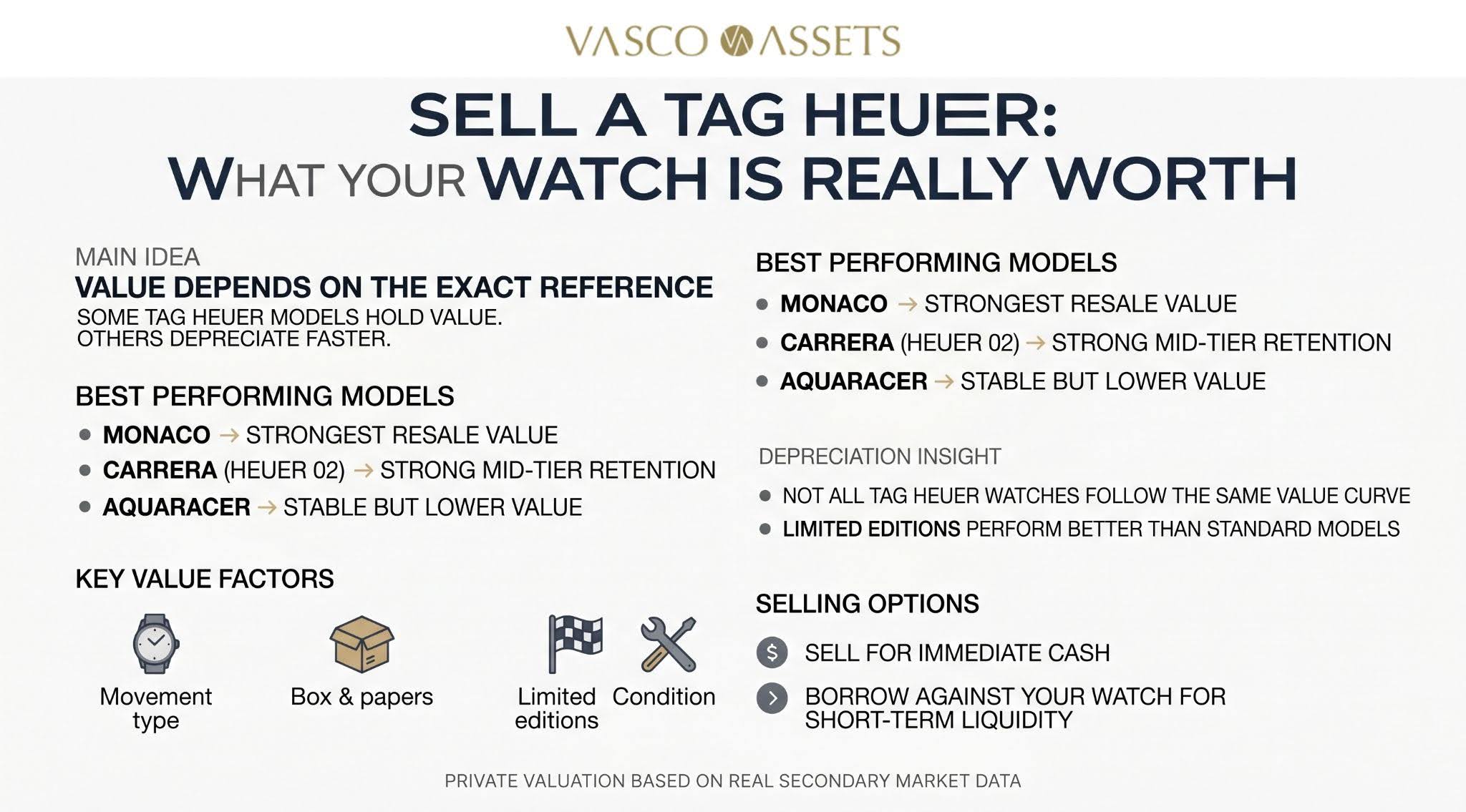
The Monaco stands alone as TAG Heuer’s most iconic and most liquid secondary market reference. Its square case, motorsport heritage, and Steve McQueen association give it genuine collector appeal — with pre-owned prices ranging from $3,500 to $6,000 and climbing for special editions. The Carrera with an in-house Heuer 02 movement commands $2,500 to $4,500 and holds meaningfully more than older ETA-based Calibre 16 references. The Aquaracer Professional 300 trades between $1,200 and $2,000 with solid liquidity. At Vasco Assets, movement provenance and collection identity are always the starting point for any appraisal.
Why TAG Heuer Depreciation Is a Mechanism, Not Just an Outcome
The Explanation Most Sellers Never Get
Most TAG Heuer resale explanations incorrectly present depreciation as an outcome — “40–50% loss” — rather than a mechanism that produces it. That framing describes what happens but not why the market structurally forces it. TAG Heuer pricing does not collapse because demand is simply weak. Broad luxury watch research shows that most Swiss watches fall into a mid-tier retention band where 20–40% of retail value is lost immediately due to secondary market repricing dynamics — not product failure or brand weakness.
TAG Heuer Is Not One Asset Class — It Is Many
TAG Heuer is not a single unified asset class. It is a collection of distinct liquidity micro-markets operating at the reference level. A Monaco, a Carrera, and an Aquaracer are not variations of the same investment profile — they are structurally different assets with different buyer depth, turnover speed, and dealer risk exposure. Most explanations fail here: they treat TAG Heuer as one pricing unit, when in practice dealers never price the brand — they price reference-specific exit risk.
How Reference-Level Liquidity Fractures Price Floors
A slow-moving Formula 1 reference creates inventory friction — longer holding times, higher financing costs, and greater discount risk at exit. A more liquid Monaco reference reduces holding cost uncertainty and justifies a tighter spread. Dealers adjust bids accordingly, not because of brand sentiment, but because of how quickly each reference can be converted back into cash without discount escalation. This is the key insight: the real question is not simply “why does TAG Heuer depreciate?” but why liquidity fractures differently across references, producing structurally different price floors within the same brand.
Depreciation as Fragmented Liquidity Conditions
Once this is understood, depreciation stops looking like a blanket percentage and starts functioning as what it actually is — the aggregated result of fragmented liquidity conditions at the micro-market level. The Bank for International Settlements confirms that in dealer markets, liquidity is constrained by inventory risk and holding costs rather than just buyer willingness to pay. Understanding this mechanism is what separates sellers who negotiate well from those who simply accept whatever a generalist offers.
Your TAG Heuer Has a Time-to-Cash Curve, Not a Fixed Price
Urgency Is a Pricing Variable, Not a Side Factor
Your TAG Heuer does not have a single fixed resale price. It has a time-to-cash curve, where liquidity conditions and execution speed determine how much value is retained depending on how fast you need to exit. A Monaco in excellent condition with box and papers may trade near retail in a patient, well-matched private sale. Selling to a dealer for immediate capital introduces an absorption discount. Listing privately introduces time-on-market risk — the longer a mid-tier reference sits, the more likely price reductions become.
What the Research Confirms
Federal Reserve research on market frictions shows that price impact is inversely related to market depth, meaning urgency and thin buyer pools materially affect realized pricing even for identical assets. For TAG Heuer’s mid-tier references, where secondary market depth is shallower than Rolex or Patek Philippe, this effect is amplified. Value is not just what your TAG Heuer sells for — it is what it sells for within your required timeframe. Working with a specialist who can transact immediately is how sellers close that gap.
What Your TAG Heuer Is Actually Worth
Movement, Reference, and In-House Provenance
The most important valuation variable for TAG Heuer — after the Monaco — is whether the watch houses an in-house movement. A Carrera with the Heuer 02 in-house calibre commands a measurable premium over the same case housing an older outsourced movement, a distinction that generalist appraisers routinely miss. At Vasco Assets, movement provenance is always assessed and reflected in the offer alongside reference identity and secondary market positioning.
Documentation and Condition
A TAG Heuer with original box, warranty card, and hang tags commands more than an unpapered example of the same reference — a standard confirmed by the FTC’s Jewelry Guides on accurate luxury goods representation. Case sharpness, crystal condition, bracelet wear, and dial originality are all factored into the appraisal. Aftermarket modifications and replaced components reduce secondary market desirability, and specialist appraisers at Vasco Assets will identify and price them accurately.
Should You Sell Your TAG Heuer or Borrow Against It?
When Selling Is the Right Decision
Selling is the right choice when the need for capital is long-term, when the watch no longer fits your collection, or when a limited edition has reached peak secondary market pricing you wish to lock in. For those who have moved on from the piece, a private acquisition through Vasco Assets delivers immediate, final liquidity — with a certified appraisal ensuring the price reflects what your specific reference is genuinely worth today.
The Tax Dimension
Before completing a sale, tax implications deserve consideration. The IRS classifies collectibles — including luxury watches sold at a gain — as subject to a maximum federal capital gains rate of 28% on long-term gains. For a Monaco or limited Carrera that has appreciated, the net proceeds after tax may be meaningfully lower than the headline sale price. A tax professional should be consulted before completing any significant transaction.
When a Collateral Loan Makes More Sense
If you still value the piece and your capital need is short-term, a collateral loan from Vasco Assets may be the smarter option. Loan terms run 30 to 120 days with no credit check required, and your watch is stored securely and returned in full upon repayment. For those considering a securities-backed credit line as an alternative, the Financial Industry Regulatory Authority (FINRA) cautions that these carry risks including potential forced liquidation if portfolio values decline — a risk that a watch-backed loan does not carry.
What to Avoid When Selling a TAG Heuer
Generalist Buyers and Their Blind Spots
Pawn shops and generalist buyers cannot differentiate between a Carrera with an in-house Heuer 02 movement and one with an outsourced calibre, nor do they understand the fragmented liquidity micro-markets that produce different price floors within the same brand. The result is a systematic undervaluation anchored to the lowest common denominator. For a Monaco or limited-edition Carrera, that gap can represent thousands of dollars in unrealized capital.
Platform Fees That Erode Your Net Proceeds
Peer-to-peer platforms introduce fraud risk, authentication uncertainty, and fee structures that quietly reduce what you receive. eBay’s final value fees for luxury watches run from 5.5% to 7.8% on high-value transactions — before shipping, insurance, and the time investment of managing a listing. A private acquisition through Vasco Assets removes all of that friction and delivers a clean, direct transaction with no surprises.
Vasco Assets: Private TAG Heuer Acquisition and Expert Lending
Specialist Valuation, Not Generalist Guesswork
Vasco Assets is a private international investment firm based in Newport Beach, California, with certified expertise across luxury watches, jewelry, diamonds, gold, and rare collectibles. Their appraisers follow TAG Heuer’s secondary market actively — across Monaco, Carrera, Aquaracer, Autavia, and vintage references — ensuring every offer reflects real current market conditions, not outdated benchmarks or conservative wholesale floors.
A Process Built for Speed and Discretion
The process begins with a complimentary TruValue valuation. Once Vasco’s certified appraisers assess your watch, you receive a transparent, liquidity-adjusted offer based on actual market data. If you accept, payment is issued promptly with no commissions, no listing delays, and no fraud risk. Contact Vasco Assets or call 949.674.3575 to schedule your appraisal — no obligation, no pressure, and a result in as little as 24 hours.
FAQs
1. How does Vasco Assets determine the value of my TAG Heuer?
Vasco Assets uses a certified TruValue appraisal process that accounts for the specific reference, movement calibre and generation, condition, documentation, production status, and current secondary market data. Whether your TAG Heuer houses an in-house Heuer 02 movement or an older outsourced calibre is a significant factor in the final offer.
2. Why does TAG Heuer depreciate differently across references?
TAG Heuer is not one asset class — it is a collection of distinct liquidity micro-markets at the reference level. A Monaco, a Carrera, and a Formula 1 each carry different buyer depth, turnover speed, and dealer risk exposure. Dealers price reference-specific exit risk, not the brand. This produces structurally different price floors within the same brand — and a specialist appraisal from Vasco Assets identifies exactly where your reference sits.
3. Which TAG Heuer models hold value best?
The Monaco consistently commands the strongest secondary market values — trading between $3,500 and $6,000 pre-owned, with limited editions occasionally above retail. The Carrera with an in-house Heuer 02 movement follows at $2,500 to $4,500. Entry-level Formula 1 and Link references depreciate more significantly, retaining 40–50% of retail value on average.
4. Will I owe capital gains tax when I sell my TAG Heuer?
Potentially. The IRS classifies collectibles — including luxury watches sold at a gain — as subject to a maximum federal capital gains rate of 28% on long-term gains. Consult a tax professional before selling an appreciated timepiece to understand your net proceeds after tax.
5. Can I borrow against my TAG Heuer instead of selling it?
Yes. Vasco Assets offers collateral loans against TAG Heuer watches and other luxury timepieces, with loan terms of 30 to 120 days, no credit check required, and funds available in as little as 24 hours. Your watch is stored securely and returned in the same condition upon full repayment.
6. Does having box and papers affect the sale price?
Yes — significantly. A TAG Heuer with its original box, warranty card, and hang tags commands a measurable premium over an unpapered example of the same reference. Vasco’s appraisers factor every element of your watch’s presentation into the offer.
7. Can I sell other watches or luxury assets at the same time?
Yes. Vasco Assets acquires a broad range of luxury assets including other watch brands, fine jewelry, diamonds, gold, fine art, and rare collectibles. Multiple items can be evaluated together in a single confidential transaction, streamlining the process for sellers with broader collections.